Welcome to Lembeh

View room

A room with a view

We’ve made it! After nearly two weeks in Jakarta and Makassar, I have arrived at my first fieldwork site in Indonesia: Lembeh Strait. I am getting help from Luke: a good friend, great photographer and all-round science hobbit. We are based in Lembeh Resort, where we are diving with Critters@Lembeh. Besides doing research for my PhD, Luke and me will also help the divecentre by surveying their housereef and creating a custom nudibranch-guide for it. We might even do some work on their artificial reefs as well to make it even more attractive to the local critters.

Juvenile ribbon eel

Juvenile ribbon eel

We will be in Lembeh Resort for about 6 weeks, so right now we’ve only just gotten comfortable in our new accommodation (If you are a scientist who does fieldwork as well, you might want to skip the next paragraph to avoid getting overly jealous) Our room is pretty sweet, it overlooks the Strait and part of the resort. We’ve got desks and WiFi, plenty of space for equipment and we’ve even got hot water in the shower! Absolutely luxury! What is (arguably) even more important, is that we’ve got the housereef at our doorstep, it’s the full 5m away from where we set up our divegear.

Shortfin lionfish

Zebra lionfish

At the moment we are exploring the reef to decide where we can set up our experiments, and to see where the most interesting areas are. It’s not a pure black sand site, but has got some corals and even seagrass as well. We’ve already found some very nice nudibranchs, ribbon eels, scorpionfish and a baby cockatoo waspfish. Tonight we’re doing a nightdive to check out what the housereef looks like with fluorescence torches. With some luck I’ll post some very psychedelic pictures in the next post…

For those interested in the socio-economic study I am doing, I have written an article for Wetpixel.com, an underwater photography site. It gives some background about why I want to know the economic value of muck diving critters, and why this has been done previously for other animals such as sharks and manta rays. It also has a link to my popular critter survey, if you haven taken the survey yet, now is the time to do so!
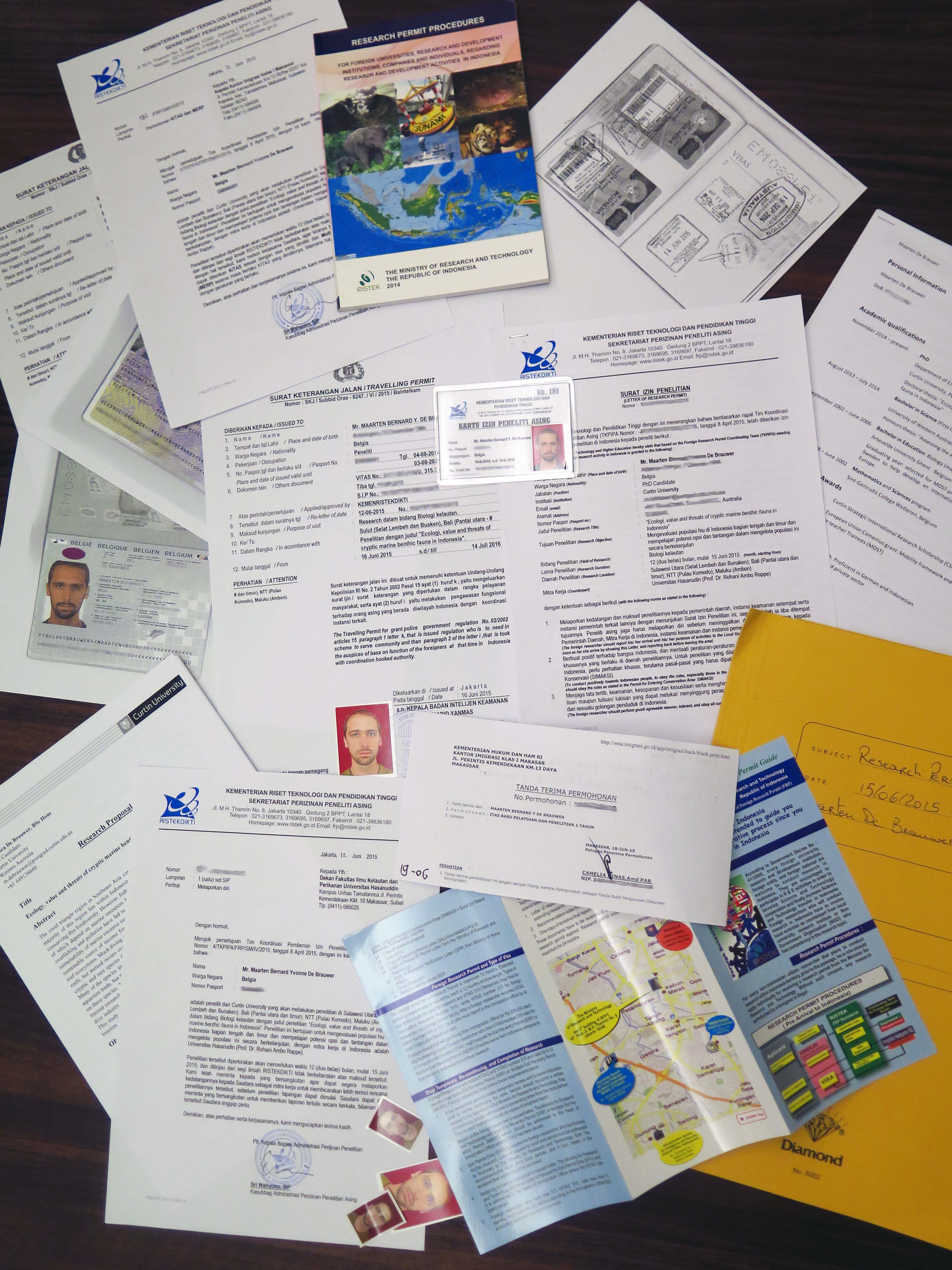
Research and paperwork

Research permit paperwork fun!

Research permit paperwork fun!

Some reactions I often get when explaining what I do for a living are: “You’re so lucky!”, “Do you need someone to come along?”, “How did you pull that one?” or anything along those lines. While this is undoubtedly true – I AM very lucky to be doing this, I do occasionally need assistance in the field, working my ass off – there is more to research than diving in gorgeous locations and looking at amazing critters. A lot of my work happens behind a desk, I’m not just talking about the analysing data, before you can even start collecting any data all, there’s preparation. And preparing for an extended fieldwork season in Indonesia and Philippines takes patience, lots of paperwork and a certain brand of single-minded pigheadedness.

So what did it take to get me here? The key thing anyone who wants to do research in Indonesia needs is a research permit. They are notoriously hard to get, so much that there are stories out there of universities actively discouraging research in Indonesia, since it’s too much hassle. I started looking into the details almost a year ago (before I even knew for sure if I had funding for my project). Besides a lot of standard paperwork, the crucial point of any application is an Indonesian counterpart. This would preferably be someone in a respected university or government organisation. I work with the kind people at Hasanuddin University in Makassar. Besides the counterpart you also need: research proposals, references, copies of passports, cv’s, pictures, proof of funding, medical clearance, equipment lists,… If you manage to assemble all of it, you can apply and hope for the best. For me, it took about 7 months between starting the procedure and getting notice that my application had been accepted.

Prof. Jamaluddin and Prof. Rohani, my counterparts at Hasanuddin University

Prof. Jamaluddin and Prof. Rohani, my counterparts at Hasanuddin University

This, however, is not the end of the road. It get you two things: a visa for a year, and the privilege of getting to know many of the Indonesian administrative buildings and staff up close and personal. At the moment I am spending my days in Jakarta and Makassar running (well, strolling really, or taking taxis, it’s hot here) to various government agencies to get: research permits, letters of the police to allow me to travel, notices from the department of forestry that allow me to conduct research in national parks, documents from immigration that allow me to do my work, etc. I am hopeful to get all I need to start research by the end of next week.

But that only gets you permission from the Indonesian government to do research here. When working at a university, you also need their permission to do all the things you want to do. My research requires me to travel, dive, observe animals, interview people and do internet surveys. This means university requires me to do even more paperwork than the Indonesian government. Some of the documents I have prepared over the last months include:

  • Risk assessments
  • Travel applications
  • Animal ethics applications
  • Human ethics applications
  • Dive medicals
  • Travel diaries
  • Fieldwork plans
  • Travel checklists

This list is by no means exhaustive. I estimate that up until now, I have spent about 75% of my time on paperwork or other various administrative processes. But you know what the funny thing is?

I still think it’s amazing and love every bit of it!

Survey: Popular species in muck dive tourism in Southeast Asia

As part of my research I am trying to figure out which species are most popular with muck divers. To do this, I have developed a survey for divers who are interested in muck diving. To better protect these species, it is crucial to know the key characteristics of muck dive tourism. So I invite you to take the survey and help me (and the critters) with my research.

Best of Dauin_OrnateGhostPipe_RedBlack_DiverFor those of you not familiar with the term “Muck Diving”, it is a distinct type of scuba diving that mostly occurs over sand or mud areas, with little or no coral reef. The focus of muck diving is on finding small critters that are rarely encountered on coral reefs.

Completing the survey should take no more than 5 minutes. Participating in this survey is entirely voluntary, your identity cannot be connected in any way to your survey answers and you can opt out at any time.

To access the survey please follow this link, or you can copy and paste this address in your browser:

https://curtin.asia.qualtrics.com/SE/?SID=SV_1F97mQ8sVf9aqON

If you have questions regarding this study, please contact me in the comments section of this post, or via at maarten.debrauwer@curtin.edu.au.

First blog post

Hi there,

this is the first post of what will hopefully become a regular blog of my adventures while conducting fieldwork in Indonesia. I am just at the start of a 6-month trip where I will be conducting research in some of the most amazing dive locations in the world.

You can find more information about myself and the project in the “About” and “Research” pages. As the project really gets going, I will be posting updates about my work, pictures of some of the amazing critters than can be found in Indonesian waters, and some behind the scenes information of what this kind of fieldwork does to you.

Happy reading!