The value of muck dive critters

One of the benefits of doing fieldwork from a dive resort instead of a research station, is that I get to talk to a lot of people who aren’t scientists, but are still interested in the species I am investigating. I frequently get questions that are very relevant, but that you’d rarely get from professional researchers.

Is it a sponge? Is it a rock? It's a Warty Frogfish! (Antennarius maculatus)

Is it a sponge? Is it a rock? It’s a Warty Frogfish! (Antennarius maculatus)

One of those returning questions is: “WHY are you doing this research?”. What is the point of spending over 3 years of your life looking at animals that most people have never heard about, let alone care about? Experienced divers are usually interested in the results, but non-divers can be baffled by the fact that I would like to know everything there is to know about animals that look like sponges and move about as much as well. What is more, I’m not just interested in their biology, I also want to know how much they are worth economically.

As divers and photographers, assigning an economic value to the species we like to observe might sound like a strange idea. Finding, watching and photographing amazing underwater life is an experience that is invaluable to many of us. It’s more than just ticking boxes, it is an experience that takes us out of everyday life and inspires us. It is something to talk about and share with fellow divers, friends and family. Putting dollar signs on that might seem like selling out, until you realise divers are not the only ones using the marine environment.

The protection of species or ecosystems frequently competes with other economic interests, such as palm oil plantations and fishing. While these are important sources of income, they can decrease the value and health of the natural environment. Determining the monetary value of dive tourism allows us to make comparisons with other industries and with different uses of marine resources. Case studies show that tourism can be a valuable, sustainable alternative to more destructive uses of the natural environment.

A good example is shark diving in Palau, which has been estimated to be worth about US$ 18 million per year. Harvesting the Palauan shark population for fishing instead would be worth less than US$ 11,000. In the light of these numbers, it is clear why it was a good idea from the Palauan government to declare the waters around Palau as shark sanctuary. When practiced in a sustainable manner, dive tourism offers an alternative income for fishing communities, while simultaneously increasing awareness in those communities and the tourists diving in the region.

As part of my PhD, I am investigating the economic value of muck dive tourism in Southeast Asia. Results will hopefully stimulate conservation and research interest in the species that are important to divers, but are often poorly understood by science. Besides interviewing divers, dive guides and dive centre owners, I have also developed an online survey to investigate which species are most popular with muck divers.

If you would like to help out (and haven’t done so already) please take the survey. It should take you no more than 5 minutes. To access the survey please follow this link. If you want to learn more about reason why we should protect endangered species and how economic value plays an important role, this article on BBC Earth is a great read. It explains better than I ever could why I am spending my days looking at critters in the sand.

This is an adapted version of an article I wrote last month for Wetpixel, if you’d like to read more, you can find the full article here

Indian Ocean Walkman (Inimicus didactylus)

What would the value be of this adorable fish? (Indian Ocean Walkman -Inimicus didactylus)

Psychedelic nightdiving fun!

I have been doing quite a lot of night dives recently. Those who know me from when I was still working as a dive instructor might be a bit surprised by this, as I never use to be the biggest night dive enthusiast around. There are two reasons I’m swimming around in the dark a lot recently:

  1. Night diving in Lembeh Strait (and Indonesia in general) is pretty amazing
  2. I’ve been playing with a new toy that makes it all a bit more interesting: a high intensity blue light torch. This torch, combined with a yellow filter allows a diver to see “biofluorescence
Zombie Seahorse (Hippocampus histrix)

Thorny seahorse – zombie version

So as an excuse to post some very psychedelic photos, let me tell you a bit more about biofluorescence under water.

It is important to realise that biofluorescence is NOT the same as bioluminescence. The former needs an external light source (the sun, a dive torch,…), the latter means that the animal itself produces light. For more info on the differences, check out the site of the Luminescent labs.

Devil Scorpionfish

Devil Scorpionfish (Scorpaenopsis diabolus)

Biofluorescence under water has been described as early as 30 years ago and was first noted in corals and anemones. It has been used for years in coral research that looks at coral growth, diseases and bleaching. More recently however, people have started noticing that many more animals than just coral are fluorescent. A paper in 2008 described how many goby species show red fluorescence. Other publications have described fluorescence in many invertebrates such as mantis shrimps, crabs, worms, nudibranchs,… But I really got interested last year when a paper was published that described how fluorescence in fish was much more widespread than previously assumed. The reason it caught my attention is because it seems to be particularly common in “cryptically patterned species”, many of which happen to be the camouflaged little critters I’m so interested in.

Juvenile Whiptail (Pentapodus emeyrii)

Juvenile Whiptail (Pentapodus emeyrii)

Fluorescent nudibranch (Trapania scurra)

Fluorescent nudibranch (Trapania scurra)

So I got myself the necessary equipment and now I am trying to figure out what exactly fluoresces here in Lembeh, and maybe even getting a clue about why they fluoresce as well. There are a few theories out there: it could be used as a form of communication, it might be some sort of camouflage, it could even just be pure coincidence and we might be looking at a cool, but irrelevant quirky thing that evolved but serves no real purpose (I highly doubt this). Fish see the world differently than we do and many species can actually observe UV-light and fluorescence, which would lead me (and other researchers) to believe there is some function there. To prove these functions however, a lot more research and experiments are needed.

Shrimp trying to hide behind algae

Shrimp trying to hide behind algae

What matters most for this blog post, is that it looks rather amazing and that it shows a different, little known side of the underwater world. In case you were wondering, or doubting what you are seeing, none of the pictures in this post have been photoshopped beyond cropping and cleaning up some backscatter.

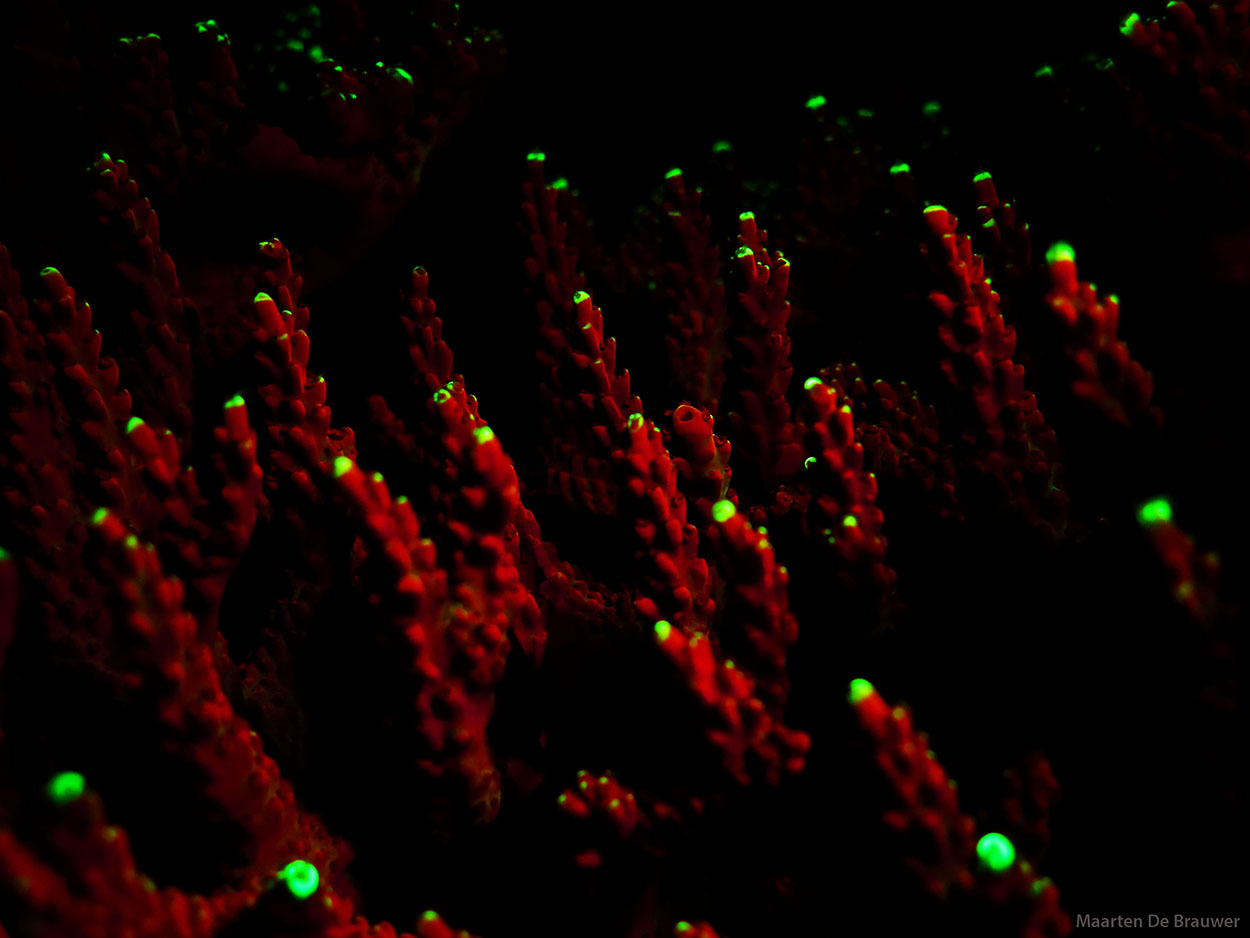
Acropora coral

Acropora coral

Copepod constellation

Copepod constellation

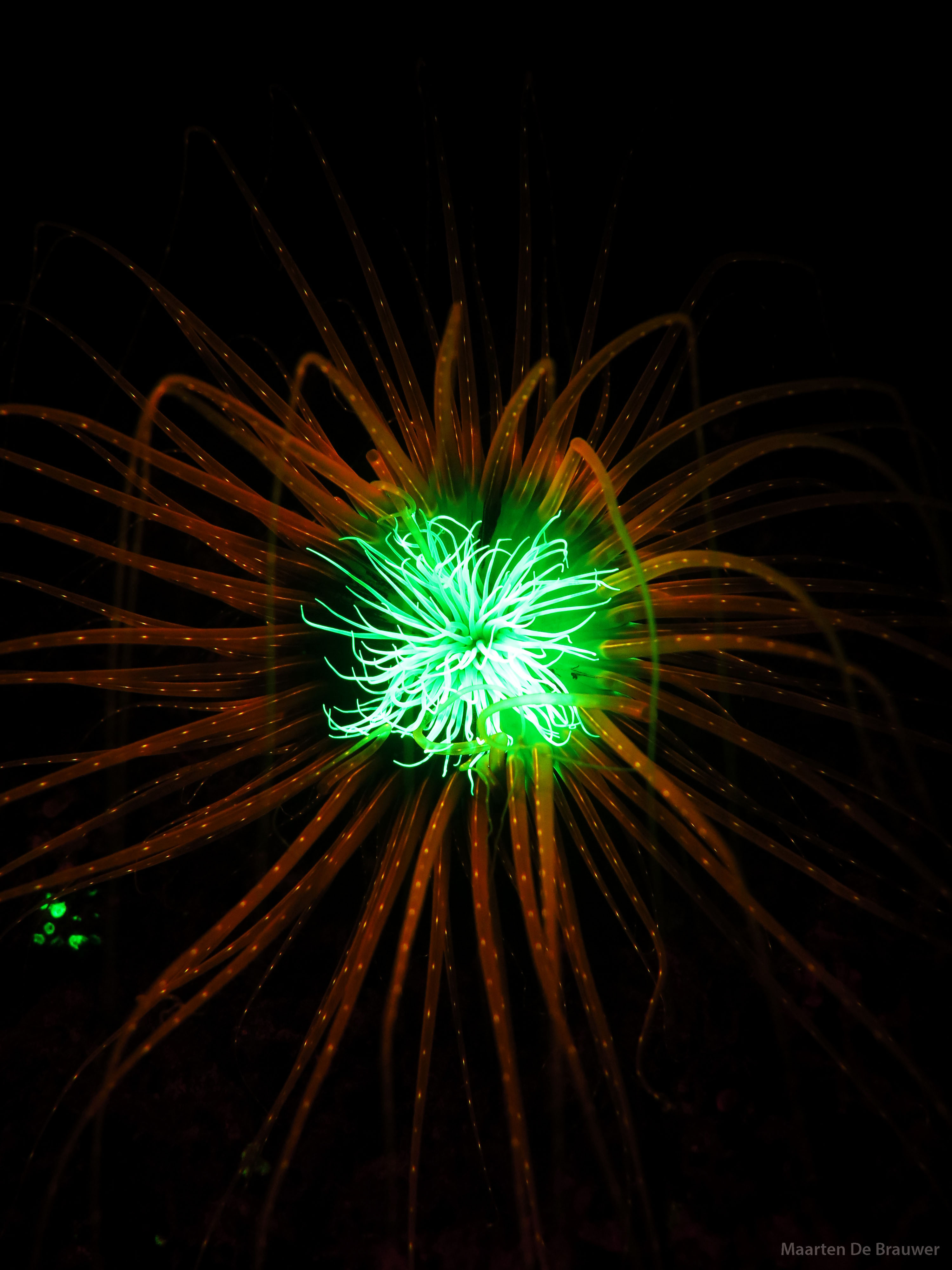
Tube anemone

Tube anemone

If you want to know more about how fluorescence works and how to take fluoro pictures yourself, this site is a good place to get started.

Thorny seahorse (Hippocampus histrix)

Thorny seahorse (Hippocampus histrix)

Stupidity in scientific research

I have found a good reason to call myself stupid without being ashamed for it! This essay written by Martin Schwartz is a very interesting read. Have a read if you’ve got a minute and want to feel better about not knowing everything.

A few quotes:

“Science makes me feel stupid too. It’s just that I’ve gotten used to it. So used to it, in fact, that I actively seek out new opportunities to feel stupid. I wouldn’t know what to do without that feeling. I even think it’s supposed to be this way.”

“One of the beautiful things about science is that it allows us to bumble along, getting it wrong time after time, and feel perfectly fine as long as we learn something each time.”

“The more comfortable we become with being stupid, the deeper we will wade into the unknown and the more likely we are to make big discoveries.”

Here is the link to the original essay, enjoy your read….

Research and paperwork

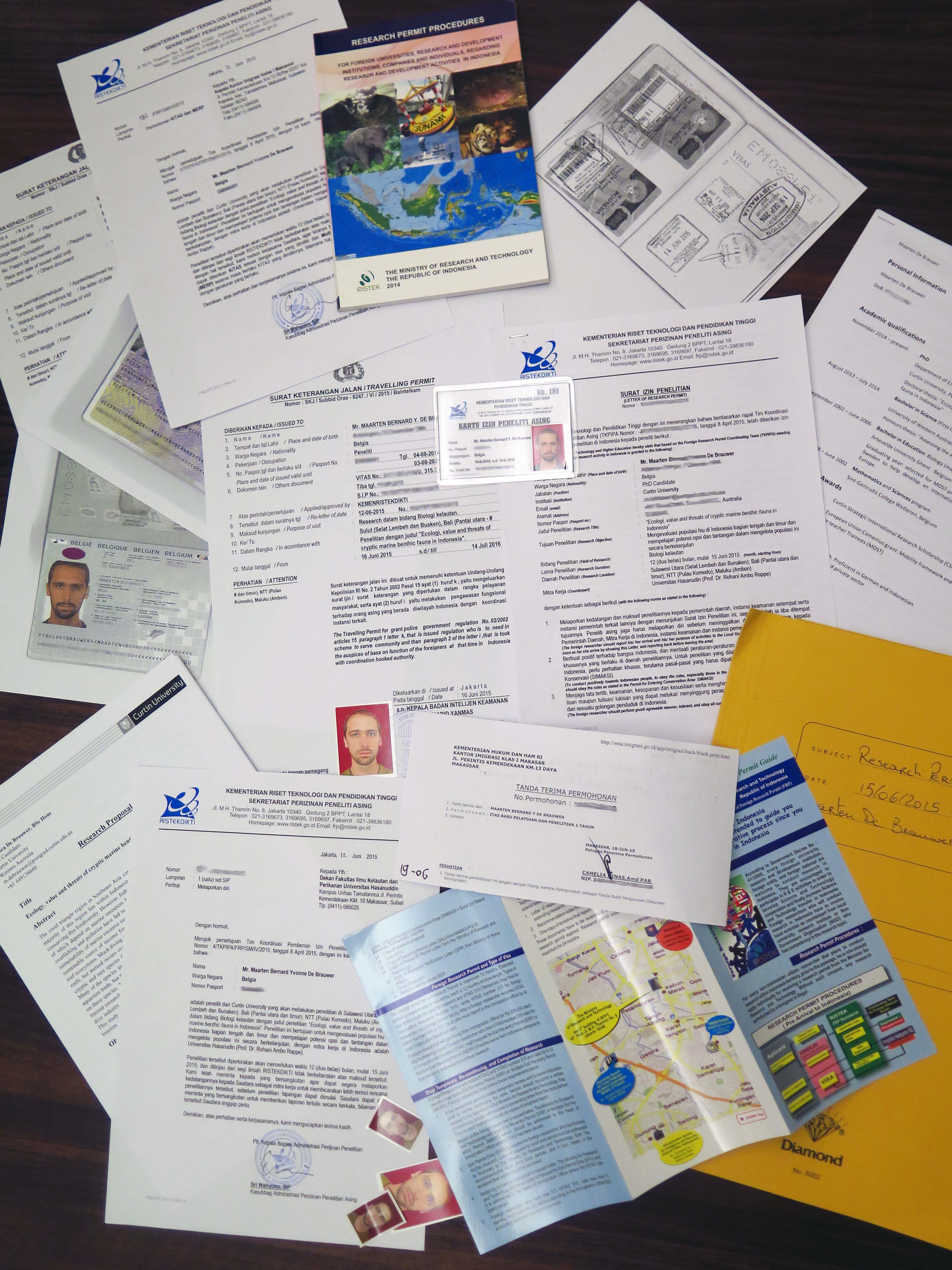
Research permit paperwork fun!

Research permit paperwork fun!

Some reactions I often get when explaining what I do for a living are: “You’re so lucky!”, “Do you need someone to come along?”, “How did you pull that one?” or anything along those lines. While this is undoubtedly true – I AM very lucky to be doing this, I do occasionally need assistance in the field, working my ass off – there is more to research than diving in gorgeous locations and looking at amazing critters. A lot of my work happens behind a desk, I’m not just talking about the analysing data, before you can even start collecting any data all, there’s preparation. And preparing for an extended fieldwork season in Indonesia and Philippines takes patience, lots of paperwork and a certain brand of single-minded pigheadedness.

So what did it take to get me here? The key thing anyone who wants to do research in Indonesia needs is a research permit. They are notoriously hard to get, so much that there are stories out there of universities actively discouraging research in Indonesia, since it’s too much hassle. I started looking into the details almost a year ago (before I even knew for sure if I had funding for my project). Besides a lot of standard paperwork, the crucial point of any application is an Indonesian counterpart. This would preferably be someone in a respected university or government organisation. I work with the kind people at Hasanuddin University in Makassar. Besides the counterpart you also need: research proposals, references, copies of passports, cv’s, pictures, proof of funding, medical clearance, equipment lists,… If you manage to assemble all of it, you can apply and hope for the best. For me, it took about 7 months between starting the procedure and getting notice that my application had been accepted.

Prof. Jamaluddin and Prof. Rohani, my counterparts at Hasanuddin University

Prof. Jamaluddin and Prof. Rohani, my counterparts at Hasanuddin University

This, however, is not the end of the road. It get you two things: a visa for a year, and the privilege of getting to know many of the Indonesian administrative buildings and staff up close and personal. At the moment I am spending my days in Jakarta and Makassar running (well, strolling really, or taking taxis, it’s hot here) to various government agencies to get: research permits, letters of the police to allow me to travel, notices from the department of forestry that allow me to conduct research in national parks, documents from immigration that allow me to do my work, etc. I am hopeful to get all I need to start research by the end of next week.

But that only gets you permission from the Indonesian government to do research here. When working at a university, you also need their permission to do all the things you want to do. My research requires me to travel, dive, observe animals, interview people and do internet surveys. This means university requires me to do even more paperwork than the Indonesian government. Some of the documents I have prepared over the last months include:

  • Risk assessments
  • Travel applications
  • Animal ethics applications
  • Human ethics applications
  • Dive medicals
  • Travel diaries
  • Fieldwork plans
  • Travel checklists

This list is by no means exhaustive. I estimate that up until now, I have spent about 75% of my time on paperwork or other various administrative processes. But you know what the funny thing is?

I still think it’s amazing and love every bit of it!