Using SMURFs to catch baby fish

Luke and I have been in Dauin for a few days now. We are here to investigate the recruitment of cryptobenthic fish. If you’ve read this blog before, you’ll know that I am interested in camouflaged, small critters that live on the seafloor (=cryptobenthic). You might not, however, have heard about “recruitment”. This is the term used to describe the process of larval fish (which usually swim in the open ocean) “settling down” on the reef. When fish larvae settle, they change rapidly from small, transparent, weird oddballs to colourful reef fish. Or in the case of the critters I study, to camouflaged weird oddballs.

histriohistrio_with_adult

Larvae and adult Sargassum Frogfish (Histrio histrio) Source: http://nfchroniclesnoaa.blogspot.com

There are many reasons why I would like to know more the recruitment of the species I study. The most important one is that nobody really knows why some of these baby fishes show up where they do. If you don’t know this information, it is really hard to protect the right places that would be a suitable habitat for baby fish. Another reason is that this process is vastly different from anything we see on land, making it fun and challenging to try and figure out what is going on.

So how does one best study tiny baby fish? In the case of my critters, looking for the small adults is already hard, so how do you even begin to try and find the even tinier versions? The slightly disappointing answer is: “We don’t really know”. There are multiple techniques to find new recruits or larvae that are about to settle down (light traps, visual surveys, crest nets, …). But most of those don’t seem to be very effective for camouflaged critters. One method did show promise in a study in the Caribbean, the benthic “SMURF”.  If at this moment you are imaging little blue creatures with scuba tanks, catching baby fish with lassos and you don’t want to spoil that mental picture, please stop reading now.

SMURF

SMURF at sea (Photo Luke Gordon)

Since you’re still reading, I can now disappoint you about my SMURFs, they are not the ones you have seen on tv (no ethics clearance possible). SMURF stand for “Standard Monitoring Unit for Recruitment of Fishes”. It is a mesh-basket you fill with any substrate you want (pebbles, sand, coral rubble, plastic,…) which you then place in the ocean for a set time. After that time you collect the basket and see how many baby fish were attracted to your unit. Not quite the blue man-option, but you are the one who kept reading.

Luke and me made a whole bunch of units, which we deployed around Dauin. To deploy the units we had the help from my supervisor Euan Harvey, who decided to drop by to see what we are up to in Philippines. Euan is an expert in remote sampling using video cameras, but he definitely seemed to enjoy setting up experiments on baby critters as well. This could be due to the fact that on his very first muck dive here, we found Flamboyant cuttlefish, Blue-ringed octopus, a bunch of Frogfish, Ghostpipefishes, Seahorses and loads more critters.

_MG_6706

Euan photographing Ghostpipefish (Photo Luke Gordon)

This is the second time I am trying this experiment, the first attempt was thwarted by the ocean. Conditions are looking better now, so with some luck the units will survive the next weeks. By the end of the SMURF-project, we will hopefully know if this method  works well for the species I study. With some luck, I will even be able to tell you if baby cryptic fish prefer sand, pebbles, or rubbish. The method can then be used in the future for other people wanting to study the recruitment of cryptic species, so we can start to unravel some of the bigger questions about these poorly studied animals.

Divers and Seahorses: ADEX

Last week I had the pleasure of attending the annual ADEX Dive Expo in Singapore. If you want to find out what scuba diving is about, or want to realise what a big deal it is, this is the place. Just to give an indication of the growing interest in diving: the expo received close to 60 000 visitors in 3 days! Besides the many stands from dive centres, resorts, photography shops, etc. who were trying to convince people to buy dive trips or equipment, there was a lot more to see and do. Throughout the weekend, there were non-stop presentations by marine biologists, NGOs, photographers, writers and even mermaids.

This year’s theme was “Seahorses“, so some of the world’s seahorse experts such as Dave Harasti, Amanda Vincent and Richard Smith were around to talk about these funky critters. There were speakers from the Coral Triangle Initiative, Greenfins, iSeahorse, Blue Ocean Network and many more NGO’s. It wasn’t possible for me to see them all, but I saw enough to learn a whole lot of new interesting things about seahorses and their conservation.

I was quite honoured to have been invited as well to give two talks. I talked about fluorescence in camouflaged species and how valuable muck diving can be to small coastal communities. From the chats I had with people afterwards, it seems I wasn’t talking absolute nonsense and people were actually interested in what I had to say. While it is too early to tell, in the future there might even be some interesting projects coming out of these meetings.

Talk_ADEX.jpg

Explaining the value of Muck Diving

The most interesting facts I’ve learned this weekend? It seems seahorses often end up as prey for frogfish, scorpionfish and even the occasional octopus. This is also the reason why successful marine protected areas with lots of predators might lead to less seahorses in those protected areas. I’ve also noticed once again that there is more and more demand for truly sustainable dive tourism in a way that really benefits local communities and not just the owners of dive resorts.

Spending a few days in the comfort of modern Singapore was nice, but now it’s time to get back to work. And for now work = fieldwork!  😀 Yesterday I arrived in Dauin accompanied by none other than Luke, my very good friend and trusty science hobbit! Keep your eyes on the blog for our adventures looking for baby critters…

Mandarin madness

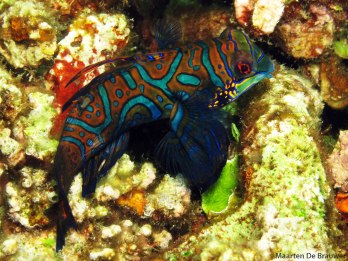
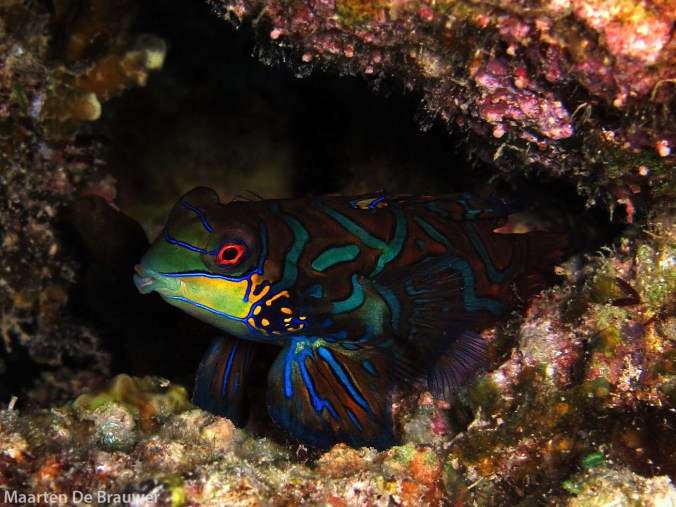
My last trip to Komodo was a successful one, not only because of the data I collected or the nice group on the boat, but also because I managed to have a good look at two very elusive critters, one of them a first! I had seen Mandarinfish (Synchiropus splendidus) before, but this was the first time I had a proper look at a Picturesque Dragonet (Synchiropus picturatus).

Both species are closely related Dragonets belonging to the genus Synchiropus. They are exquisitely coloured, which makes them big hits both with divers and marine aquaria hobbyists. The colours and patterns of the picturesque dragonet have earned it the synonym of “psychedelic mandarinfish” or even “LSD-fish” in German! Of the two, the mandarinfish is best known to divers, probably because it is found more frequently in areas where divers are likely to dive, unlike its psychedelic sister-species.

Both species are found in the Indo-West Pacific, they range from the south of Japan to the north of Australia. The best places to spot them are Indonesia and the Philippines. They are found in sheltered lagoons, usually in areas with coral rubble. You can also find mandarinfish in stands of branching corals. Picturesque dragonets are more frequently found in areas with silty bottoms close to mangroves. Both species are shallow water fish that are rarely seen deeper than 20m.

The best time to see mandarinfish is at dusk or late in the afternoon on overcast days. At these times the fish come out of hiding to spawn. Both species live in small social groups which usually consist of a male and a few females. The males are easily recognized by their larger size and long dorsal fin.

Synchiropus picturatus_2_MDB

Two Picturesque Dragonets (female in the front, male at the back)

As is the case with many secretive critters, we don’t know very much about them. The things we do know show that there is more to them than just a pretty face. For example, they secrete a thick mucous that might even contain toxins. According to the literature, this mucous smells bad and tastes bitter, which makes me wonder exactly how they found this out 😉 Regardless of research methods, this toxicity means that the highly visible colours could in fact be a warning signal to potential predators, much in the way nudibranchs advertise their toxicity. For those interested in impressing their fellow divers, this trick is called “aposemetic colouration“.

Best of Lembeh_Synchiropus splendidus2_MDB

Mandarinfish – a fierce predator?

Mandarinfish are tiny carnivorous fish, which feed on tiny prey. Too bad they are so small, just imagine how much fun it would be to see a great white shark in the colours of a mandarinfish?!? Until the day an evolutionary trip-up creates a giant mandarinfish stalking the oceans, they feed mainly on small crustaceans, small molluscs and fish eggs. Which might be more convenient for the many people that keep these small fish in aquariums.

And make no mistake about it, both species are VERY popular in the marine ornamental trade. Research in Batasan Island (near Bohol) in Philippines showed that in 2000, between 1800 to 2400 mandarinfish were exported per month! If you have ever searched for mandarinfish while diving, those numbers will seem even more impressive. Fishermen usually catch the fish with miniature spearguns, since other methods are not as successful. This method obviously inflicts damage on the fish, often leading to the fish dying either shortly after being caught or during transport to aquariumshops. Another problem with catching mandarinfish for the aquariumtrade is that people prefer larger fish. A trend that causes the larger males to disappear first, which can in turn lead to reduced reproduction rates for the remaining fish.

These lovely critters might be very popular with aquarium enthusiasts, unfortunately they are difficult to keep alive in a tank. The fish require specific food and shelter, lack of those are the cause of many mandarinfish dying shortly after they’ve been bought by their new owners. There have been some reports of mandarin spawning in tanks, but raising the larvae to healthy adults is still difficult. As far as I could find, the vast majority of mandarin fish sold in aquarium shops are still caught in the wild, which might have a big impact on fish populations in the ocean.

Might have a big impact, since we don’t really know. Neither species has been assessed by the IUCN, so we don’t know if populations are in decline and if they are at risk of extinction. So until we do, enjoy looking for them during your dives, but think twice before buying one!

Best of Cabilao_Mandarinfish_MDB


Video Interview: The science behind the critters

A few months ago the Department of Environment and Agriculture at Curtin University asked me if I wanted to do an interview to explain what my PhD is all about. Since I am part of that department and I love to share how amazing my weird critters are, I obviously said yes.

The underwater footage was taken by myself, Luke and one of my supervisors during fieldwork in Indonesia and Philippines last year. You can watch the video on the Environment and Agriculture website, or right here: