Coral Reef Conference in Hawaii

The International Coral Reef Symposium (ICRS) in Hawaii has come to an end. While I am using the opportunity to explore more of Hawaii, I figured it could be interesting to share some of the highlights. ICRS is a huge conference held once every 4 years, with about 2500 marine biologist gathering together for 5 days of presentations, workshops, poster sessions, networking and socializing. To give you an idea of just how much research was being presented: for 5 days straight up to 10 differently themed sessions would run at the same time. Session themes were very diverse, from reef fish ecology to the role of macro algae, to protected area management, genetic connectivity, effects of pollution, etc.

Conference centre

The very shiny conference centre

With literally more than a thousand interesting talks going on simultaneously, the hardest thing was choosing which ones to go see. Unfortunately, though not surprisingly, there were very few talks about cryptic critters (3 to be precise), but there were plenty of other really good talks to see. So here is an overview of a few talks that stuck in my mind.

One of the plenary talks was to hand the the Darwin medal to Jack Randall, this medal is awarded once every four years in recognition of major scientific contributions throughout the career of a coral reef scientist. Most people reading this blog won’t know Jack Randall, but on his own he described more new species than any other fish taxonomist ever did. In other words, an absolute legend in the world of fish taxonomy. It was inspiring to hear him talk about his long career and to see how passionate he still is at the age of 92!

Another talk that stuck with me was a talk on cryptobenthic fishes (small fishes) living on coral reefs. Chris Goatley‘s research showed how important it can be for small fish to grow even the smallest bit. A difference of only 1mm can increase their chances of survival massively. Size however is not the only factor that helps them survive, for these small fishes, the most important thing seems to be experience. In other words, a fish of 2cm that is 2 months old has a much higher chance of surviving than a similar sized fish of 2 weeks old. Which proves that you can forget about that 3 second fish-memory myth as well.

Miss Baldisimo from the University of Philippines talked about the aquarium trade, a hot topic now that Finding Dory is out. The trade usually does not get much attention but it is still massive, and Philippines is the biggest exporter of marine aquarium fish globally. What was new to me, is that in some areas fishermen are starting to specialise in collecting frogfish! Unfortunately there is still massive overfishing and high mortality of the fish during catching and export. What makes this even more tragic, is that the fishermen are very poorly paid for their hard work, the price per fish has not increased in over 20 years! So think twice before you want to get a marine aquarium.
DSC_2991_smal

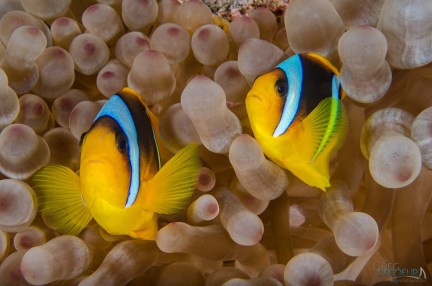
Clownfish in trouble? (Picture: Greg Lecoeur)

Also connected to Finding Dory, was a presentation about clownfish in the Red Sea. Researchers have noticed a huge decline (86%) in host anemones in the  gulf of Eilat. This has lead to a similar decline in Red Sea Anemonefish (Amphiprion bicinctus) and might even lead to a local extinction if this trend continuous. The researchers could not find the cause of this decline, which is particularly worrying. Luckily the species is very common in the rest of the Red Sea, so there is no immediate threat for the species as a whole.


I had the pleasure of watching the talk of a blogger I had been following before the conference even started. Jobot turned out to be someone I had actually already met a few years ago during fieldwork in Lizard Island. For her very cool project she used acoustic trackers to see when reef fish died or got eaten.  One of the most surprising results she found, was that most predation (fish being eaten by bigger fish) happened during the day and not at night! Sunset and sunrise were even more intense, which has been assumed for a long time, but the fact that less fish get eaten at night was a surprise for most people attending the talk.

Poster

Discussing fluorescence in fish

During the conference I presented a poster about the fluorescence research I have been doing the last year and a half. It seems that the poster was well received, as I got the student prize for the best poster during the conference. I am still not sure what I actually won since I was not present at the last plenary talk, so still some mystery in the aftermath of the conference.

HIMB

Chilling out at HIMB

The day after the conference I was lucky enough to be able to visit the Hawaii Institute of Marine Biology (HIMB). HIMB is a world class research station located on a small island at the northeast coast of Oahu. Besides being a place where awesome science is done, they also had hammerhead sharks in their big enclosure, and seeing hammerheads is always a treat 😉


In short: I had a great time at the conference, not only because of the science but also because I got to meet up with old friends and meet a lot of great new people. The next few days I am off to do some volcano exploring on the Big Island in Hawaii, before heading back to Perth for some more serious sciencing!


Ethical issues in Underwater Photography

During my PhD I have written and talked a lot about the value of scuba diving and particularly of muck diving. Dive tourism often provides an income to communities who have limited sustainable alternatives to make a living. Over the last years, there have been big changes in dive tourism, such as the increasing popularity of underwater photography. Muck diving in particular has a large portion of divers who use underwater cameras: I found out that on average 73% of people visiting muck dive destinations use a camera of some sort.

More people using cameras underwater can be a good thing. Photographers often spend more time and money in dive locations, meaning a higher income for local communities. Having a lot of photos taken underwater can directly help science by giving us information about species distribution (via initiatives like iSeahorse) or even by helping researchers discover new species (the story of the “Lembeh Seadragon“). Finally, more beautiful photos of ocean critters can help conservation by creating awareness with people who would otherwise never go near the ocean.

Kyonemichthys rumengani

The “Lembeh Seadragon” (Kyonemichthys rumengani) was first brought to the attention of scientists by underwater photographers.      Photo: Maarten De Brauwer

However, there are some serious issues with the use of cameras under water. Using an extra tool while diving is distracting and often leads to poor buoyancy control. Multiple studies have looked at the effects of divers who use cameras on coral reefs, and it is very clear that photographers cause more damage on coral reefs than divers without cameras. Possible solutions for this problem include buoyancy training, good dive briefings that create awareness with the divers, and attentive dive guides who can adjust diver behaviour before too much damage is done.

Another problem with underwater photography is that it is a goal-driven and therefore often competitive activity. Photographers want to see rare species, shoot interesting behaviour or get a unique shot that will impress fellow divers in off- and online communities. But the reality is that rare species are hard to find and often really shy. You have to be lucky to observe eye-catching behaviour and it takes a lot of skill to get creative shots underwater. The desire for beautiful pictures too often leads to divers trying to “force” a photo to happen, and forcing wildlife is never a good idea.

This is not just an issue with underwater photography, it happens on land as well. In 2010 a Wildlife photographer of the year lost his title when it became clear he faked his winning shot. In India, the bad behaviour of tourists trying to take pictures of tigers has led to the creation of a guidebook for ethical wildlife photography. There are worse stories out there and this article explains just how bad “getting that perfect shot” can get.

Underwater wildlife photography has its own specific problems. Unlike terrestrial photography, divers can often get within touching distance of the species they want to photograph. At that point it is often very difficult to resist the temptation not to touch or harass the animal. There are many reasons why you shouldn’t, and you’ll find most of them explained clearly here. Luckily most fish, especially the bigger species like sharks or manta rays can swim off when things get too crazy, but this doesn’t work for all ocean critters.

Animals that cannot swim away because they are too slow or rely on camouflage instead of speed, are popular with photographers because you can take your time for a picture. Frogfishes, seahorses, nudibranchs, scorpionfishes … never had to cope with humans and cameras, so they don’t have any defence against them. Some of the poor diver behaviour I have seen seems relatively harmless, like gently coaxing an animal in a better position. But it can go as far as smacking Rhinopias around to daze them so they will sit still, pulling of arms of feather stars to get pictures of the fish living inside them, or breaking off seafans with pygmy seahorses on them and bringing them up to shallow water so divers can spend more time taking pictures. In these extreme cases, diver behaviour can lead to serious harm or even the death of rare animals.

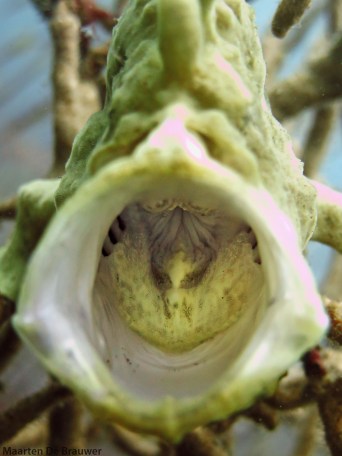
Froggie yawn

Pictures of interesting behaviour like this yawning frogfish (Antennarius commersoni) are popular, but the yawn might actually be a sign of distress.

To a large extent it remains unknown what the effects of diver manipulation are, though it is clear to see that it at the very least stresses animals. I am currently working on a project to find out which negative diver behaviours around critters are most common and how it effects the animals. The goal is to enable the dive industry to focus on preventing the behaviours which have the highest impact.

While most divers don’t approve of this unethical behaviour, industry leaders like organisers of photo competitions or dive centres still seem reluctant to admit there are serious ethical issues in underwater photography. Maybe out of fear of giving underwater photography a bad name, or out of fear to make less profit when strict rules are applied. What we need is a change in mentality from divers and industry leaders. Well known photographers like Dr. Alex Tattersall and Josef Litt are increasingly making themselves heard to set the right example. Organisations like Greenfins work closely with dive operators to improve destructive dive practices. A lot of this unethical behaviour can and will disappear with the support of divecentres, dive magazines and role models from the underwater photography community. So if you enjoy taking pictures underwater, consider signing this petition that asks for higher ethical standards in dive magazines and photo competitions.

Blue-ringed Octopus: cuteness with a twist

I am definitely not the first person to write about the Blue-ringed Octopus, and once you’ve seen one for yourself it is quite understandable that people get excited about them. Blue-ringed Octopus are probably one of the only invertebrates you can call “cute”. With their small size, interesting behaviour and iridescent blue rings they look like something out of a cartoon. Add the intriguing fact that these animals are also one of the world’s most venomous animals, and it becomes logical that people are interested in these critters.

Blue-ringed Octopuses are several species in the genus “Hapalochlaena“, depending on which source you check, there are anything between 3 to 10 species. They are all small octopuses, with the biggest one (Hapalochlaena maculosa) growing to only 15cm (body + arms). They are found from the centre of the Indian Ocean to the west of the Pacific Ocean. While their colours might make you think they belong in similarly colourful tropical reefs, they are actually more frequently found in the temperate waters of southern Australia.

A fact that is repeated very often is just how venomous these little guys are. So I won’t spend too much time on it here, but if you want to read more about it check out this link to learn all about the technical toxic details. The short version is: if you get bitten, you’d better hope to have someone nearby who is highly skilled in CPR. One of the more fascinating effects that occur when bitten is “locked in syndrome“, where you appear to be dead, but are actually still aware of what is going on. If that and near-certain death doesn’t stop people from harassing them to get a nice picture, I don’t know what will 😉 .

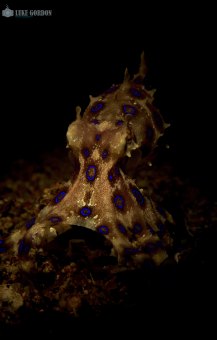
The most conspicuous features of the Blue-ringed Octopus, its blue rings, are actually hardly visible for most of the time. When you find one while diving and you don’t bother it too much, they look like any other well camouflaged octopus. The blue rings are a warning signal they only show when spooked or threatened. The mechanism of how they show those rings is a really neat one. The rings are pigmented cells that are usually covered by muscles that are contracted above them. It is only when the octopus relaxes those muscles that the blue rings show. Like a blanket that’s pulled away when unveiling a work of art. For more details, check out this paper.

One of the most interesting things I could dig up about this critter is about the way they mate. It turns out that Blue-ringed Octopuses can’t tell the difference between males and females! Males will try to mate with any other Blue-ringed Octopus they encounter, pouncing (that’s the technical term, trust me) on the potential partner and inserting their hectocotylus into the mantle cavity of the partner. It’s only after they insert this modified mating arm into the other octopus, that they can tell if their partner is in fact female or not. If the partner turns out to be another male, they amicably part ways, no harm done. In case they get lucky and their partner is a female, the male clings on for a long time: usually more than 90 minutes, but sometimes to over 4 hours! As a matter of fact, it seems the male tries to hang on as long as the female allows it, only breaking contact when forcefully removed by the female. If you are interested in the love life of small octopuses, you can read the original study here.

There is a lot more to find out of the Blue-ringed Octopus, such as the very basic question “How many species are out there?”. Considering that this animal is one of the most popular critters in muck dive tourism, it is surprising how little we really know about them. For my research I mostly look at fish, though I am always on the lookout to see what the best places are to find and study other interesting species. So who knows, I might just have a closer look at them in the future.

Best of Dauin_Blue ringed octopus_small.jpg

Photo: Maarten De Brauwer

Using SMURFs to catch baby fish

Luke and I have been in Dauin for a few days now. We are here to investigate the recruitment of cryptobenthic fish. If you’ve read this blog before, you’ll know that I am interested in camouflaged, small critters that live on the seafloor (=cryptobenthic). You might not, however, have heard about “recruitment”. This is the term used to describe the process of larval fish (which usually swim in the open ocean) “settling down” on the reef. When fish larvae settle, they change rapidly from small, transparent, weird oddballs to colourful reef fish. Or in the case of the critters I study, to camouflaged weird oddballs.

histriohistrio_with_adult

Larvae and adult Sargassum Frogfish (Histrio histrio) Source: http://nfchroniclesnoaa.blogspot.com

There are many reasons why I would like to know more the recruitment of the species I study. The most important one is that nobody really knows why some of these baby fishes show up where they do. If you don’t know this information, it is really hard to protect the right places that would be a suitable habitat for baby fish. Another reason is that this process is vastly different from anything we see on land, making it fun and challenging to try and figure out what is going on.

So how does one best study tiny baby fish? In the case of my critters, looking for the small adults is already hard, so how do you even begin to try and find the even tinier versions? The slightly disappointing answer is: “We don’t really know”. There are multiple techniques to find new recruits or larvae that are about to settle down (light traps, visual surveys, crest nets, …). But most of those don’t seem to be very effective for camouflaged critters. One method did show promise in a study in the Caribbean, the benthic “SMURF”.  If at this moment you are imaging little blue creatures with scuba tanks, catching baby fish with lassos and you don’t want to spoil that mental picture, please stop reading now.

SMURF

SMURF at sea (Photo Luke Gordon)

Since you’re still reading, I can now disappoint you about my SMURFs, they are not the ones you have seen on tv (no ethics clearance possible). SMURF stand for “Standard Monitoring Unit for Recruitment of Fishes”. It is a mesh-basket you fill with any substrate you want (pebbles, sand, coral rubble, plastic,…) which you then place in the ocean for a set time. After that time you collect the basket and see how many baby fish were attracted to your unit. Not quite the blue man-option, but you are the one who kept reading.

Luke and me made a whole bunch of units, which we deployed around Dauin. To deploy the units we had the help from my supervisor Euan Harvey, who decided to drop by to see what we are up to in Philippines. Euan is an expert in remote sampling using video cameras, but he definitely seemed to enjoy setting up experiments on baby critters as well. This could be due to the fact that on his very first muck dive here, we found Flamboyant cuttlefish, Blue-ringed octopus, a bunch of Frogfish, Ghostpipefishes, Seahorses and loads more critters.

_MG_6706

Euan photographing Ghostpipefish (Photo Luke Gordon)

This is the second time I am trying this experiment, the first attempt was thwarted by the ocean. Conditions are looking better now, so with some luck the units will survive the next weeks. By the end of the SMURF-project, we will hopefully know if this method  works well for the species I study. With some luck, I will even be able to tell you if baby cryptic fish prefer sand, pebbles, or rubbish. The method can then be used in the future for other people wanting to study the recruitment of cryptic species, so we can start to unravel some of the bigger questions about these poorly studied animals.