The underwater footage was taken by myself, Luke and one of my supervisors during fieldwork in Indonesia and Philippines last year. You can watch the video on the Environment and Agriculture website, or right here:
After a few weeks of visiting my family in Belgium and loading up on chocolate, beer and hugs of my little niece, it was time to get going again. Just over a week ago I flew back to Asia and the first stop was a small town in Philippines called Dauin.
Some of you might have already heard about Dauin. You might have heard/read me ranting on about how great the muck diving is, dived there yourself or maybe you’ve seen some of the many underwater photos appearing on various social media. For those of you who haven’t heard of it, Dauin is a small town of about 25000 inhabitants in the south of Negros. The place is close to the city Dumaguete and sometimes the two are used as synonyms in dive circles (they are not). Dauin is a sleepy coastal town where most people used to make a living from fishing or farming. “used to”, because it’s rapidly getting renowned for its awesome muck diving.
In all fairness, the story actually began with coral reef diving. Facing Dauin lies a small island called Apo. The reefs around Apo were the very first MPA (Marine Protect Area) in the Philippines and have been a poster child for MPAs in developing countries ever since. The fame of Apo brought in divers and it did not take too long before people discovered that the shore dives off Dauin were something quite special.
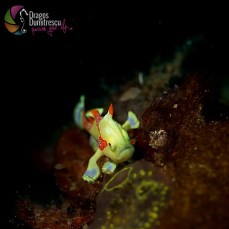
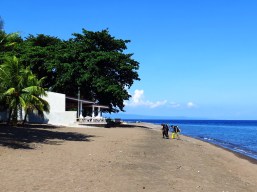
The beaches of Dauin are mostly made up of volcanic sand, though they are not as black as the ones you find in Lembeh. While there are a few small coral patch reefs, the real treasures are found in the sand. It’s muck diving at its best: you’ll find frogfishes, seahorses, mimic octopuses, flamboyant cuttlefishes, … The fact that most sites are easily reached and that there is a growing muck dive industry makes it an ideal area for me to conduct research.
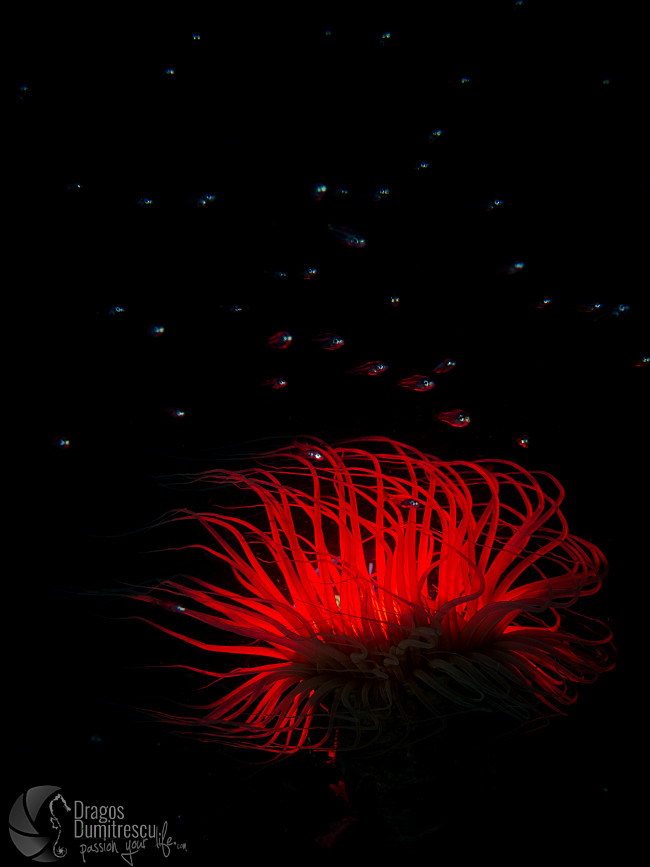
Last year I spent most of May in Dauin, doing a lot of diving and a lot of running around between divecentres to talk to people about dive tourism. This time I just went back for 5 days to talk to a few more people to fill in some gaps in my data on the socio-economic value of muck dive tourism. So unfortunately no research dives this time. Luckily I did manage to meet up with my good friend Dragos, who uses Dauin as a base to take some pretty sweet underwater photos. The underwater pictures in this post are his. If you want to see more of his (award winning) work, check out his site here.
The small trip to Dauin was the end of a productive, exhausting and entertaining research trip. I am writing this post in Manila airport, as I’m finally on my way back to Perth. After nearly 8 months of fieldwork and traveling it’ll be great to see my colleagues again and to start writing up some of my results. So keep an eye out on the blog for updates of what is going on. Or if you’re in Singapore in April, come and have a chat at the ADEX Dive expo, I am giving a talk and will be presenting some of my results.
Now the main holiday madness is over, we are all starting to take stock of the damage done by the excessive eating and drinking we’ve been doing. Or at least I am doing so… In this time of year, we can all relate to the feeling of being way too full after that unnecessary third helping of dessert. Compared to other animals we’ve got it easy, all we have to do is cook or order our food and start stuffing ourselves. It’s slightly different with the critters we find in the ocean.
Lizardfish eating a dragonet
While there is a lot of active hunting happening in the ocean, many of the species I study are ambush predators. This means they are even lazier than we are when it comes to getting food. They spend nearly all of their time lying down on the ocean floor, waiting for dinner to swim by and then gulp it down. The plus side of this is they can’t get annoyed with themselves for not ordering the more delicious looking plate their neighbour is wolfing down. The downside is that they sometimes have to wait a long time until dinner swims by.
When you are an ambush predator, being camouflaged is particularly important. If you look like what you really are (a hungry fish), no tasty morsels will be tempted to swim anywhere near your mouth. Camouflage that helps animals hunt is called “aggressive camouflage” and sometimes “aggressive mimicry”. The difference between the two is that camouflage refers to animals pretending to be a plant or dead object like a stone. Mimicry refers to pretending that you (or a part of you) are a harmless or tasty living animal such as a herbivorous fish, worm, …
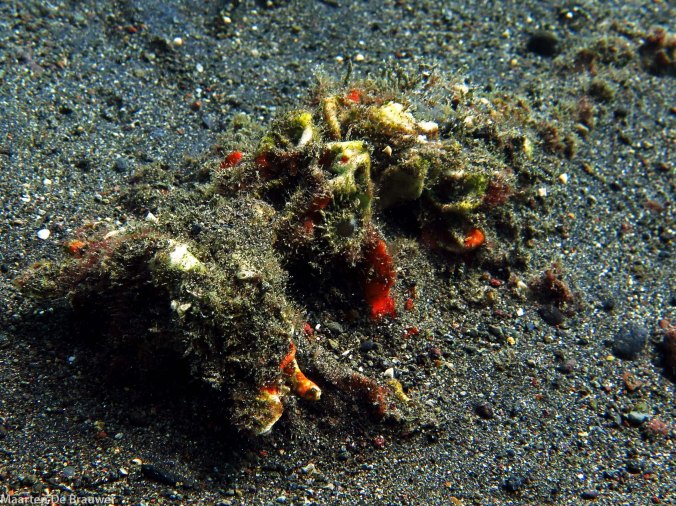
Aggressive camouflage: Estuarine Stonefish (Synanceia horrida) looking like a rock covered in algae and sponges
Good examples of critters using aggressive camouflage are stonefishes and lizardfishes. They pretend to be rocks or blend in with the sand, waiting for a bite sized morsel to swim by. Aggressive mimicry is used by many species, but it is perfected by frogfishes. They use a modified fin ray as a fishing rod, the bait on top of it (or “esca” if you want to sound all sciencey) has evolved to resemble a small animal like a shrimp or worm. This bait is wiggled around until an unsuspecting fish gets too curious for its own good and ends up as prey. In one species, Antennarius hispidusthe esca (=bait) has even been found to contain bioluminescent bacteria, great for luring in snacks at night. Frogfishes are not the only fish using a bait to attract meals, this technique is also used by some flounders and stargazers.
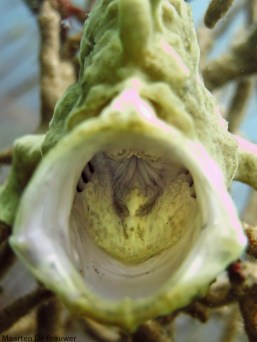
The inside of the mouth of a giant frogfish (A. commersoni)
If you have ever had a fish tank and tried to catch your fish bare handed while cleaning it, you will know that no matter how nearby a fish is, it’s hard to catch one. So ambush predators have a number of adaptations to make this easier. Most of them have a huge mouth that sucks in a lot of water when they open it quickly. This suction feeding causes the fish to get sucked into the predators mouth together with the water. On top of that, the teeth of most of these predators are pointed inward, making it easier to hold slippery prey. Another funky adaptation are “pharyngeal teeth”, small teeth on the inside of the throat that hold the prey when the predator opens its mouth to get a better grip on it. You’ve read that correctly, as if frogfish weren’t weird enough already, they also have teeth in their throat.
While most of us only binge eat on special occasions and then feel guilty about it, frogfishes and other similar predators really don’t care. They eat whenever they can, as much as they can. When you think you’re exaggerating, remember this: the mouth of a frogfish can expand to 12 times its normal size when eating. The equivalent of this would be you fitting an entire chicken in your mouth when eating. Frogfishes can also eat prey that are up to 1,5 times bigger than themselves! For us, this would be roughly the equivalent of eating a whole pig for Christmas, which would make for some interesting scenes around the dinner table…
A Scarlet Frogfish with prey in its stomach (source)
So next time you’re feeling stuffed at holiday eating fests dinners, remember it could be worse 😉
I have been reading up about seahorses recently and discovered some interesting little bits of information I could not help but share. While seahorses seem to be a big favourite for divers and non-divers alike, we actually know surprisingly little about them. Some of their strange quirks are well known. The fact that the males get pregnant is probably one of the favourite and most retold bits of knowledge about them. I want to go a bit further and more interesting than that, so let’s get started.
Seahorses belong to the family of Sygnathidae, which translates as “fused jaws”. What this means is that all seahorses and pipefishes have jaws that are stuck together, they can’t open them anymore. So if you were to imagine eating like a seahorse, try gobbling up your salad, steak, pizza, apple,… with clenched jaws, while only using your lips to help you suck the food in. A good thing seahorses do not have teeth, as that would make it even more difficult!
Hippocampus taenopterus, getting ready to growl
Another quirky thing seahorses do, is that they make noise. They make two distinct types of sounds: “clicking” and “growling”. I absolutely love the idea of a growling seahorse! It seems they do this when they are stressed out and it might even be some sort of escape mechanism to startle predators. Most likely because those predators would be laughing too hard because a seahorse just growled at them… The clicking sounds are mostly used during courtship and mating, so not only do seahorses growl to chase away predators, they also serenade their partners to get them in the right mood. Strange little critters indeed.
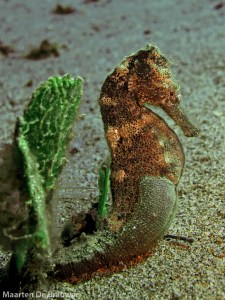
To keep up with the strangeness, have you ever wondered how strange the tail of a seahorse actually is? Probably not, I definitely hadn’t before reading this article. The tails of most animals are round, but nearly all seahorses have square tails. As it turns out, this square shape is better at grasping and holding items. At the same time it offers a higher resistance to crushing than a round tail would. So perfect for a camouflaged critter which spends most of its time clinging on to objects, pretending to be something it is not to avoid getting eaten by predators.
Different 3D printed models of seahorse tails (Source)
Hippocampus histrix
The objects seahorses hold onto can be anything, usually they cling on to objects like seagrass, algae, gorgonian seafans, etc. But they do not seem to be very picky at all. This article showed how seahorses living in areas with a lot of plastic actually use that plastic as camouflage. The seahorses even changed their colour to resemble the colour of the plastic and the spots on it. Unfortunately I cannot put the original pictures online due to copyright issues, so if you want to see them, follow this link. Since seahorses don’t really mind what they hold on to, artificial structures can be used to provide habitat for them when their natural habitat has been destroyed. This way populations can continue to exist until the natural vegetation has recovered.
Loss of habitat is one of the risks that endanger seahorses, the trade for traditional Chinese medicine is another big threat to them. IUCN has listed 7 species as Vulnerable and one species as Endangered, but most species have either not been assessed or we lack the data to assess whether or not they are endangered. To combat the illegal trade and offer some means of protection, all seahorses are listed with CITES, which means trading them is strictly controlled. One of the simple rules used to do this, is a size limit of 10cm. This size ensures that most traded seahorse species are mature individuals who can reproduce and that juveniles are left alone.
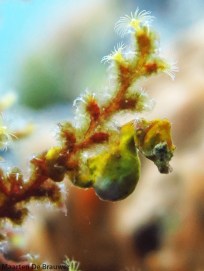
Hippocampus pontohi
The fact that we don’t really know how many species of seahorses exist, makes protecting them hard. Estimates of the number of seahorse species range from 40 to 48 species. It is quite likely new species are still waiting to be discovered, though the opposite might happen as well. Two species of pygmy seahorses (Hippocampus severnsi and Hippocampus pontohi) were described in 2008. But recent genetic analyses showed that they are actually the same species which comes in different colour variations.
If you want to know more about seahorses or just have a good laugh, check out this great video from Ze Frank with some more true facts about seahorses.
 Some of you might have already heard about Dauin. You might have heard/read me ranting on about how great the muck diving is, dived there yourself or maybe you’ve seen some of the many underwater photos appearing on various social media. For those of you who haven’t heard of it, Dauin is a small town of about 25000 inhabitants in the south of Negros. The place is close to the city
  The beaches of Dauin are mostly made up of volcanic sand, though they are not as black as the ones you find in Lembeh. While there are a few small coral patch reefs, the real treasures are found in the sand. It’s muck diving at its best: you’ll find





 Critter Research