Psychedelic nightdiving fun!

I have been doing quite a lot of night dives recently. Those who know me from when I was still working as a dive instructor might be a bit surprised by this, as I never use to be the biggest night dive enthusiast around. There are two reasons I’m swimming around in the dark a lot recently:

  1. Night diving in Lembeh Strait (and Indonesia in general) is pretty amazing
  2. I’ve been playing with a new toy that makes it all a bit more interesting: a high intensity blue light torch. This torch, combined with a yellow filter allows a diver to see “biofluorescence
Zombie Seahorse (Hippocampus histrix)

Thorny seahorse – zombie version

So as an excuse to post some very psychedelic photos, let me tell you a bit more about biofluorescence under water.

It is important to realise that biofluorescence is NOT the same as bioluminescence. The former needs an external light source (the sun, a dive torch,…), the latter means that the animal itself produces light. For more info on the differences, check out the site of the Luminescent labs.

Devil Scorpionfish

Devil Scorpionfish (Scorpaenopsis diabolus)

Biofluorescence under water has been described as early as 30 years ago and was first noted in corals and anemones. It has been used for years in coral research that looks at coral growth, diseases and bleaching. More recently however, people have started noticing that many more animals than just coral are fluorescent. A paper in 2008 described how many goby species show red fluorescence. Other publications have described fluorescence in many invertebrates such as mantis shrimps, crabs, worms, nudibranchs,… But I really got interested last year when a paper was published that described how fluorescence in fish was much more widespread than previously assumed. The reason it caught my attention is because it seems to be particularly common in “cryptically patterned species”, many of which happen to be the camouflaged little critters I’m so interested in.

Juvenile Whiptail (Pentapodus emeyrii)

Juvenile Whiptail (Pentapodus emeyrii)

Fluorescent nudibranch (Trapania scurra)

Fluorescent nudibranch (Trapania scurra)

So I got myself the necessary equipment and now I am trying to figure out what exactly fluoresces here in Lembeh, and maybe even getting a clue about why they fluoresce as well. There are a few theories out there: it could be used as a form of communication, it might be some sort of camouflage, it could even just be pure coincidence and we might be looking at a cool, but irrelevant quirky thing that evolved but serves no real purpose (I highly doubt this). Fish see the world differently than we do and many species can actually observe UV-light and fluorescence, which would lead me (and other researchers) to believe there is some function there. To prove these functions however, a lot more research and experiments are needed.

Shrimp trying to hide behind algae

Shrimp trying to hide behind algae

What matters most for this blog post, is that it looks rather amazing and that it shows a different, little known side of the underwater world. In case you were wondering, or doubting what you are seeing, none of the pictures in this post have been photoshopped beyond cropping and cleaning up some backscatter.
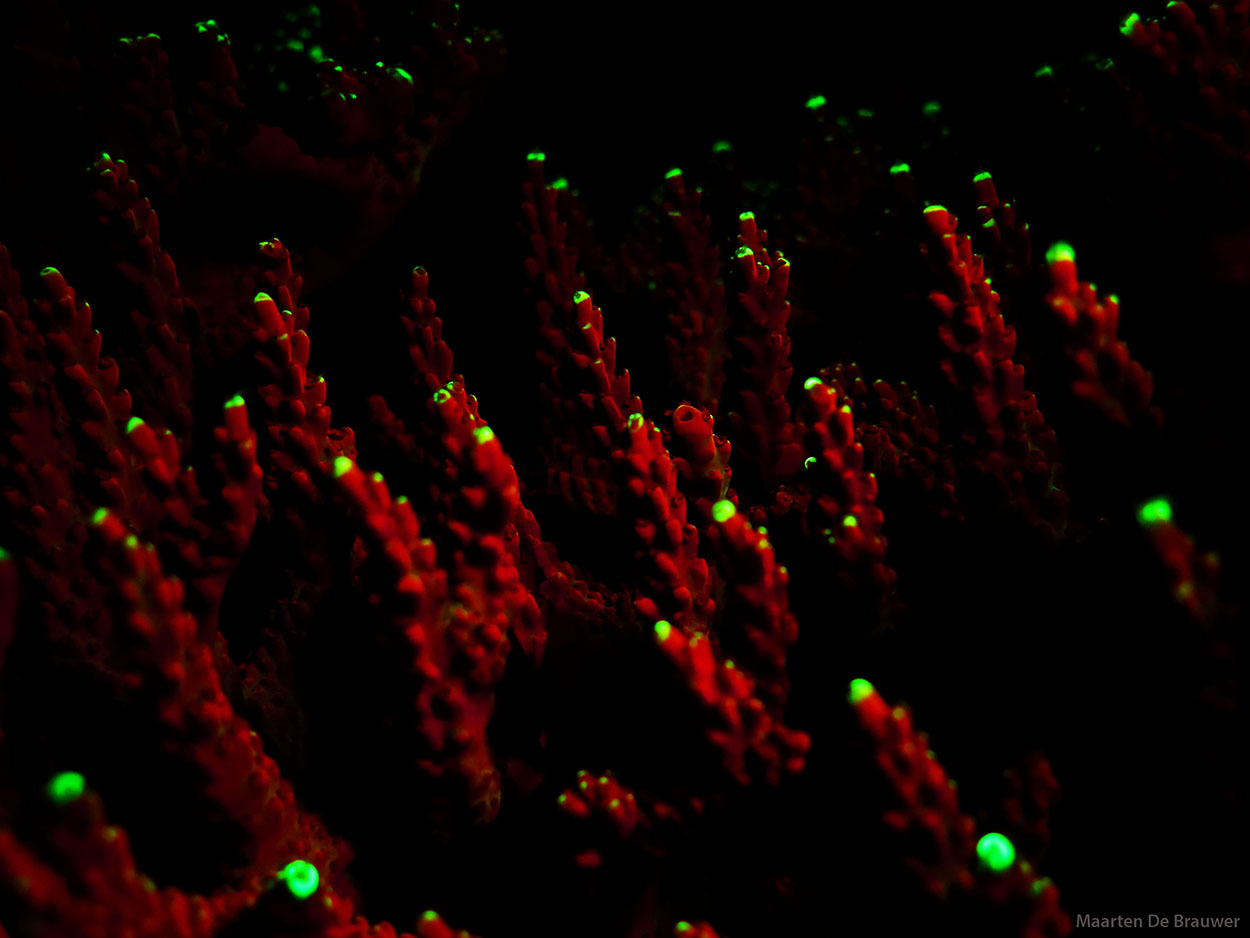
Acropora coral

Acropora coral

Copepod constellation
Copepod constellation

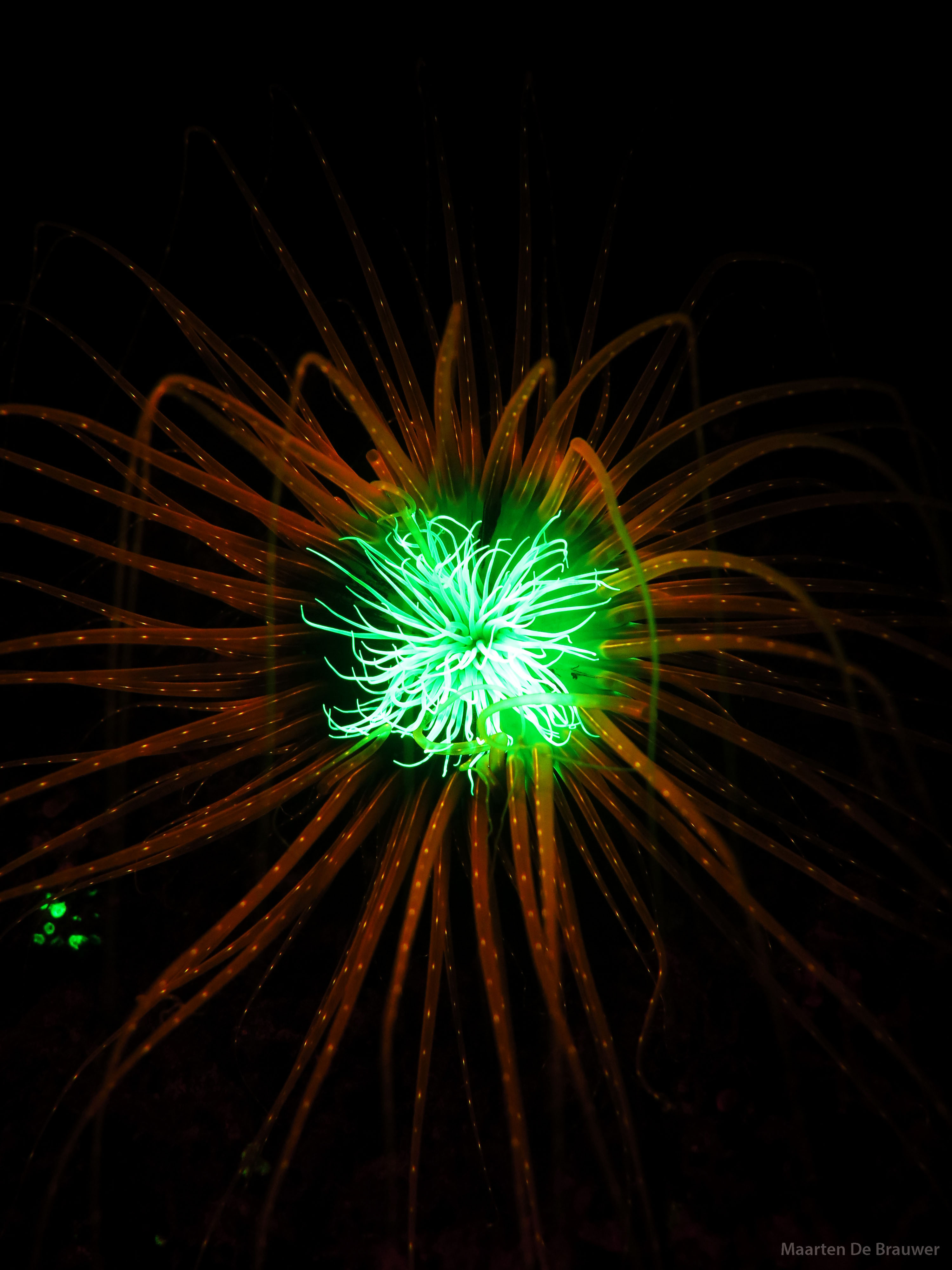
Tube anemone

Tube anemone

If you want to know more about how fluorescence works and how to take fluoro pictures yourself, this site is a good place to get started.

Thorny seahorse (Hippocampus histrix)

Thorny seahorse (Hippocampus histrix)

Winged Pipefish

As the research that I am doing looks at some of the strangest critters you can find in the ocean, it seems only right to give them a space on this blog. The little guy who kicks of the page is a little known pipefish: the “Winged Pipefish”.

Adult Winged Pipefish

Winged Pipefish

While doing surveys on the Critters@Lembeh housereef, I found a large (15cm) Winged pipefish (Halicampus macrorhynchus) chilling out on a patch of rubble. I have seen this species a few times before on dives in Indonesia, and always liked it a lot, even if you don’t hear or read about them very often. Maybe I like them just because it’s less of an in your face – “take a picture of me now, I’m AWESOME” – kind of critter than some of the more popular ones, but they still manage to be pretty cool creatures. As with most other pipefishes, little is known about their life history and behaviour. Besides the original description, I found a grand total of 0 (=zero) scientific papers that focus on the ins and outs of this amazing fish…

Juvenile Winged Pipefish

Juvenile Winged Pipefish

So here is what we do know: The juveniles are beautiful, mimicking algae or bits of seagrass. The tiny juvies have got large appendages resembling wings, hence the name. The wings don’t serve many other purposes besides looks (more on that later). They can be found on sand or rubble, often in areas with a lot of plant debris or seagrass. I think they are cutest juvenile pipefish you can find, but they are a very rare find, in 12 years of diving I only ever managed to find a single one.

With age the wings appear to get smaller (they grow into them). In big adults the only things that can be seen are small skin flaps on the side. The adult pipefish still look quite amazing, and can display all kinds of colours, ranging from brown to yellow to pink. At this stage, they are more commonly found on coral rubble or coral reefs.

The biggest adults can get overgrown with algae and are extremely well camouflaged, like the one on the housereef. The big ones I’ve seen were always on coral rubble and looked kind of gritty and tough (as far as pipefishes can look tough).

Halicampus macrorhynchus

Halicampus macrorhynchus

For those if you interested in finding or photographing one of these guys, Winged Pipefish range from the Red Sea to as far as Hawaii and Panama. Look in rubble, sand or seagrass patches between 3m and 25m.

Spot the pipefish...

Spot the pipefish…

Oh, and the function of the skin flaps and wings? It is assumed that they help to break up the shape of the fish, making it even harder to find for predators or divers.

Stupidity in scientific research

I have found a good reason to call myself stupid without being ashamed for it! This essay written by Martin Schwartz is a very interesting read. Have a read if you’ve got a minute and want to feel better about not knowing everything.

A few quotes:

“Science makes me feel stupid too. It’s just that I’ve gotten used to it. So used to it, in fact, that I actively seek out new opportunities to feel stupid. I wouldn’t know what to do without that feeling. I even think it’s supposed to be this way.”

“One of the beautiful things about science is that it allows us to bumble along, getting it wrong time after time, and feel perfectly fine as long as we learn something each time.”

“The more comfortable we become with being stupid, the deeper we will wade into the unknown and the more likely we are to make big discoveries.”

Here is the link to the original essay, enjoy your read….