Blue-ringed Octopus: cuteness with a twist

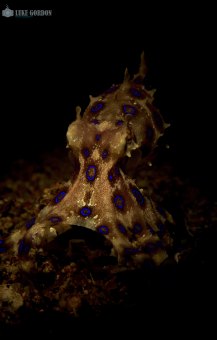
I am definitely not the first person to write about the Blue-ringed Octopus, and once you’ve seen one for yourself it is quite understandable that people get excited about them. Blue-ringed Octopus are probably one of the only invertebrates you can call “cute”. With their small size, interesting behaviour and iridescent blue rings they look like something out of a cartoon. Add the intriguing fact that these animals are also one of the world’s most venomous animals, and it becomes logical that people are interested in these critters.

Blue-ringed Octopuses are several species in the genus “Hapalochlaena“, depending on which source you check, there are anything between 3 to 10 species. They are all small octopuses, with the biggest one (Hapalochlaena maculosa) growing to only 15cm (body + arms). They are found from the centre of the Indian Ocean to the west of the Pacific Ocean. While their colours might make you think they belong in similarly colourful tropical reefs, they are actually more frequently found in the temperate waters of southern Australia.

A fact that is repeated very often is just how venomous these little guys are. So I won’t spend too much time on it here, but if you want to read more about it check out this link to learn all about the technical toxic details. The short version is: if you get bitten, you’d better hope to have someone nearby who is highly skilled in CPR. One of the more fascinating effects that occur when bitten is “locked in syndrome“, where you appear to be dead, but are actually still aware of what is going on. If that and near-certain death doesn’t stop people from harassing them to get a nice picture, I don’t know what will 😉 .

The most conspicuous features of the Blue-ringed Octopus, its blue rings, are actually hardly visible for most of the time. When you find one while diving and you don’t bother it too much, they look like any other well camouflaged octopus. The blue rings are a warning signal they only show when spooked or threatened. The mechanism of how they show those rings is a really neat one. The rings are pigmented cells that are usually covered by muscles that are contracted above them. It is only when the octopus relaxes those muscles that the blue rings show. Like a blanket that’s pulled away when unveiling a work of art. For more details, check out this paper.
One of the most interesting things I could dig up about this critter is about the way they mate. It turns out that Blue-ringed Octopuses can’t tell the difference between males and females! Males will try to mate with any other Blue-ringed Octopus they encounter, pouncing (that’s the technical term, trust me) on the potential partner and inserting their hectocotylus into the mantle cavity of the partner. It’s only after they insert this modified mating arm into the other octopus, that they can tell if their partner is in fact female or not. If the partner turns out to be another male, they amicably part ways, no harm done. In case they get lucky and their partner is a female, the male clings on for a long time: usually more than 90 minutes, but sometimes to over 4 hours! As a matter of fact, it seems the male tries to hang on as long as the female allows it, only breaking contact when forcefully removed by the female. If you are interested in the love life of small octopuses, you can read the original study here.

There is a lot more to find out of the Blue-ringed Octopus, such as the very basic question “How many species are out there?”. Considering that this animal is one of the most popular critters in muck dive tourism, it is surprising how little we really know about them. For my research I mostly look at fish, though I am always on the lookout to see what the best places are to find and study other interesting species. So who knows, I might just have a closer look at them in the future.

Best of Dauin_Blue ringed octopus_small.jpg

Photo: Maarten De Brauwer

Divers and Seahorses: ADEX

Last week I had the pleasure of attending the annual ADEX Dive Expo in Singapore. If you want to find out what scuba diving is about, or want to realise what a big deal it is, this is the place. Just to give an indication of the growing interest in diving: the expo received close to 60 000 visitors in 3 days! Besides the many stands from dive centres, resorts, photography shops, etc. who were trying to convince people to buy dive trips or equipment, there was a lot more to see and do. Throughout the weekend, there were non-stop presentations by marine biologists, NGOs, photographers, writers and even mermaids.

This year’s theme was “Seahorses“, so some of the world’s seahorse experts such as Dave Harasti, Amanda Vincent and Richard Smith were around to talk about these funky critters. There were speakers from the Coral Triangle Initiative, Greenfins, iSeahorse, Blue Ocean Network and many more NGO’s. It wasn’t possible for me to see them all, but I saw enough to learn a whole lot of new interesting things about seahorses and their conservation.

I was quite honoured to have been invited as well to give two talks. I talked about fluorescence in camouflaged species and how valuable muck diving can be to small coastal communities. From the chats I had with people afterwards, it seems I wasn’t talking absolute nonsense and people were actually interested in what I had to say. While it is too early to tell, in the future there might even be some interesting projects coming out of these meetings.

Talk_ADEX.jpg

Explaining the value of Muck Diving

The most interesting facts I’ve learned this weekend? It seems seahorses often end up as prey for frogfish, scorpionfish and even the occasional octopus. This is also the reason why successful marine protected areas with lots of predators might lead to less seahorses in those protected areas. I’ve also noticed once again that there is more and more demand for truly sustainable dive tourism in a way that really benefits local communities and not just the owners of dive resorts.

Spending a few days in the comfort of modern Singapore was nice, but now it’s time to get back to work. And for now work = fieldwork!  😀 Yesterday I arrived in Dauin accompanied by none other than Luke, my very good friend and trusty science hobbit! Keep your eyes on the blog for our adventures looking for baby critters…

Mandarin madness

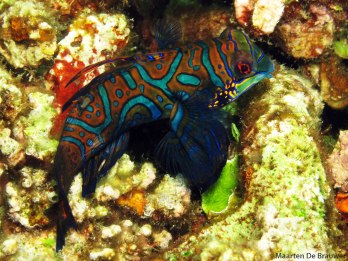
My last trip to Komodo was a successful one, not only because of the data I collected or the nice group on the boat, but also because I managed to have a good look at two very elusive critters, one of them a first! I had seen Mandarinfish (Synchiropus splendidus) before, but this was the first time I had a proper look at a Picturesque Dragonet (Synchiropus picturatus).

Both species are closely related Dragonets belonging to the genus Synchiropus. They are exquisitely coloured, which makes them big hits both with divers and marine aquaria hobbyists. The colours and patterns of the picturesque dragonet have earned it the synonym of “psychedelic mandarinfish” or even “LSD-fish” in German! Of the two, the mandarinfish is best known to divers, probably because it is found more frequently in areas where divers are likely to dive, unlike its psychedelic sister-species.

Both species are found in the Indo-West Pacific, they range from the south of Japan to the north of Australia. The best places to spot them are Indonesia and the Philippines. They are found in sheltered lagoons, usually in areas with coral rubble. You can also find mandarinfish in stands of branching corals. Picturesque dragonets are more frequently found in areas with silty bottoms close to mangroves. Both species are shallow water fish that are rarely seen deeper than 20m.

The best time to see mandarinfish is at dusk or late in the afternoon on overcast days. At these times the fish come out of hiding to spawn. Both species live in small social groups which usually consist of a male and a few females. The males are easily recognized by their larger size and long dorsal fin.

Synchiropus picturatus_2_MDB

Two Picturesque Dragonets (female in the front, male at the back)

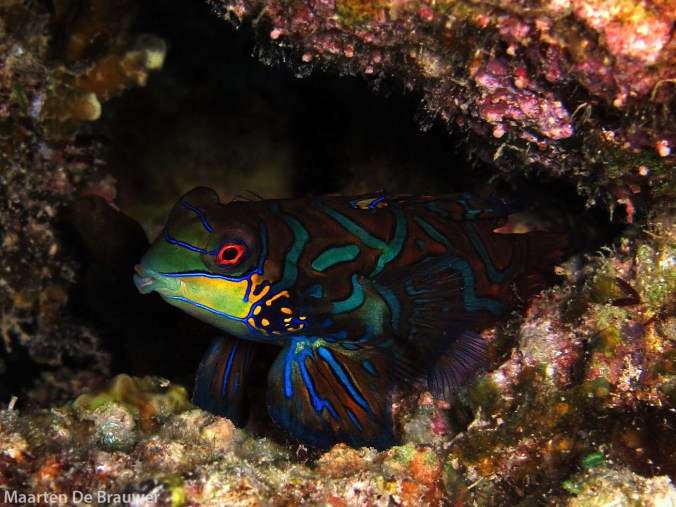
As is the case with many secretive critters, we don’t know very much about them. The things we do know show that there is more to them than just a pretty face. For example, they secrete a thick mucous that might even contain toxins. According to the literature, this mucous smells bad and tastes bitter, which makes me wonder exactly how they found this out 😉 Regardless of research methods, this toxicity means that the highly visible colours could in fact be a warning signal to potential predators, much in the way nudibranchs advertise their toxicity. For those interested in impressing their fellow divers, this trick is called “aposemetic colouration“.

Best of Lembeh_Synchiropus splendidus2_MDB

Mandarinfish – a fierce predator?

Mandarinfish are tiny carnivorous fish, which feed on tiny prey. Too bad they are so small, just imagine how much fun it would be to see a great white shark in the colours of a mandarinfish?!? Until the day an evolutionary trip-up creates a giant mandarinfish stalking the oceans, they feed mainly on small crustaceans, small molluscs and fish eggs. Which might be more convenient for the many people that keep these small fish in aquariums.

And make no mistake about it, both species are VERY popular in the marine ornamental trade. Research in Batasan Island (near Bohol) in Philippines showed that in 2000, between 1800 to 2400 mandarinfish were exported per month! If you have ever searched for mandarinfish while diving, those numbers will seem even more impressive. Fishermen usually catch the fish with miniature spearguns, since other methods are not as successful. This method obviously inflicts damage on the fish, often leading to the fish dying either shortly after being caught or during transport to aquariumshops. Another problem with catching mandarinfish for the aquariumtrade is that people prefer larger fish. A trend that causes the larger males to disappear first, which can in turn lead to reduced reproduction rates for the remaining fish.

These lovely critters might be very popular with aquarium enthusiasts, unfortunately they are difficult to keep alive in a tank. The fish require specific food and shelter, lack of those are the cause of many mandarinfish dying shortly after they’ve been bought by their new owners. There have been some reports of mandarin spawning in tanks, but raising the larvae to healthy adults is still difficult. As far as I could find, the vast majority of mandarin fish sold in aquarium shops are still caught in the wild, which might have a big impact on fish populations in the ocean.

Might have a big impact, since we don’t really know. Neither species has been assessed by the IUCN, so we don’t know if populations are in decline and if they are at risk of extinction. So until we do, enjoy looking for them during your dives, but think twice before buying one!

Best of Cabilao_Mandarinfish_MDB


Psychedelic Frogfish!!!

There was some VERY exciting news last weekend, the elusive Psychedelic Frogfish (Histiophryne psychedelica) has been spotted again in Ambon! This very rare and very trippy frogfish has only been described in 2009 and has hardly been seen again since. Practically nothing is known about them, except for the fact that they are amazing! Here is a video (property of Dive into Ambon) to prove it:

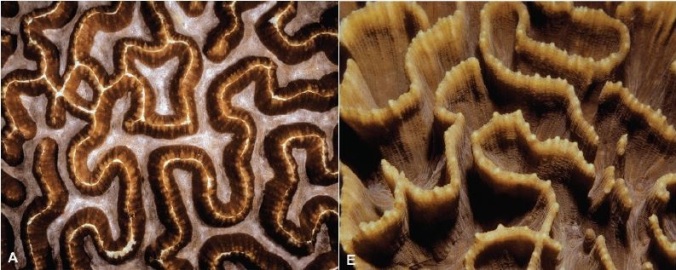
The psychedelic frogfish has only ever been seen alive in Ambon and they don’t seem to get much bigger than 10cm. Their exceptional colouration provides excellent camouflage and is thought to mimic coral species like Symphyllia sinuosa, Pectinia lactuca and other corals with similar morphology.

Symphillia and Pectinia

S. sinuosa (A) and P. lactuca (E). Photos: D. J. Hall from Pietsch et al. 2009

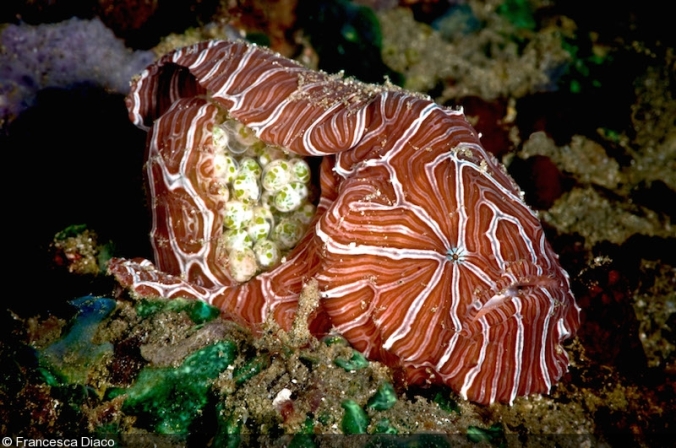
As a species of the genus Histiophryne, Psychedelic frogfish are “egg-brooders”, meaning they keep their eggs attached to their body to protect them from predators. It is even believed that they might use their eggs as bait to lure fish in that don’t recognise the eggs are attached to a predator larger than themselves! This is what it looks like:

Psychedelic frogfish_eggs

Psychedelic frogfish with eggs. Photo: Francesca Diaco from Dive Photo Guide

Who could not get very enthusiastic about a fish this bizarre and beautiful? Just too bad I don’t have time to go to Ambon myself any time soon 😉