Black sand: Origins

The species I study are found in a very specific habitat. Unlike many (dare I say most) marine biologists who work in the tropics, I hardly spend any time at all on coral reefs, mangroves or seagrass beds. I estimate that since starting my PhD, roughly 80% of my dives were done over sand. No coral, no rocks, hardly any distinctive feature at all, just wide expanses of sand. Mind you, not just any kind of sand, the critters I look for seem to be found most often on black sand.

blacksandbeach

A black sand beach in Lembeh Strait, Indonesia

For those who have never had the pleasure of diving over black sand or those used to diving in places like Egypt, Maldives or the Great Barrier Reef, the idea of a black sand beach or dive site might seem strange or hard to imagine. When reading the words “tropical beach”, most of us imagine powdery white sand, turquoise water, and a bunch of palm trees added for good measure. But I am happiest starting my dive from a beach as black as my (soul) wetsuit and dive boots. The first time you see a true black sand beach is mesmerising and even a bit alienating, it somehow doesn’t seem right. The water looks grey instead of blue, darker, and less inviting than those beautiful blue lagoons from travel brochures. Until you put your head under water and start looking around…

But why are some beaches black? What is the difference between the powdery white sand of Maldives and the pitch black sands of Lembeh or Hawaii? After the ICRS conference in Honolulu last week I decided to go have a closer look at the origins of my preferred study systems: active volcanoes! There are few places on this world better suited to do this than on Hawaii’s big island. Accompanied by Jamie, a marine scientist specialising in underwater soundscapes, I set off to find out how close to a volcano one needs to get before the hairs on your legs get scorched off 😉

Lava_jungle.jpg

Lava flow making its way through the forest

Turns out the answer is: not very close at all. In what was the highlight of our trip we flew in an open-doors helicopter over a lake of magma and a lava stream running down a mountain. Even hovering 50m above the lava you can feel the incredible heat emanating from the stream! The Kilauea volcano is one of the most active volcanoes in the world, and has been erupting since 1983. The result is an amazing landscape of solidified lava, covering vast expanses of the island.  During our 3 day stay in the Volcano National Park, we visited lava tubes, hiked over solidified lava lakes, were awestruck by the raw spectacle of watching a volcanic crater at night, and got sunburned ambling across a frozen lava wasteland that was a village until only few year ago. While we were in Hawaii, there were no lava streams entering the ocean, but there were plenty of places where it recently did.

Lava_ocean

Fresh lava flow in the ocean

Liquid lava flowing in the ocean is one of the two ways black sand beaches can be formed. The lava is so hot that when it runs into the cold water, it causes explosions that shatter tiny fragments of volcanic sand/glass around. This process can happen so fast that a black sand beach can be formed overnight! The size of these fragments can be from small boulders to actual fine sand, dependent on the temperature of the lava and the water. The dark colour of the sand is caused by the mixture of minerals inside the lava, the minerals giving the darker colours are mostly iron oxides such as magnetite.

The other way black sand beaches are formed, is through erosion of black volcanic rocks by rivers, which then carry the black grains of sand down to the ocean. Depending on which other types of rock the rivers flow over other minerals will be added to the mix, resulting in sand colours that can range from pitch black to dark brown or even beige or green. For any geology-inclined readers, this site has got all the details you could possibly want to know about black sand.

blacksand

Black sand + dive boots

So to summarise: black sand ecosystems are formed by some of the most epic geological processes in the world, magma from the centre of the earth erupting and shaping the world as we know it. The powdery white sand beaches of Maldives on the other hand, are mostly formed by the build-up of whole lot of parrotfish poop***. An interesting process for sure, but give me an epic black sand beach over a pile of fish poop any day 😉


***Technically speaking parrotfish poop, eroded corals, shells and bits of other stuff, but I’m taking some freedom here 😉

Coral Reef Conference in Hawaii

The International Coral Reef Symposium (ICRS) in Hawaii has come to an end. While I am using the opportunity to explore more of Hawaii, I figured it could be interesting to share some of the highlights. ICRS is a huge conference held once every 4 years, with about 2500 marine biologist gathering together for 5 days of presentations, workshops, poster sessions, networking and socializing. To give you an idea of just how much research was being presented: for 5 days straight up to 10 differently themed sessions would run at the same time. Session themes were very diverse, from reef fish ecology to the role of macro algae, to protected area management, genetic connectivity, effects of pollution, etc.

Conference centre

The very shiny conference centre

With literally more than a thousand interesting talks going on simultaneously, the hardest thing was choosing which ones to go see. Unfortunately, though not surprisingly, there were very few talks about cryptic critters (3 to be precise), but there were plenty of other really good talks to see. So here is an overview of a few talks that stuck in my mind.

One of the plenary talks was to hand the the Darwin medal to Jack Randall, this medal is awarded once every four years in recognition of major scientific contributions throughout the career of a coral reef scientist. Most people reading this blog won’t know Jack Randall, but on his own he described more new species than any other fish taxonomist ever did. In other words, an absolute legend in the world of fish taxonomy. It was inspiring to hear him talk about his long career and to see how passionate he still is at the age of 92!

Another talk that stuck with me was a talk on cryptobenthic fishes (small fishes) living on coral reefs. Chris Goatley‘s research showed how important it can be for small fish to grow even the smallest bit. A difference of only 1mm can increase their chances of survival massively. Size however is not the only factor that helps them survive, for these small fishes, the most important thing seems to be experience. In other words, a fish of 2cm that is 2 months old has a much higher chance of surviving than a similar sized fish of 2 weeks old. Which proves that you can forget about that 3 second fish-memory myth as well.

Miss Baldisimo from the University of Philippines talked about the aquarium trade, a hot topic now that Finding Dory is out. The trade usually does not get much attention but it is still massive, and Philippines is the biggest exporter of marine aquarium fish globally. What was new to me, is that in some areas fishermen are starting to specialise in collecting frogfish! Unfortunately there is still massive overfishing and high mortality of the fish during catching and export. What makes this even more tragic, is that the fishermen are very poorly paid for their hard work, the price per fish has not increased in over 20 years! So think twice before you want to get a marine aquarium.

DSC_2991_smal

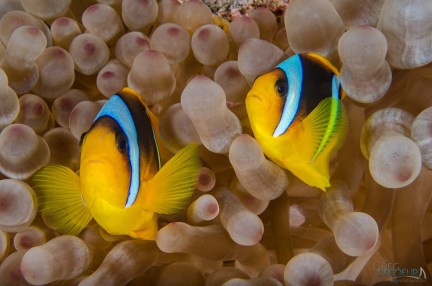
Clownfish in trouble? (Picture: Greg Lecoeur)

Also connected to Finding Dory, was a presentation about clownfish in the Red Sea. Researchers have noticed a huge decline (86%) in host anemones in the  gulf of Eilat. This has lead to a similar decline in Red Sea Anemonefish (Amphiprion bicinctus) and might even lead to a local extinction if this trend continuous. The researchers could not find the cause of this decline, which is particularly worrying. Luckily the species is very common in the rest of the Red Sea, so there is no immediate threat for the species as a whole.


I had the pleasure of watching the talk of a blogger I had been following before the conference even started. Jobot turned out to be someone I had actually already met a few years ago during fieldwork in Lizard Island. For her very cool project she used acoustic trackers to see when reef fish died or got eaten.  One of the most surprising results she found, was that most predation (fish being eaten by bigger fish) happened during the day and not at night! Sunset and sunrise were even more intense, which has been assumed for a long time, but the fact that less fish get eaten at night was a surprise for most people attending the talk.

Poster

Discussing fluorescence in fish

During the conference I presented a poster about the fluorescence research I have been doing the last year and a half. It seems that the poster was well received, as I got the student prize for the best poster during the conference. I am still not sure what I actually won since I was not present at the last plenary talk, so still some mystery in the aftermath of the conference.

HIMB

Chilling out at HIMB

The day after the conference I was lucky enough to be able to visit the Hawaii Institute of Marine Biology (HIMB). HIMB is a world class research station located on a small island at the northeast coast of Oahu. Besides being a place where awesome science is done, they also had hammerhead sharks in their big enclosure, and seeing hammerheads is always a treat 😉


In short: I had a great time at the conference, not only because of the science but also because I got to meet up with old friends and meet a lot of great new people. The next few days I am off to do some volcano exploring on the Big Island in Hawaii, before heading back to Perth for some more serious sciencing!


Using SMURFs to catch baby fish

Luke and I have been in Dauin for a few days now. We are here to investigate the recruitment of cryptobenthic fish. If you’ve read this blog before, you’ll know that I am interested in camouflaged, small critters that live on the seafloor (=cryptobenthic). You might not, however, have heard about “recruitment”. This is the term used to describe the process of larval fish (which usually swim in the open ocean) “settling down” on the reef. When fish larvae settle, they change rapidly from small, transparent, weird oddballs to colourful reef fish. Or in the case of the critters I study, to camouflaged weird oddballs.

histriohistrio_with_adult

Larvae and adult Sargassum Frogfish (Histrio histrio) Source: http://nfchroniclesnoaa.blogspot.com

There are many reasons why I would like to know more the recruitment of the species I study. The most important one is that nobody really knows why some of these baby fishes show up where they do. If you don’t know this information, it is really hard to protect the right places that would be a suitable habitat for baby fish. Another reason is that this process is vastly different from anything we see on land, making it fun and challenging to try and figure out what is going on.

So how does one best study tiny baby fish? In the case of my critters, looking for the small adults is already hard, so how do you even begin to try and find the even tinier versions? The slightly disappointing answer is: “We don’t really know”. There are multiple techniques to find new recruits or larvae that are about to settle down (light traps, visual surveys, crest nets, …). But most of those don’t seem to be very effective for camouflaged critters. One method did show promise in a study in the Caribbean, the benthic “SMURF”.  If at this moment you are imaging little blue creatures with scuba tanks, catching baby fish with lassos and you don’t want to spoil that mental picture, please stop reading now.

SMURF

SMURF at sea (Photo Luke Gordon)

Since you’re still reading, I can now disappoint you about my SMURFs, they are not the ones you have seen on tv (no ethics clearance possible). SMURF stand for “Standard Monitoring Unit for Recruitment of Fishes”. It is a mesh-basket you fill with any substrate you want (pebbles, sand, coral rubble, plastic,…) which you then place in the ocean for a set time. After that time you collect the basket and see how many baby fish were attracted to your unit. Not quite the blue man-option, but you are the one who kept reading.

Luke and me made a whole bunch of units, which we deployed around Dauin. To deploy the units we had the help from my supervisor Euan Harvey, who decided to drop by to see what we are up to in Philippines. Euan is an expert in remote sampling using video cameras, but he definitely seemed to enjoy setting up experiments on baby critters as well. This could be due to the fact that on his very first muck dive here, we found Flamboyant cuttlefish, Blue-ringed octopus, a bunch of Frogfish, Ghostpipefishes, Seahorses and loads more critters.

_MG_6706

Euan photographing Ghostpipefish (Photo Luke Gordon)

This is the second time I am trying this experiment, the first attempt was thwarted by the ocean. Conditions are looking better now, so with some luck the units will survive the next weeks. By the end of the SMURF-project, we will hopefully know if this method  works well for the species I study. With some luck, I will even be able to tell you if baby cryptic fish prefer sand, pebbles, or rubbish. The method can then be used in the future for other people wanting to study the recruitment of cryptic species, so we can start to unravel some of the bigger questions about these poorly studied animals.

Divers and Seahorses: ADEX

Last week I had the pleasure of attending the annual ADEX Dive Expo in Singapore. If you want to find out what scuba diving is about, or want to realise what a big deal it is, this is the place. Just to give an indication of the growing interest in diving: the expo received close to 60 000 visitors in 3 days! Besides the many stands from dive centres, resorts, photography shops, etc. who were trying to convince people to buy dive trips or equipment, there was a lot more to see and do. Throughout the weekend, there were non-stop presentations by marine biologists, NGOs, photographers, writers and even mermaids.

This year’s theme was “Seahorses“, so some of the world’s seahorse experts such as Dave Harasti, Amanda Vincent and Richard Smith were around to talk about these funky critters. There were speakers from the Coral Triangle Initiative, Greenfins, iSeahorse, Blue Ocean Network and many more NGO’s. It wasn’t possible for me to see them all, but I saw enough to learn a whole lot of new interesting things about seahorses and their conservation.

I was quite honoured to have been invited as well to give two talks. I talked about fluorescence in camouflaged species and how valuable muck diving can be to small coastal communities. From the chats I had with people afterwards, it seems I wasn’t talking absolute nonsense and people were actually interested in what I had to say. While it is too early to tell, in the future there might even be some interesting projects coming out of these meetings.

Talk_ADEX.jpg

Explaining the value of Muck Diving

The most interesting facts I’ve learned this weekend? It seems seahorses often end up as prey for frogfish, scorpionfish and even the occasional octopus. This is also the reason why successful marine protected areas with lots of predators might lead to less seahorses in those protected areas. I’ve also noticed once again that there is more and more demand for truly sustainable dive tourism in a way that really benefits local communities and not just the owners of dive resorts.

Spending a few days in the comfort of modern Singapore was nice, but now it’s time to get back to work. And for now work = fieldwork!  😀 Yesterday I arrived in Dauin accompanied by none other than Luke, my very good friend and trusty science hobbit! Keep your eyes on the blog for our adventures looking for baby critters…