The story of a science hobbit

Luke, science hobbit

Luke, science hobbit

The research project I am working on might be one I designed and that will (hopefully) result in me getting a PhD degree, but I could never succeed in this without the help of many other people. I have got three supervisors in Australia, local counterparts here in Indonesia, connections in the dive world, friends and family who provide moral support,… And then there’s my trusty science hobbit, Luke. As much as everyone else has supported me and helped out so far, I could not have achieved a fraction of what I have in Indonesia without Luke’s help. So I am using this blog to thank him and to tell his story (and to shamelessly promote his awesome photography work while I’m at it).

Luke and I met in 2011 where we were both working for Coral Cay Conservation in Napantao, Philippines. He was one of the two science officers, while I was responsible for making sure everyone was diving safely. Luke and Jen (the other science officer) were amicable kown as science hobbits, a title that I have kept on using ever since. We shared a room for months, so we got to know each other very well. Besides sharing a passion for nudibranchs and by extension any other ocean critter, it turned out we also make great dive buddies.

Luke and me in Philippines, 2011

Luke and me in Philippines, 2011

As most divers will know, diving with some buddies just works better than with others. It’s more than just safety and doesn’t necessarily have anything to do with how well you get along on land. I have dived with partners and friends who were great divers, but which just didn’t work as a buddy. Vice versa I’ve dived with people that I hardly knew on land, but with whom diving just went super smooth. Anyone who has ever had the chance (or bad luck) to dive with Luke and me will contest to the fact that we work well underwater. We not only know each other’s dive style, air consumption and intentions, we actually manage to have proper conversations while we’re diving. I have vivid (and hilarious) memories of us discussing which species of nudibranch we found on a dive in Komodo, ignoring the ripping currents because we needed to settle that particular point right then and there 😀

Photographing manta rays in Ecuador

Luke photographing manta rays in Ecuador

So who is this science hobbit really? I can tell you that he is not only a great diver, he is also one of the most knowledgeable field marine biologists I have ever met. You need coral identified? Ask Luke. Not sure what fish it is? Ask Luke. Need to know more about coral nurseries? Ask Luke. Want to build a coral reef aquarium, do fish surveys, know more about conservation, diving in Fiji, Madagascar or Philippines? Luke’s your man! I even have to admit that he might be better at spotting baby frogfish than I am. On top of all that, he is also genuinely a nice guy who is great fun to work with. All of this is probably why he has been asked to work with so many NGOs and researchers in places like Fiji, Philippines, Maldives, Madagascar, Ecuador, Indonesia,… It is definitely the reason why I asked him to come and help me in Indonesia for the past 3 months.

To add to those skills, he is also not half bad as a photographer. When I say not half bad, I mean pretty bloody amazing! Most of the pictures on this blog are his work, so go back, read through some of the posts and have a look at the pictures. Even better, check out his website or facebook page. You can even order prints of his pictures as well, so check it out! On the site you can order prints of some of his best shots. At the moment Luke is giving 50% off prints for the first 20 prints ordered, just use the code FROGFISH when ordering your prints. If anyone is still looking for Christmas or birthday present ideas for ocean lovers, it’s your chance to get a good deal.
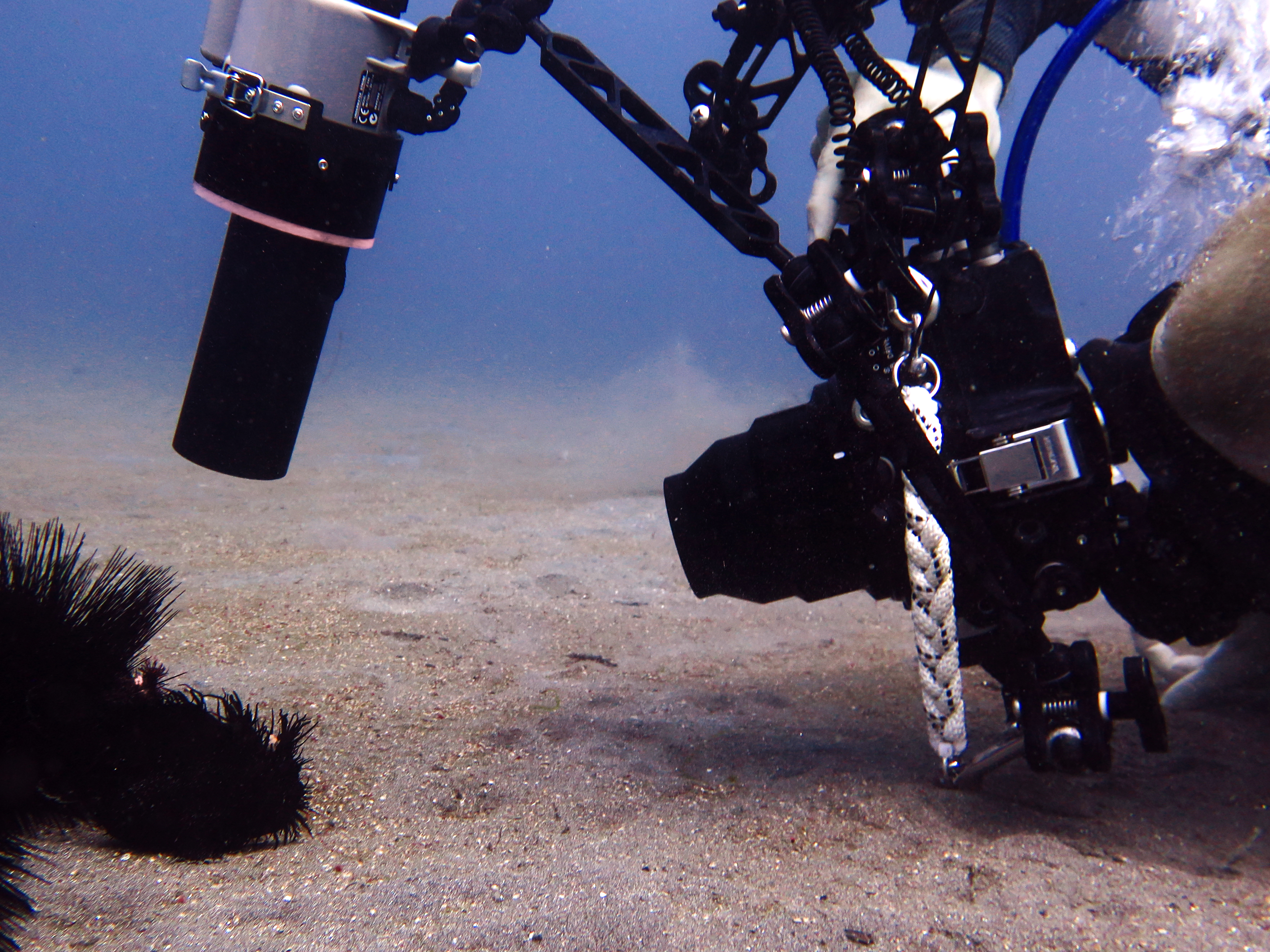
Luke in action, find the black frogfish

Luke in action, find the black frogfish

Unfortunately I had to say goodbye to one of my best friends and greatest colleagues ever. He has been whisked away to Australia by his girlfriend to go and explore that part of the world. In all fairness to Katie, she did let me use him for a good 3 months, significantly postponing their Australia plans. Besides that, she is just as amazing a person as Luke is, so I am wishing both of them all the best on their new adventures. I sincerely hope they have the best of times together and that they get all the good luck they both deserve.

Once again a massive thank you Mr. Luke, hoping our next dive together will be sooner rather than later!

Dragons, Currents and Hidden Gems

Komodo tripThere hasn’t been much activity on the blog recently, mostly since I’ve been stowed away on various boats exploring the marine life around the Komodo Islands. I just got back from a very comfortable liveaboard trip ran by Safari Bali, who have been kind enough to let me hop on the Sea Safari 7 as resident marine biologist. In return for the trip I do presentations for the guests, help them identify creatures they’ve seen, or generally answer any ocean-related question they might have. A great deal if you ask me, since it gives me the chance to do research in one of the best dive destinations in the world.

Komodo has been one of my favourite spots since I dived it the first time six years ago. The enormous diversity in marine life and dive sites is hard to find anywhere else. Raja Ampat might have more species, but to me Komodo is more interesting. There are more muck sites, stronger currents, lots of weird critters and they’ve got dragons…it’s hard to top dragons.

Komodo Dragon

Komodo Dragon (Photo by Jennifer Tambosco)

Komodo national park was established in 1980 and was declared a World Heritage Site in 1986. The park was originally designed to protect the endemic Komodo Dragons. They are the world’s largest reptile and are only found in the Komodo National Park and a few areas on the west coast of Flores. It was quickly recognised that the diversity in the surrounding ocean was a lot bigger than on land and protection was put in place for the marine environment as well.

Ghostpipefish party, six Solenostomus paradoxus hanging out

Ghostpipefish party, six Solenostomus paradoxus hanging out

Life under water is governed by the strong currents around the islands. The Komodo islands form a passage between the Pacific and Indian Ocean, the water flowing between them causes the famous currents in the area. These currents bring in important nutrients on which the marine life depends and it doesn’t take many dives in the area before you realise just how much of an effect they have. Diving in Komodo is always exciting, not just because you’re often flying around under water at exhilarating speeds, but also because of the enormous diversity of life that is created by these currents.

Pygmy Seahorse (Hippocampus bargibanti)

Pygmy Seahorse (Hippocampus bargibanti)

Explaining just how diverse and exciting diving in Komodo is very difficult. To make life easier for myself, here is an excerpt from my logbook from the trip: manta rays, sharks, eagle rays, frogfishes, octopuses, turtles, napoleon wrasses, seahorses, ghostpipefishes, giant trevallies,… On top of that reefs are generally very healthy, with huge clouds of reef fish hovering around them. From the boat we’ve seen at least 3 different species of dolphins and a whale. In this crazy fish soup I spent most of my time looking for pygmy seahorses, which greatly confused some of the other divers on board. Why bother with critters 1cm in size if you’ve got manta rays and sharks flying overhead? This is a fair point, but I am trying to get an idea of how many pygmy seahorse are out there, so the manta rays will have to wait… In all fairness, I might have gotten distracted a few times, but who can blame me for that?

Selfie time with the local kids :) (Photo  by Jennifer Tambosco)

Selfie time with the local kids 🙂 (Photo by Jennifer Tambosco)

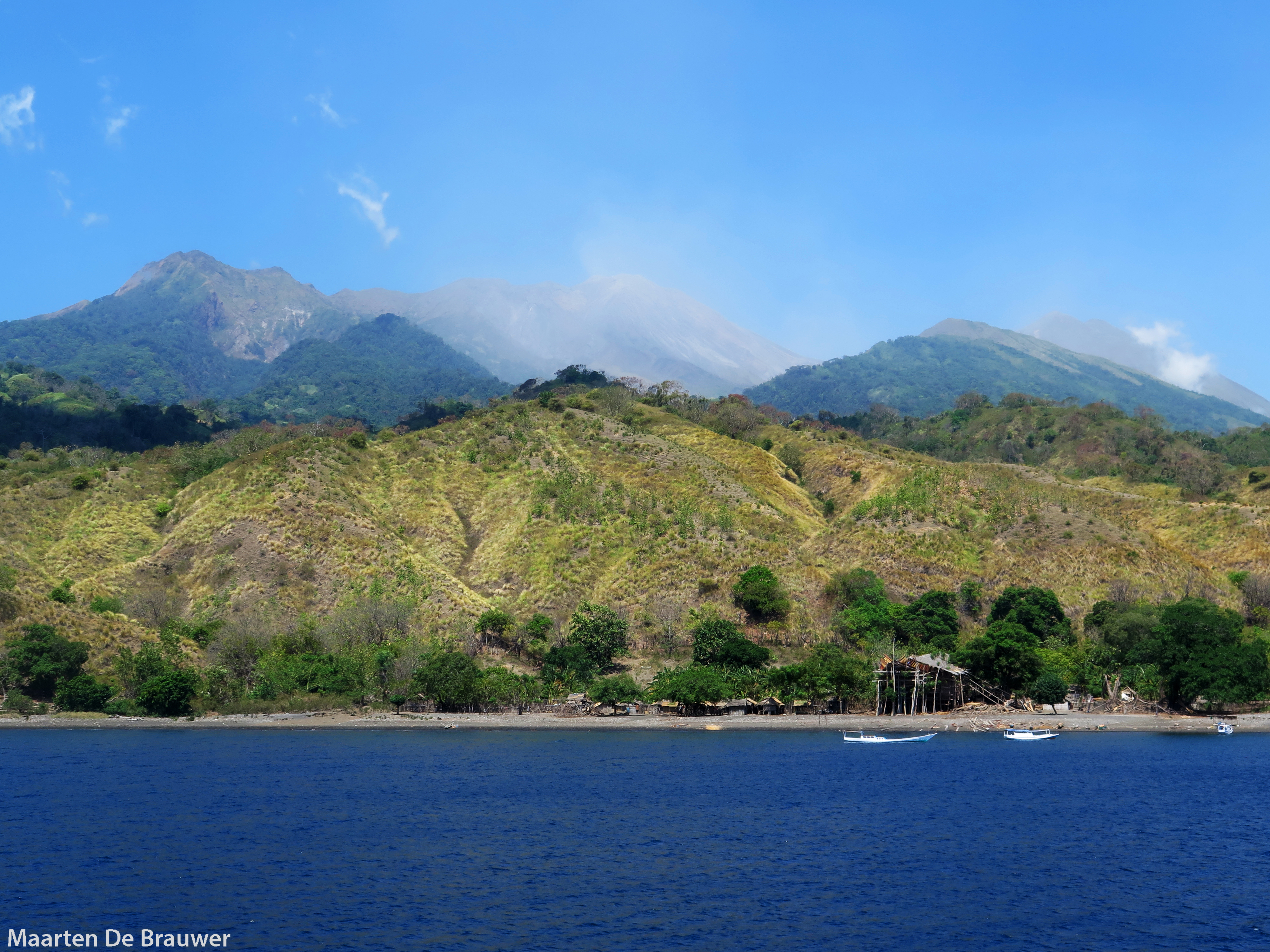
I am also using these trips to explore other sites in the area for critters. There are over 17000 islands in Indonesia and the best way to explore them is by boat. Some of the places we dived at along the way are absolutely beautiful and still pretty unexplored. One of my favourites was Sangeang, an active complex volcano (it has 2 cones) with 2 small villages on its slopes that specialise in traditional boat building. The dive sites around Sangeang are phenomenal; great muck diving, loads of critters, and mostly unexplored. Another gem (though better known) is the south of Komodo. The waters around Nusa Kode are cold (20°C) but very rich, it had some of the highest concentrations of anemonefishes I’ve seen in Asia. A night dive in the bay made it in my top 3 of best night dives ever, I won’t bore you with details, but if you like weird and wonderful critters it’s an absolute must!

Bontoh village, Sangeang volcano in the background

Bontoh village, Sangeang volcano in the background

Psychedelic nightdiving fun!

I have been doing quite a lot of night dives recently. Those who know me from when I was still working as a dive instructor might be a bit surprised by this, as I never use to be the biggest night dive enthusiast around. There are two reasons I’m swimming around in the dark a lot recently:

  1. Night diving in Lembeh Strait (and Indonesia in general) is pretty amazing
  2. I’ve been playing with a new toy that makes it all a bit more interesting: a high intensity blue light torch. This torch, combined with a yellow filter allows a diver to see “biofluorescence
Zombie Seahorse (Hippocampus histrix)

Thorny seahorse – zombie version

So as an excuse to post some very psychedelic photos, let me tell you a bit more about biofluorescence under water.

It is important to realise that biofluorescence is NOT the same as bioluminescence. The former needs an external light source (the sun, a dive torch,…), the latter means that the animal itself produces light. For more info on the differences, check out the site of the Luminescent labs.

Devil Scorpionfish

Devil Scorpionfish (Scorpaenopsis diabolus)

Biofluorescence under water has been described as early as 30 years ago and was first noted in corals and anemones. It has been used for years in coral research that looks at coral growth, diseases and bleaching. More recently however, people have started noticing that many more animals than just coral are fluorescent. A paper in 2008 described how many goby species show red fluorescence. Other publications have described fluorescence in many invertebrates such as mantis shrimps, crabs, worms, nudibranchs,… But I really got interested last year when a paper was published that described how fluorescence in fish was much more widespread than previously assumed. The reason it caught my attention is because it seems to be particularly common in “cryptically patterned species”, many of which happen to be the camouflaged little critters I’m so interested in.

Juvenile Whiptail (Pentapodus emeyrii)

Juvenile Whiptail (Pentapodus emeyrii)

Fluorescent nudibranch (Trapania scurra)

Fluorescent nudibranch (Trapania scurra)

So I got myself the necessary equipment and now I am trying to figure out what exactly fluoresces here in Lembeh, and maybe even getting a clue about why they fluoresce as well. There are a few theories out there: it could be used as a form of communication, it might be some sort of camouflage, it could even just be pure coincidence and we might be looking at a cool, but irrelevant quirky thing that evolved but serves no real purpose (I highly doubt this). Fish see the world differently than we do and many species can actually observe UV-light and fluorescence, which would lead me (and other researchers) to believe there is some function there. To prove these functions however, a lot more research and experiments are needed.

Shrimp trying to hide behind algae

Shrimp trying to hide behind algae

What matters most for this blog post, is that it looks rather amazing and that it shows a different, little known side of the underwater world. In case you were wondering, or doubting what you are seeing, none of the pictures in this post have been photoshopped beyond cropping and cleaning up some backscatter.

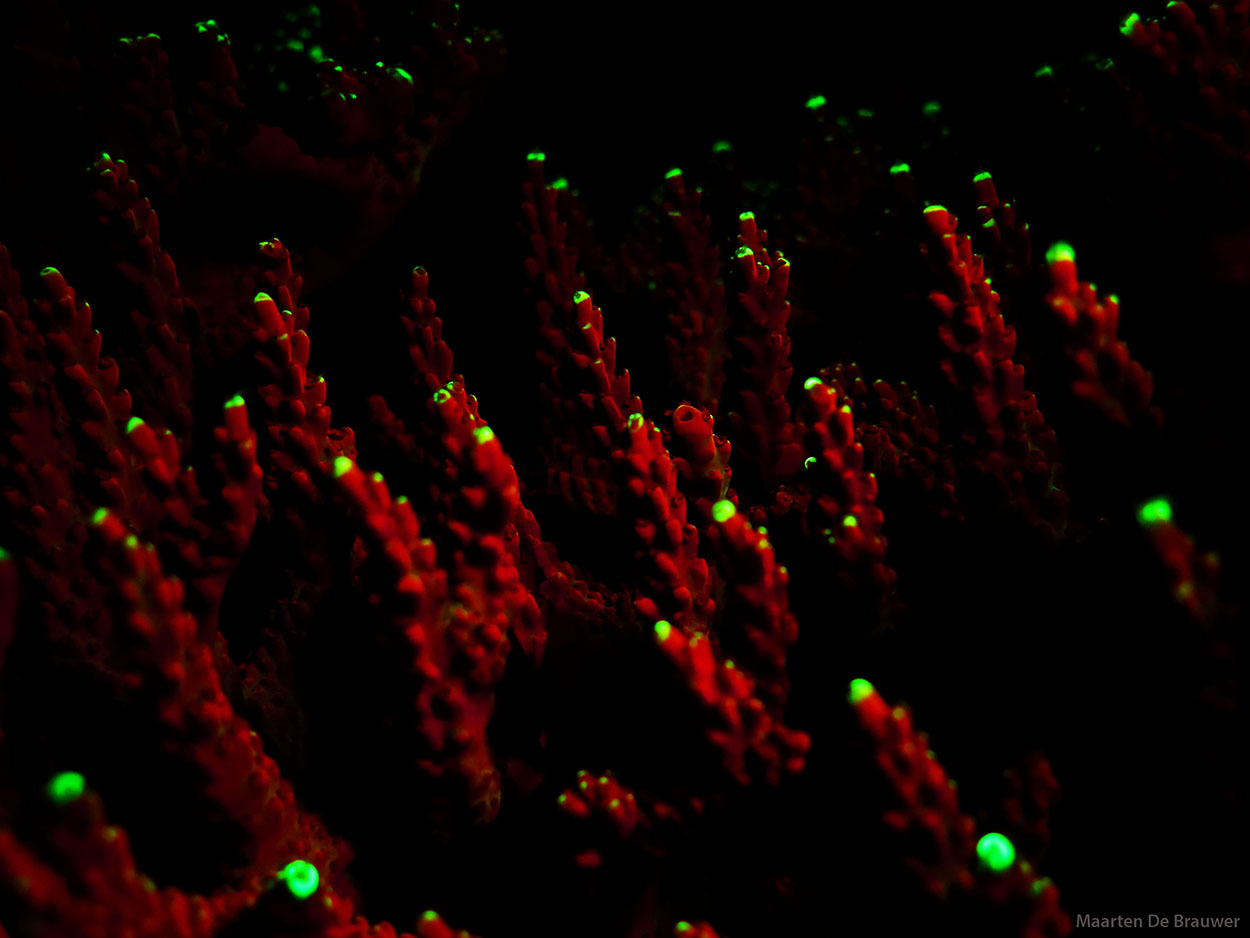
Acropora coral

Acropora coral

Copepod constellation

Copepod constellation

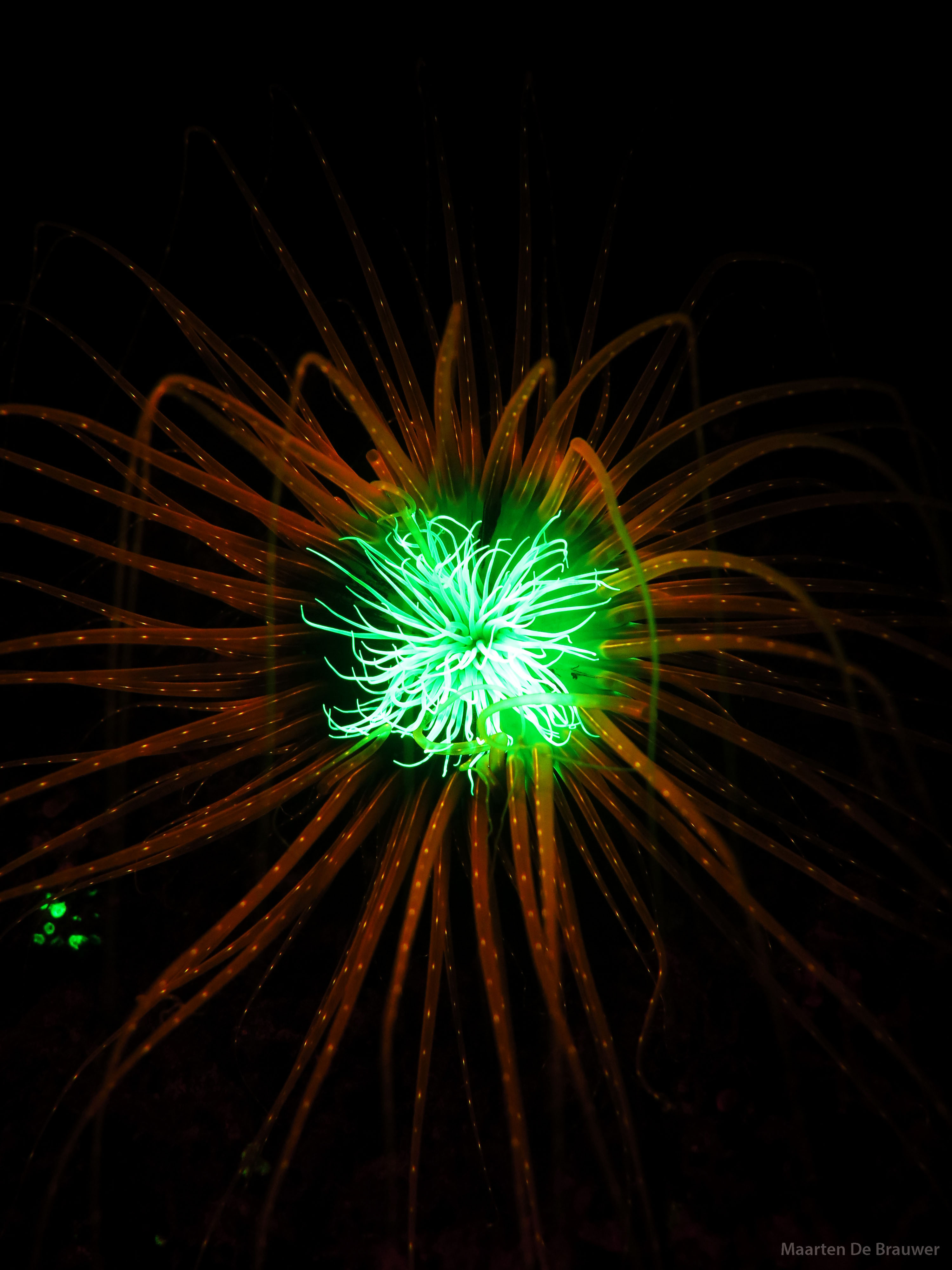
Tube anemone

Tube anemone

If you want to know more about how fluorescence works and how to take fluoro pictures yourself, this site is a good place to get started.

Thorny seahorse (Hippocampus histrix)

Thorny seahorse (Hippocampus histrix)

Stupidity in scientific research

I have found a good reason to call myself stupid without being ashamed for it! This essay written by Martin Schwartz is a very interesting read. Have a read if you’ve got a minute and want to feel better about not knowing everything.

A few quotes:

“Science makes me feel stupid too. It’s just that I’ve gotten used to it. So used to it, in fact, that I actively seek out new opportunities to feel stupid. I wouldn’t know what to do without that feeling. I even think it’s supposed to be this way.”

“One of the beautiful things about science is that it allows us to bumble along, getting it wrong time after time, and feel perfectly fine as long as we learn something each time.”

“The more comfortable we become with being stupid, the deeper we will wade into the unknown and the more likely we are to make big discoveries.”

Here is the link to the original essay, enjoy your read….