Who pays for science?

I frequently talk to divers who are very enthusiastic about marine life and want to learn more about their favourite critters. It often comes as a surprise to these critter-lovers that hardly any research is done on most of the animals they’ve just seen. There are quite a few reasons for this, but one of them is: Science is Bloody Expensive! There might be many people out there wanting to do research on your favourite fish, coral, bird, tree, … But more often than not, the reason they’re not doing that research is lack of money to pay for it. When I say paying for research, I mean paying for all research costs and those often run very high, very quickly.  

In my case, the most obvious cost might be fieldwork, but that includes more than just boat hire, accommodation and food. Fieldwork also means flights, visas, permits, insurance, specialised equipment, other transport costs,… Not just for me, but also for any volunteers or supervisors that come out to help. As much as I am passionate about what I do, I also need to live, so I need to be paid a salary. When I am not doing fieldwork, I need an office, desk, computer, specialised software, access to scientific journals, equipment to do analyses, etc. Again, I don’t work alone but get help from supervisors, administrative staff at the university, etc. all of which need to get paid as well. It’s not hard to see how this can get expensive, but even I was surprised to learn that the global cost for all research is estimated to be as high as 1 trillion dollar!!!

PhD Grant

So who pays for all of this? Where does the money come from to develop a cure for cancer, send people to space or let me look at weird fish? As you might expect, it’s complicated. A lot of it is funded by governments, so actually by yourself through paying taxes (Thanks!). Applied research such as engineering or chemistry is often partially funded by industry partners to find direct solutions to problems. Then there is a part of funding that comes through NGOs, rich benefactors, etc.

The next question is, who decides which research gets money? The most common way is through the process of scientific grants. The baseline of grants is: you write a proposal of the research you want to do, submit it to the agency who gives the grants (can be any of the funding bodies mentioned earlier) and they decide which project deserves the money most. As you might imagine, this process is VERY competitive and success rates tend to be relatively low. There are many different types of grants (lots of money, little bit of money, small projects, long-term projects,…) and in general a higher value means more competition and lower success rates. Having to apply for grants and the insecurity of continued funding is often cited as one of the most stressful things about scientific research.

Genie grantsIn case you were wondering, my research funding is a merry mix of all of the above. The biggest part is paid by a scholarship I got from Curtin University (so indirectly the Australian government). Most of my fieldwork  is funded through the lab  of my supervisors (which itself is funded by a variety of grants), or by in kind donations from the divecentres I do fieldwork with. Recently I was also awarded a grant from the Society of Conservation Biology. The grant I received was to assess the population status of pygmy seahorses in Bangka Island in North-Sulawesi, Indonesia. This island is under threat from mining, but turns out to be rather rich in pygmy seahorses. I am currently preparing a publication on this research, so I should be able to tell you more about it in the near future.

 

Video Interview: The science behind the critters

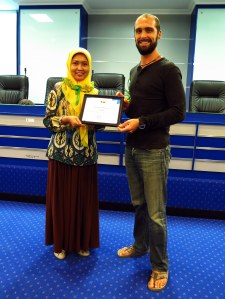
A few months ago the Department of Environment and Agriculture at Curtin University asked me if I wanted to do an interview to explain what my PhD is all about. Since I am part of that department and I love to share how amazing my weird critters are, I obviously said yes.

The underwater footage was taken by myself, Luke and one of my supervisors during fieldwork in Indonesia and Philippines last year. You can watch the video on the Environment and Agriculture website, or right here:

Guest lecture at Hasanuddin University

As I mentioned in an earlier post, my research in Indonesia would not be possible without the help of local counterparts. I work with some excellent people at Universitas Hasanuddin in Makassar, Sulawesi.

Banner

Last week I was invited to teach a lecture about the research I have been doing so far. The idea was to share ideas with local researchers and to suggest potential areas of research for students at the faculty of marine science and fisheries. I was honoured to get such an invitation. As a researcher you are often working on your little island (often literally in my case) and we sometimes forget that sharing knowledge should be the ultimate goal of doing your research.

FrameI feel this is even more important when working in countries like Indonesia. Places which are rich in biodiversity and natural resources, but often lack the infrastructure and resources to protect it in a way that benefits the local people. Over the last years I have met many very motivated and talented researchers, but all too often they do not have the resources to reach their full potential. Things that seem simple for those of us fortunate enough to be based in a first world country often are complicated for those who don’t. Whether it’s attending international conferences to stay up to date with what is new and network with other researchers, buying good quality equipment to do your research or writing scientific papers in a language that is very different to your own…

To me it seems logical to try and work with researchers and give something back for letting me do my work in their home country. Too often researchers or big international companies come in, do their thing (and in some cases make a huge profit out of it) without giving something back. “Bioprospecting“, the search for natural products or compounds to use and commercialise is becoming more common and is an important source of new medicines (among others). However, sometimes this turns into biopiracy, when compounds are taken without permission or without compensation. Which is why there is such a thing as the Convention on Biological Diversity and the newly ratified Nagoya Protocol. It is also one of the main reasons why the process of obtaining research permits in Indonesia is rather…complicated.

Group photo.jpg

So I talked about my research and why I think it is important and very exciting. I also talked about some of the new things I found out (hopefully more about that in the near future) and about some of the ideas I have for new areas of research. Hopefully this was the start of more future collaborations with researchers and students in Hasanuddin. The little critters I’m studying can definitely do with some more research attention!

I’d also like to use this blog to say a big thank you to the people at Unhas who invited me (ibu Rohani and pak Jamaluddin) and to the people who showed up for my little talk. It was a great experience for me and I hope it won’t be the last time I visit.


Little known facts about seahorses

I have been reading up about seahorses recently and discovered some interesting little bits of information I could not help but share. While seahorses seem to be a big favourite for divers and non-divers alike, we actually know surprisingly little about them. Some of their strange quirks are well known. The fact that the males get pregnant is probably one of the favourite and most retold bits of knowledge about them. I want to go a bit further and more interesting than that, so let’s get started.

seahorse-head-bones

The fused jaw of a seahorse (Source)

Seahorses belong to the family of Sygnathidae, which  translates as “fused jaws”. What this means is that all seahorses and pipefishes have jaws that are stuck together, they can’t open them anymore. So if you were to imagine eating like a seahorse, try gobbling up your salad, steak, pizza, apple,… with clenched jaws, while only using your lips to help you suck the food in. A good thing seahorses do not have teeth, as that would make it even more difficult!

Best of Dauin_Seahorse Estuary_MDB

Hippocampus taenopterus, getting ready to growl

Another quirky thing seahorses do, is that they make noise. They make two distinct types of sounds: “clicking” and “growling”. I absolutely love the idea of a growling seahorse! It seems they do this when they are stressed out and it might even be some sort of escape mechanism to startle predators. Most likely because those predators would be laughing too hard because a seahorse just growled at them… The clicking sounds are mostly used during courtship and mating, so not only do seahorses growl to chase away predators, they also serenade their partners to get them in the right mood. Strange little critters indeed.

To keep up with the strangeness, have you ever wondered how strange the tail of a seahorse actually is? Probably not, I definitely hadn’t before reading this article.  The tails of most animals are round, but nearly all seahorses have square tails. As it turns out, this square shape is better at grasping and holding items. At the same time it offers a higher resistance to crushing than a round tail would. So perfect for a camouflaged critter which spends most of its time clinging on to objects, pretending to be something it is not to avoid getting eaten by predators.

Seahorse tails

Different 3D printed models of seahorse tails (Source)

Best of Dauin_Seahorse thorny_MDB

Hippocampus histrix

The objects seahorses hold onto can be anything, usually they cling on to objects like seagrass, algae, gorgonian seafans, etc. But they do not seem to be very picky at all. This article showed how seahorses living in areas with a lot of plastic actually use that plastic as camouflage. The seahorses even changed their colour to resemble the colour of the plastic and the spots on it. Unfortunately I cannot put the original pictures online due to copyright issues, so if you want to see them, follow this link. Since seahorses don’t really mind what they hold on to, artificial structures can be used to provide habitat for them when their natural habitat has been destroyed. This way populations can continue to exist until the natural vegetation has recovered.

Loss of habitat is one of the risks that endanger seahorses, the trade for traditional Chinese medicine is another big threat to them. IUCN has listed 7 species as Vulnerable and one species as Endangered, but most species have either not been assessed or we lack the data to assess whether or not they are endangered. To combat the illegal trade and offer some means of protection, all seahorses are listed with CITES, which means trading them is strictly controlled. One of the simple rules used to do this, is a size limit of 10cm. This size ensures that most traded seahorse species are mature individuals who can reproduce and that juveniles are left alone.

Hpontohi_MDB

Hippocampus pontohi

The fact that we don’t really know how many species of seahorses exist, makes protecting them hard. Estimates of the number of seahorse species range from 40 to 48 species. It is quite likely new species are still waiting to be discovered, though the opposite might happen as well. Two species of pygmy seahorses (Hippocampus severnsi and Hippocampus pontohi) were described in 2008. But recent genetic analyses showed that they are actually the same species which comes in different colour variations.


If you want to know more about seahorses or just have a good laugh, check out this great video from Ze Frank with some more true facts about seahorses.