Time for something new

I never liked going to school. Not as a kid, not as a teenager, and not even as a young adult. Maybe I just disliked being bored so often? Even in the classes I was interested in, I felt that just absorbing all the knowledge in world was not exciting. My impression was that science already knew everything and that new discoveries were pretty much impossible. That science had somehow “stopped”.

Well, let me tell you one thing, it most definitely has not! I was not learning “all the knowledge in the world”, in fact LOTS of new things are discovered all the time! Since this blog is about ocean critters, let’s look at some of the critters that have recently been discovered. In the last year alone, new seahorses, frogfishes, gobies, jawfishes, and many other species have been discovered. So if you thought you’d seen it all, think again 😉

Seahorses and relatives

A new species of pygmy seahorse was described 3 months ago by Graham Short and colleagues. This ridiculously cute little seahorse lives in Japan and is called Hippocampus japapigu (=Japanese pig seahorse). These little wonders are less than 2cm in size and have a wonderful honeycomb colour pattern. Unlike some other pygmy seahorses, the Japanese pygmy seahorse does not live in seafans, instead it can be found in hydroids, algae, or soft corals.

01-og-pygmy-seahorse-figure_3_hippocampus_japapigu_in_life-2.adapt.676.1

The newly describe Japanese pygmy seahorse (Hippocampus japapigu). Photo: Richard Smith

Even more recently, less than a month ago, another new pygmy seahorse species was discovered in South Africa. The first ever pygmy seahorse in South Africa! Dive operators in the Sodwana Bay region had found this small seahorse and asked pygmy seahorse expert Richard Smith about it. Together with IUCN seahorse expert Louw Claassens he went for an expedition and has confirmed the new species. It has not got a name just yet, but should be officially described sometime next year.

During the same expedition, Richard and Louw also found a new species of pygmy pipehorse! You might have never heard of pipehorses, but they are just fantastic. Sort of like a seahorse that disguised itself as a pipefish, or maybe the other way around?

SA pipehorse

A newly discovered, still unnamed pygmy pipehorse from South Africa. Photo: Richard Smith

Frogfish

Big news from Australia as well! A new frogfish species was described in the journal Copeia this week. The Narungga frogfish (Histiophryne narungga) is found in South and West Australia, and was named after the indigenous people living in the area. The beautiful new frogfish lives mostly in shallow water, where it does what frogfishes does best: mimicking sponges or other benthic organisms, hoping to catch unsuspecting prey that swims by. This small (less than 10cm), new frogfish is very much on my “critters to see before I leave Australia”-wish list!

H narungga

Narungga frogfish (Histiophryne narungga): A new Australian frogfish species. Photo: Rudie Kuiter

The researchers describing the Narungga frogfish, Rachel Arnold and Theodore Pietsch, are pretty much the rock stars of the frogfish world. Together they have described 9 new frogfish species in the last 10 years, the most famous of which is the Psychedelic frogfish!

Gobies

I’ll be honest, for someone who studies cryptobenthic fishes, I don’t know nearly enough about gobies. Luckily, other researcher do know a lot about gobies and they seem to be good at finding new species as well. This year a new species was discovered from the west Pacific Ocean. The polkadot dwarf goby (Eviota maculosa) lives in Indonesia, Australia and Pohnpei. Its small size, less than 2cm, probably explains why it has taken researchers so long to realise this was an undescribed species.
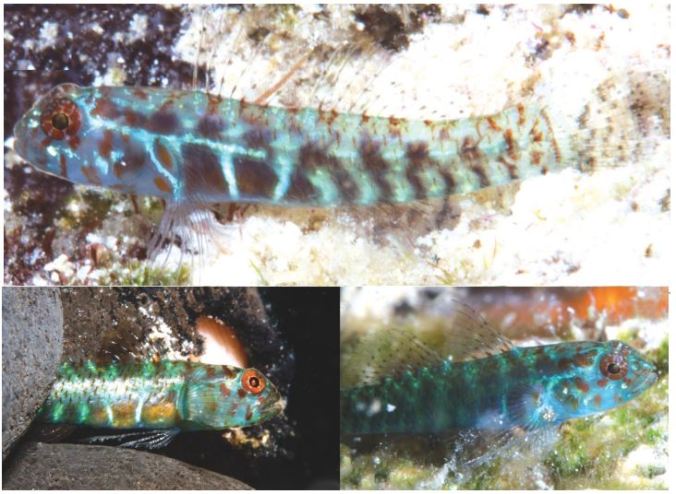
Eviota maculosa

Eviota maculosa, a new goby species from the west Pacific. Photo Mark Erdmann

Jawfishes

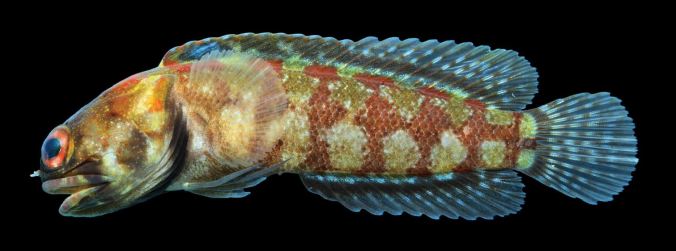
If you are not a keen muck diver or underwater photographer, you can be forgiven for not knowing about jawfishes. These cryptic fish live in holes in the sand and don’t venture out very often. Most notably, they are “mouthbrooders“, fish that hatch their eggs in their mouths. This week, two new jawfishes were described from Brazil. Thiony’s jawfish (Opistognathus thionyi) and the Brazilian dusky jawfish (Opistognathus vicinus) both seem to be endemic to Brazil, meaning they do not occur anywhere else. Thiony’s jawfish seems to live deeper than the Brazilian dusky jawfish, but otherwise, not much else is known about these new species.
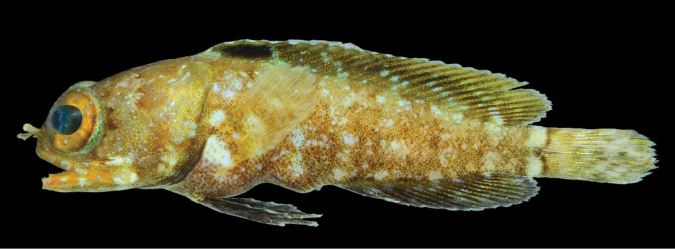
O thionyi

Thiony’s jawfish (Opistognathus thionyi) from Brazil. Photo: Raphael M. Macieira
O vicinus

Brazilian dusky jawfish (Opistognathus vicinus) from Brazil. Photo: Raphael M. Macieira

This list of new critters is by no means complete. Many more species have been recently discovered, and many more will be discovered in the future. I find it very exciting that science isn’t ready yet and that there is so much more of the amazing natural world left to discover. If that doesn’t make you want to become a scientist, I don’t know what will… (We often have cookies in the office if that’s more your thing?)

Finding the Knysna Seahorse: Mini-blog 6

I feel like I only just arrived in South Africa to look for endangered seahorses, but instead I am flying to Johannesburg where I will catch a connecting flight to Perth. This trip was no different than other fieldwork trips in that regard: what looks like a long time of sampling at the planning stage just flies by before you know it.

Louw and me have been busy since the last mini-blog. Most importantly, we successfully finished sampling! The last locations were less explored areas than the first ones, which is very exciting. Even if we do not find seahorses in these spots, they give inspiration to come back for new research projects.

IMG_1921

Cormorant in Jongensfontein

After wrapping up the sampling we visited Stellenbosch University. The university is the home to the von der Heyden Lab, which specialises on genetic research for conservation and biodiversity planning. They also have an eDNA project which investigates fish diversity in South Africa. During our visit I gave a talk about my own research to the marine students in the university. It was great to share my love for strange critters, especially since the students had some very relevant questions at the end of the talk. As much as I enjoy talking (or writing) about my research, it’s even more fun to have a conversation about it and getting a fresh look through someone else’s eyes.

IMG_2043q

South African penguins (Spheniscus demersus) taking a stroll

In the last two days of the trip we relaxed, caught up with friends, and explored Cape Town and False Bay. The highlights were definitely diving in the kelp forests of Simonstown and visiting the nearby African penguin (Spheniscus demersus) colony. While I have dived in cold water before, I never had the pleasure of seeing this particular ecosystem. If you ever have the opportunity, I can highly recommend it!

IMG_2164

Kelp diving

If a coral reef dive is like swimming through an underwater flower garden, kelp diving would be the equivalent of walking through a forest. There’s something very special about weaving your way through underwater plants that reach from he bottom all the way to the surface. The sunlight is filtered and the canopy above creates shadows you just do not get in other kinds of diving. On top of that, the bottom is very rich with all kinds of life. There are plenty of invertebrates like sea urchins, featherstars and nudibranchs. The fish life is very different than what I am used to, the small pufadder shysharks (Haploblepharus edwardsii) only live in South Africa area and are the cutest little things. To top it off, two southern right whales passe by close to shore as we were exiting the water. Louw even managed to snorkel out and catch a glimpse of them!

I guess it’s safe to say that this trip has been a successful one. It will be another few months before we will have all the results, but I am very excited to discover in which places we found the elusive Knysna seahorse!

IMG_2134

Not a bad spot for a dive…


Finding the Knysna Seahorse: Mini-blog 5

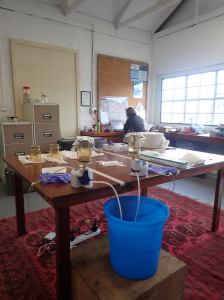
It’s already been a week since I arrived in South Africa to study the endangered Knysna seahorse with Dr. Louw Claassens from the Knysna Basin Project. Together we are testing if environmental DNA (eDNA) can be used to find rare seahorses and pipefishes.

38875489_206756850187960_5584208399702163456_n

eDNA filtering in progress

To do this, we have been travelling along the southern coast of South Africa, taking water samples along the way in estuaries where our focal species lives, where it used to live, or where it might live. Yesterday we left Knysna to sample water in Klein Brak and Groot Brak. We are especially interested in the Klein Brak estuary, since there are multiple anecdotes that the Knysna seahorse (Hippocampus capensis) used to live here. Nobody has checked recently if it really was the Knysna seahorses and it seems that the most recent sighting has been many years ago. Because of this, it is usually assumed that there are no more Knysna seahorses in Klein Brak.

This brings me to a very important (maybe the most important?) question about this whole endeavour: WHY are we actually doing this? It’s all good an well to say that we want to help these endangered animals, but what exactly are we hoping to achieve? What will our results mean for managing the endangered Knysna seahorse, the critically endangered Estuarine pipefish, or any other endangered small fish for that matter?

IMG_1835

Knysna estuary, just imagine all the seahorses down there!

What we are hoping to achieve can be summarised in three main points.

  1. We want to test if the eDNA method can really be used to find small, endangered fishes (particularly seahorses and their relatives). So far, previous research has shown that eDNA work on large fishes such as sawfish, but it is not sure yet if this will work for seahorses, which are obviously much smaller.
  2. The best case scenario would be that we could also find seahorses in estuaries where it was thought to have disappeared. This would be great news for the conservation status for the species, as it would mean that it occurs in a wider area than we thought, which would mean that it is less likely to go extinct.
  3. If this would happen, it would mean two things. First of all, the new locations would have to be studied, so we can find out how many live in these estuaries. It would also mean that those new places need extra protection and monitoring to ensure the species do not disappear from their newly discovered homes.

Ultimately, if the eDNA method works for small, endangered seahorses (or their relatives), it could be used to monitor small fishes worldwide. This would help solving one of the biggest problems with studying small species, especially those that are rare or hard to find.

LouwKnysna (1)

Louw looking for Knysna seahorses in the Thesen Island Marina (she found 3!)

Finding the Knysna Seahorse: Mini-blog 4

We are 5 days into sampling environmental DNA of the Knysna seahorse (Hippocampus capensis) and I continue to be impressed by the landscapes and nature of South Africa. After sampling at the southern Eastern Cape we traveled to the Knysna estuary in the Western Cape. We not only collected water samples along our way, but also passed through a national park to get a look at some of the wildlife.

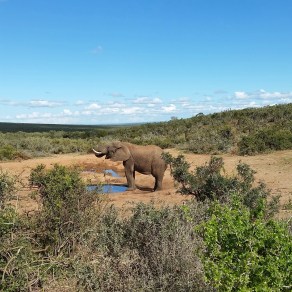
ElephantAnd oh my, how lovely that was. I might be a marine scientist, but seeing the impressive wildlife here is pretty amazing as well. Obviously seeing elephants, zebras, lions and all the other cool animals roaming around is awesome, but there is so much more than that. There’s all the different kinds of gazelles, the warthogs (might be a personal favourite) and the very diverse birdlife. Unfortunately there won’t be enough time this trip to really experience it all, so I will just have to come back!
The focus of the trip is still very much on the endangered Knysna seahorse.  But what does it mean when we say that an animal is endangered? And why are the Knysna seahorse and the estuarine pipefish endangered?

The easiest way to explain what “Endangered” means, is that an animal or plant has a high chance of becoming extinct in the near future. This can be caused by directly killing the animals/plants, such as overfishing or hunting (think rhinos and the ivory trade), but also by more indirect threats. For example: if you cut down the rainforest, the animals that need the forest to live in will disappear as well, even if you do not kill the animal directly.

20180811_075851

Swartvlei estuary

In the case of the two species we are working on, two big factors are responsible for their high extinction risk. Both the Knysna seahorse and the Estuarine pipefish only occur in a very, very small area of the world. The seahorse only lives in 3 estuaries and the pipefish in 4 estuaries in the southern tip of South Africa. They do not live in the ocean or the rivers, but only in the small area of mix salt and fresh water where the rivers go into the ocean.

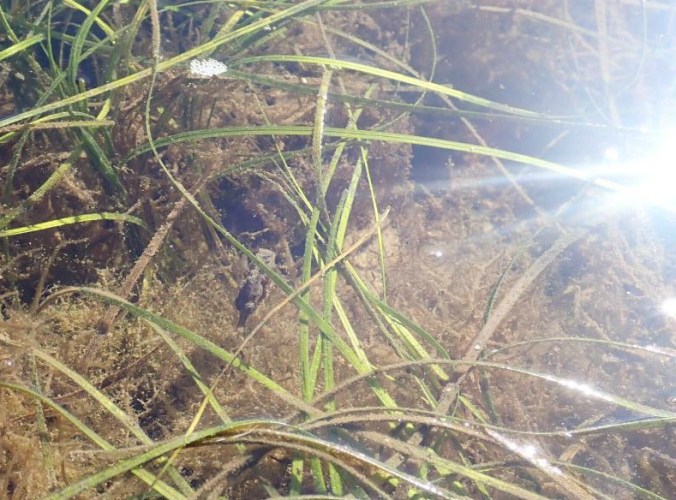
The other big factor is that both species only live in a particular habitat. That is, they don’t just live anywhere in those estuaries, that would be too easy! No no, the species we study aren’t happy anywhere else than in areas where there is enough seagrass. So even though there might be a lot of space in the estuaries they live, they only live in a very small area in that space.

Seahorse

Can you spot the Knysna seahorse (Hippocampus capensis) in the seagrass?

What this means is that small changes to the seagrass can have a very big effect on the seahorses or pipefishes. As you may or may not know, seagrass is disappearing all over the world, including South Africa. Some of the most important causes are poor water quality, coastal development, and climate change (Here is a great site for more info on threats to seagrass meadows).

For our two species, even a small, localised decrease of seagrass means they can go extinct in those estuaries where the seagrass is affected. The estuarine pipefish has in fact already disappeared from two estuaries where it used to live. This might also already have happened to the Knysna seahorse, but there is very little information about where it used to live and where it lives now, so it is hard to be certain about this.

Hopefully our work will help to protect these beautiful, but vulnerable animals. How the results of our research might help is for one of the next mini-blogs.

Sampling

Early morning water sampling