Keeping seahorses

The last two months I have been running an experiment that involves keeping more than 30 seahorses in aquaria. Not because I am trying to become a marine aquarium expert or because I like seeing fish in tanks. On a personal level I think there are too many environmental issues with aquarium trade to get into it myself. Overfishing of species like Banggai Cardinalfish and Mandarinfish are two examples that come to mind. But this post is not about the aquarium trade, so I will leave those particular issues for another time. While I prefer seeing seahorses in the ocean, for this experiment it was necessary to bring them to the “Curtin Aquatic Research Laboratories” (CARL). This blog explains some of the challenges that come with keeping seahorses healthy in an aquarium. If you are considering ever keeping seahorses yourself, please read this blog carefully.

14808071_10154728145537608_910910029_o

West Australian Seahorses (Hippocampus subelongatus) in their artificial seagrass home

DISCLAIMER: This blog describes scientific research, catching seahorses as a private person is NOT allowed in Australia. If you have any questions about keeping seahorses, feel free to contact me in the comments section.

First challenge: Permits. It takes a lots of paperwork to be allowed to do research on seahorses in captivity. Seahorses are on Appendix II of CITES (Convention for International Trade in Endangered Species), which means they cannot be traded internationally if they are smaller than 10cm. But it does not mean that seahorses cannot be fished. As a matter of fact, they are caught in their millions for traditional Chinese medicine! For this experiment it was crucial to use wild-caught West Australian seahorses (Hippocampus subelongatus), which meant applying for permits from the Department of Fisheries and seeking approval from the Department of Parks And Wildlife. Besides government paperwork, doing any kind of research with animals means writing up extensive application (close to 40 pages) for the universities’ ethics committee to ensure proper treatment of the animals while in my care.
seahorse_tank

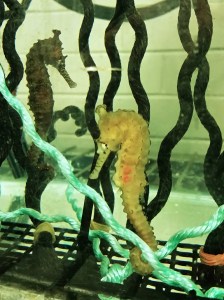
Seahorse tag with red elastomer so it can be identified later

Second challenge: Catching seahorses. As anyone who has ever looked for seahorses can attest to, they are hard to find. There are a few sites around Perth where there are plenty of seahorses to be found, but getting all seahorses from one location would have a huge impact on that particular site. To limit the impact of my collecting, I spread out my fish-catching over multiple sites. To further reduce impact, I did not take any pregnant males or any seahorses that were clearly couples ready to mate. Since I needed a variety of sizes and a similar amount of males and females, collecting enough seahorses took a lot of dives spread out over a few weeks. Once seahorses were caught, they also needed to be transported safely to our facility, which meant not going too far, and using specialised tools to  (sturdy catch bags, coolers, oxygen, etc.) to reduce stress for the animals during transport.

Third challenge: High quality aquaria. Seahorses  are notoriously difficult to keep in tanks. They are very sensitive to bad water quality, which can lead to all kinds of issues. Preparing the aquaria started 6 weeks ahead of catching the seahorses. This is  done to ensure that the biofilters that ensure good water quality get properly established. The tanks themselves need to be large and high enough to house seahorses, and they need hold-fasts that mimic seagrass so the seahorses have something to cling on to.

img_7536

First arrivals in the tanks

Seahorses live in salt water, so getting seawater is another issue. Our labs are not directly by the ocean, so we need to import seawater. This then gets sterilised (using UV filters) before we use it. Water quality needs to be monitored daily and adjustments made where needed. This means no weekends off since minor problems could mean dead seahorses. While we have the aquaria and equipment available at CARL, the costs of this would be considerable for a private person.

Fourth challenge: Food. This is probably the biggest challenge of them all. Wild-caught seahorses only eat live food and will not eat dry or frozen fish food. So we need small shrimp to feed them. In our case we are using artemia (= sea monkeys = brine shrimp). Artemia are tiny (less than 1mm) when they hatch, but our seahorses will only eat them when they are about 1cm in size, which means  they have to be grown out for a few weeks before feeding. So we prepared 3 different artemia cultures, each one set up 2 weeks apart to ensure a constant supply of right-sized food. The artemia also need to be fed, in their case with algae. This means 5 cultures of different species of algae to make sure our seahorse-food stayed healthy and fat. Both algae and artemia water quality also need to be monitored, since dead algae/artemia would ultimately mean starving seahorses. To top it off, artemia are not naturally nutritious enough to be the only food source for seahorses. So we added an artemia enrichment-tank (where we add a fatty mix of all nutrients needed for healthy seahorses), which needs to be set up, cleaned, and harvested every day.  The result is that for 3 tanks with seahorses, we have 9 tanks for their food preparation. I’m not sure if you have enough space for that at home?

Fifth challenge: Feeding. As if breeding the food was not hard enough already, feeding them makes it even more complicated. Seahorses have no real stomach to speak of, so they are lousy at digesting their food properly. Because of this they need to eat almost constantly, which is possible in the wild, but harder in an aquarium where too much food will lead to bad water quality. In our case it means feeding them three times per day, every day (bye bye weekends or late nights!). Since our guys have been caught so recently, we can’t just drop the food in the tank and leave it. What works best is hand feeding them with a pipette to make sure they see the food and eat it. Each feeding session takes about 30 minutes, with longer sessions (90 minutes) in the morning, since food has to be harvested first and then a new culture prepared for the next day.

14786903_10154728145307608_1893594246_o

Feeding the seahorses using a pippette

Sixth challenge: Keeping them healthy. Seahorses kept in aquaria are prone to infections, so besides good water quality  it is important to keep everything clean. This means sterilizing all the equipment we use, only handling seahorses with surgical gloves on, keeping workspaces clean, etc. Regardless of this, infections can still happen. So far I have had to treat one infection with freshwater baths. Earlier this week two males had bubbles in their pouch (common in tank-kept seahorses), which needed to be removed using syringes and gentle pouch-massaging. You read that correctly, my PhD involves giving belly-rubs to seahorses.

All of this is needed just to keep our seahorses alive. I won’t go into what it means to actually run the experiments as well. But if you managed to read this entire post, it should be clear that keeping seahorses means a LOT of work. I am only able to do this because I can use the great facilities at Curtin University and because I have the support of experienced lab technicians, dedicated volunteers, and supervisors with experience in aquaculture. After 2 months of caring for my seahorses, I feel even more strongly than before that seahorses should be in the ocean and not in a small aquarium. If you do want to keep them yourself, think it through before you begin. Make sure you have the right setup BEFORE buying seahorses, only buy captive bred animals and be prepared to sacrifice a lot of your free time for your seahorses.

To finish, here is a short video of one of our seahorses eating artemia:



Cleaning mutualism on the reef: It’s a Hip-Hop World!

simon3

Dr. Simon Gingins

This month’s guestblog is by Dr. Simon Gingins, who currently does research on damselfish at the department of Collective Behaviour in the Max Planck Institute, in Konstanz (Germany). Simon and I met a few years ago at the Lizard Island Research Station, where he was doing research on the behaviour of cleaner wrasses. His blog describes some of his cleaner wrasse research….and hiphop. Besides being a good researcher, Simon is also a great photographer, so make sure to have a look at his site.


cleaner_anthias

An anthias gets cleaned by a bluestreak cleaner wrasse

I know this is old school, but do you remember Eminem’s song Lose yourself? Well, to my big surprise, I recently realized that the lyrics fit very well with the ecology of cleaners. Let me show you by quoting the relevant parts of this song throughout the text. But first, let me start with the beginning. What is cleaning? Cleaning is a behaviour that implies the removal of parasites or dead tissues off another animal. It is widespread, particularly on coral reefs. Many species engage in cleaning, including shrimps and crabs, but it is mostly performed by fishes, as diverse as surgeonfishes, triggerfishes, jacks, butterflyfishes, gobies, and many more. Most fishes only clean occasionally, mainly as juveniles, and get most of their food by other means. However, a handful of species are “professional cleaners” and get all of their food through cleaning. Here, I will focus on the most studied of these species, the bluestreak cleaner wrasse Labroides dimidiatus. This species can have more than 2000 cleaning sessions per day, and client fishes actively visit their territories, called “cleaning stations”. They also give massages by vibrating their pectoral fins on the body of their clients, which was shown to decrease cortisol levels in client fishes. Cortisol is a proxy to measure stress, and thus this additional service is beneficial for clients as is calms them down.

So the cleaner gets a meal and the client gets its nasty parasites removed and a massage. Sound like everybody’s happy, no? Well, the situation actually gets more complicated because the cleaner wrasse prefers to bite client fishes and get a mouthful of yummy mucus, rather than focus on the parasites. Biting client fishes is cheating, but mucus appears to be like crack for cleaners. Or as Eminem puts it:

If you had, one shot, or one opportunity,
To seize everything you ever wanted. In one moment.
Would you capture it? or just let it slip?”

Well, it depends, because of course client fishes don’t visit cleaners to be exploited, and they’re not really happy when they get cheated. So how do clients respond to cheating cleaners? Imagine a client fish with a large territory. Large enough that it has access to many cleaning stations.

“He’s known as the globetrotter”

If it’s not happy with the service of one cleaner, it can just leave and look for another one. Basically, it can play the competition.

 “They moved on to the next schmoe”

This is what my ex-supervisor Redouan Bshary referred to as “big city life”: If you’re not happy with your hairdresser, just go to another one. But some client species don’t have choice options. The size of their territory is more like a village than a big city, and these fishes often have access to only one cleaning station, if any. Cleaners appear to be aware of these differences, and give priority and a better service to big city clients than to villagers. But the villagers still have one trick up their sleeve to make cleaners more cooperative: they punish. When they get cheated, they often chase the cleaner and try to bite it:

“No more games, I’m a change what you call rage”

And it was shown that the next time they meet, the cleaner will be more cooperative with the individual that punished it.

cleaner_grouper

Bluestreak  cleaner wrasses cleaning a grouper

Finally, there is one category of clients with whom cleaners behave very, very nicely: predators. A predator striking at a cleaner during a cleaning interaction has never been witnessed so far. Nevertheless, it’s pretty obvious why cheating a predator might not turn out to be a good idea. To quote Eminem again, in interactions with predators:

“Success is my only m*********ing option, failure’s not!”

In summary, when a cleaner is interacting with a client, eating its preferred food has negative consequences. The client might just leave, but it might also try to punish it, or even potentially eat it. Cleaners thus came up with very strategic behaviours in order to determine who they can cheat, and when it’s best to cheat.

“I’ve got to formulate a plot or I end up in jail or shot”

As already mentioned, they vary the quality of the service they provide according to the category of clients. But it doesn’t stop there, they also adjust their behaviour depending on whether they are being observed by potential clients or not. If a client waiting to be inspected witnesses the cleaner cheating other clients, it might decide to leave and search for a more cooperative partner.

“His hoes don’t want him no more, he’s cold product”

As a result, cleaners behave more cooperatively in the presence of an audience. This ability is quite surprising for such a small fish, since thus far the only evidence that the presence of an audience increased cooperation came from humans. While humans benefit from the computing power of a large brain to take decisions, it appears that the cleaner wrasse L. dimidiatus managed to acquire quite sophisticated behaviours without a large brain. Recent evidence suggests that their exceptional performance might be limited to situations linked to cleaning, and fall short outside of their domain of expertise. It seems that the highly social nature of cleaners and the conflicts associated with it drove cleaners to acquire the skills to deal with these specific situations. But it did not select for increased brain size or some kind of general intelligence. So the next time you go on the reef, I invite you to take some time to observe cleaners and to imagine what it’s like to deal with all these clients coming and going.

“This is my life and these times are so hard”

I’d like to conclude by pointing out that for a guy who claims to have read only one book in his entire life, Eminem proved to have great insights when it comes to cooperative behaviour in fishes. And from what he confesses in another song (Without me), he considers himself an important contributor to fish conservation too:

“No matter how many fish in the sea it’d be so empty without me”

Dr. Simon Gingins

simon2

Simon during fieldwork

Postdoctoral Fellow

Department of Collective Behaviour

Max Planck Institute

Twitter: @SimonGingins

Email: simongingins@hotmail.com

New publication: Fluo frogfish lures

After a weekend looking for vagrant fish in the cold waters of Shark Bay (more about that later this week), I came home to find a pleasant email in my inbox. A new publication has been published online last week. This one is in the journal “Coral Reefs” and is about biofluorescence in the Striated Frogfish (Antennarius striatus), more commonly known as the Hairy Frogfish. The article can be found here, but is restricted access. For those of you who cannot access it, here is what it is about.

IMG_0766

Hairy Frogfish by day. Photo: Luke Gordon


As I have written previously, I have been doing a fair bit of work looking at biofluorescence in fishes. During these surveys i had noticed something strange going on with the Hairy Frogfish: their bodies are not fluorescent, but their lure is (very strongly). As you might know, frogfish use their lure as a fishing rod, attracting small fish closer, which are then eaten whole. The fact that the Hairy Frogfish’s lure alone is fluorescent but their bodies are not, hints at the possibility that this fluorescence could be used in what is called “aggressive mimicry”. Aggressive mimicry is the term used for animals who pretend to be something harmless (the “model”) and use that to get close enough to eat their prey.

FluoLure_MDB_small

Hairy Frogfish (Antennarius striatus) with fluorescent orange lure

But the question was, what would it be trying to mimic? Are there animals out there that resemble this fluorescent lure? Cue my last Philippines trip. During a nightdive with the unparalleled science hobbit, we found three more Hairy Frogfish (with fluo orange lures). More importantly, we also found a lot of freeswimming worms near them. Most of them a similar size as the lure of the frogfish, AND the same colour fluorescence as those lures. The resemblance between the lures and the worms went further than just size, shape and movement, but also the fluorescence is imitated. We found our model species!

Lure_and_Worm

Fluorescent worm (top orange squiggle) and fluorescent lure (bottom orange squiggle)

This is very exciting, as it is the first time anyone found strong indications that biofluorescence might be used to help fish catch prey. To prove whether it is really used to hunt, lab experiments or extensive observations would need to be done to check if this fluorescence really makes a difference. So while this is a very exciting glimpse into an unexplored part of hunting strategies in the ocean, much more work needs to be done to understand all the details.

If you can’t access the article but want to read it, or you just want to know more, send me an email or ask in comments and I can send the publication to you.

Coral Reef Conference in Hawaii

The International Coral Reef Symposium (ICRS) in Hawaii has come to an end. While I am using the opportunity to explore more of Hawaii, I figured it could be interesting to share some of the highlights. ICRS is a huge conference held once every 4 years, with about 2500 marine biologist gathering together for 5 days of presentations, workshops, poster sessions, networking and socializing. To give you an idea of just how much research was being presented: for 5 days straight up to 10 differently themed sessions would run at the same time. Session themes were very diverse, from reef fish ecology to the role of macro algae, to protected area management, genetic connectivity, effects of pollution, etc.

Conference centre

The very shiny conference centre

With literally more than a thousand interesting talks going on simultaneously, the hardest thing was choosing which ones to go see. Unfortunately, though not surprisingly, there were very few talks about cryptic critters (3 to be precise), but there were plenty of other really good talks to see. So here is an overview of a few talks that stuck in my mind.

One of the plenary talks was to hand the the Darwin medal to Jack Randall, this medal is awarded once every four years in recognition of major scientific contributions throughout the career of a coral reef scientist. Most people reading this blog won’t know Jack Randall, but on his own he described more new species than any other fish taxonomist ever did. In other words, an absolute legend in the world of fish taxonomy. It was inspiring to hear him talk about his long career and to see how passionate he still is at the age of 92!

Another talk that stuck with me was a talk on cryptobenthic fishes (small fishes) living on coral reefs. Chris Goatley‘s research showed how important it can be for small fish to grow even the smallest bit. A difference of only 1mm can increase their chances of survival massively. Size however is not the only factor that helps them survive, for these small fishes, the most important thing seems to be experience. In other words, a fish of 2cm that is 2 months old has a much higher chance of surviving than a similar sized fish of 2 weeks old. Which proves that you can forget about that 3 second fish-memory myth as well.

Miss Baldisimo from the University of Philippines talked about the aquarium trade, a hot topic now that Finding Dory is out. The trade usually does not get much attention but it is still massive, and Philippines is the biggest exporter of marine aquarium fish globally. What was new to me, is that in some areas fishermen are starting to specialise in collecting frogfish! Unfortunately there is still massive overfishing and high mortality of the fish during catching and export. What makes this even more tragic, is that the fishermen are very poorly paid for their hard work, the price per fish has not increased in over 20 years! So think twice before you want to get a marine aquarium.

DSC_2991_smal

Clownfish in trouble? (Picture: Greg Lecoeur)

Also connected to Finding Dory, was a presentation about clownfish in the Red Sea. Researchers have noticed a huge decline (86%) in host anemones in the  gulf of Eilat. This has lead to a similar decline in Red Sea Anemonefish (Amphiprion bicinctus) and might even lead to a local extinction if this trend continuous. The researchers could not find the cause of this decline, which is particularly worrying. Luckily the species is very common in the rest of the Red Sea, so there is no immediate threat for the species as a whole.


I had the pleasure of watching the talk of a blogger I had been following before the conference even started. Jobot turned out to be someone I had actually already met a few years ago during fieldwork in Lizard Island. For her very cool project she used acoustic trackers to see when reef fish died or got eaten.  One of the most surprising results she found, was that most predation (fish being eaten by bigger fish) happened during the day and not at night! Sunset and sunrise were even more intense, which has been assumed for a long time, but the fact that less fish get eaten at night was a surprise for most people attending the talk.

Poster

Discussing fluorescence in fish

During the conference I presented a poster about the fluorescence research I have been doing the last year and a half. It seems that the poster was well received, as I got the student prize for the best poster during the conference. I am still not sure what I actually won since I was not present at the last plenary talk, so still some mystery in the aftermath of the conference.

HIMB

Chilling out at HIMB

The day after the conference I was lucky enough to be able to visit the Hawaii Institute of Marine Biology (HIMB). HIMB is a world class research station located on a small island at the northeast coast of Oahu. Besides being a place where awesome science is done, they also had hammerhead sharks in their big enclosure, and seeing hammerheads is always a treat 😉


In short: I had a great time at the conference, not only because of the science but also because I got to meet up with old friends and meet a lot of great new people. The next few days I am off to do some volcano exploring on the Big Island in Hawaii, before heading back to Perth for some more serious sciencing!