Keeping seahorses

The last two months I have been running an experiment that involves keeping more than 30 seahorses in aquaria. Not because I am trying to become a marine aquarium expert or because I like seeing fish in tanks. On a personal level I think there are too many environmental issues with aquarium trade to get into it myself. Overfishing of species like Banggai Cardinalfish and Mandarinfish are two examples that come to mind. But this post is not about the aquarium trade, so I will leave those particular issues for another time. While I prefer seeing seahorses in the ocean, for this experiment it was necessary to bring them to the “Curtin Aquatic Research Laboratories” (CARL). This blog explains some of the challenges that come with keeping seahorses healthy in an aquarium. If you are considering ever keeping seahorses yourself, please read this blog carefully.

14808071_10154728145537608_910910029_o

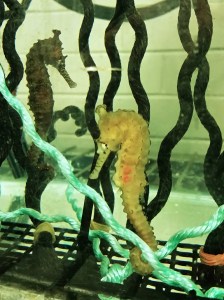
West Australian Seahorses (Hippocampus subelongatus) in their artificial seagrass home

DISCLAIMER: This blog describes scientific research, catching seahorses as a private person is NOT allowed in Australia. If you have any questions about keeping seahorses, feel free to contact me in the comments section.

First challenge: Permits. It takes a lots of paperwork to be allowed to do research on seahorses in captivity. Seahorses are on Appendix II of CITES (Convention for International Trade in Endangered Species), which means they cannot be traded internationally if they are smaller than 10cm. But it does not mean that seahorses cannot be fished. As a matter of fact, they are caught in their millions for traditional Chinese medicine! For this experiment it was crucial to use wild-caught West Australian seahorses (Hippocampus subelongatus), which meant applying for permits from the Department of Fisheries and seeking approval from the Department of Parks And Wildlife. Besides government paperwork, doing any kind of research with animals means writing up extensive application (close to 40 pages) for the universities’ ethics committee to ensure proper treatment of the animals while in my care.
seahorse_tank

Seahorse tag with red elastomer so it can be identified later

Second challenge: Catching seahorses. As anyone who has ever looked for seahorses can attest to, they are hard to find. There are a few sites around Perth where there are plenty of seahorses to be found, but getting all seahorses from one location would have a huge impact on that particular site. To limit the impact of my collecting, I spread out my fish-catching over multiple sites. To further reduce impact, I did not take any pregnant males or any seahorses that were clearly couples ready to mate. Since I needed a variety of sizes and a similar amount of males and females, collecting enough seahorses took a lot of dives spread out over a few weeks. Once seahorses were caught, they also needed to be transported safely to our facility, which meant not going too far, and using specialised tools to  (sturdy catch bags, coolers, oxygen, etc.) to reduce stress for the animals during transport.

Third challenge: High quality aquaria. Seahorses  are notoriously difficult to keep in tanks. They are very sensitive to bad water quality, which can lead to all kinds of issues. Preparing the aquaria started 6 weeks ahead of catching the seahorses. This is  done to ensure that the biofilters that ensure good water quality get properly established. The tanks themselves need to be large and high enough to house seahorses, and they need hold-fasts that mimic seagrass so the seahorses have something to cling on to.

img_7536

First arrivals in the tanks

Seahorses live in salt water, so getting seawater is another issue. Our labs are not directly by the ocean, so we need to import seawater. This then gets sterilised (using UV filters) before we use it. Water quality needs to be monitored daily and adjustments made where needed. This means no weekends off since minor problems could mean dead seahorses. While we have the aquaria and equipment available at CARL, the costs of this would be considerable for a private person.

Fourth challenge: Food. This is probably the biggest challenge of them all. Wild-caught seahorses only eat live food and will not eat dry or frozen fish food. So we need small shrimp to feed them. In our case we are using artemia (= sea monkeys = brine shrimp). Artemia are tiny (less than 1mm) when they hatch, but our seahorses will only eat them when they are about 1cm in size, which means  they have to be grown out for a few weeks before feeding. So we prepared 3 different artemia cultures, each one set up 2 weeks apart to ensure a constant supply of right-sized food. The artemia also need to be fed, in their case with algae. This means 5 cultures of different species of algae to make sure our seahorse-food stayed healthy and fat. Both algae and artemia water quality also need to be monitored, since dead algae/artemia would ultimately mean starving seahorses. To top it off, artemia are not naturally nutritious enough to be the only food source for seahorses. So we added an artemia enrichment-tank (where we add a fatty mix of all nutrients needed for healthy seahorses), which needs to be set up, cleaned, and harvested every day.  The result is that for 3 tanks with seahorses, we have 9 tanks for their food preparation. I’m not sure if you have enough space for that at home?

Fifth challenge: Feeding. As if breeding the food was not hard enough already, feeding them makes it even more complicated. Seahorses have no real stomach to speak of, so they are lousy at digesting their food properly. Because of this they need to eat almost constantly, which is possible in the wild, but harder in an aquarium where too much food will lead to bad water quality. In our case it means feeding them three times per day, every day (bye bye weekends or late nights!). Since our guys have been caught so recently, we can’t just drop the food in the tank and leave it. What works best is hand feeding them with a pipette to make sure they see the food and eat it. Each feeding session takes about 30 minutes, with longer sessions (90 minutes) in the morning, since food has to be harvested first and then a new culture prepared for the next day.

14786903_10154728145307608_1893594246_o

Feeding the seahorses using a pippette

Sixth challenge: Keeping them healthy. Seahorses kept in aquaria are prone to infections, so besides good water quality  it is important to keep everything clean. This means sterilizing all the equipment we use, only handling seahorses with surgical gloves on, keeping workspaces clean, etc. Regardless of this, infections can still happen. So far I have had to treat one infection with freshwater baths. Earlier this week two males had bubbles in their pouch (common in tank-kept seahorses), which needed to be removed using syringes and gentle pouch-massaging. You read that correctly, my PhD involves giving belly-rubs to seahorses.

All of this is needed just to keep our seahorses alive. I won’t go into what it means to actually run the experiments as well. But if you managed to read this entire post, it should be clear that keeping seahorses means a LOT of work. I am only able to do this because I can use the great facilities at Curtin University and because I have the support of experienced lab technicians, dedicated volunteers, and supervisors with experience in aquaculture. After 2 months of caring for my seahorses, I feel even more strongly than before that seahorses should be in the ocean and not in a small aquarium. If you do want to keep them yourself, think it through before you begin. Make sure you have the right setup BEFORE buying seahorses, only buy captive bred animals and be prepared to sacrifice a lot of your free time for your seahorses.

To finish, here is a short video of one of our seahorses eating artemia:


Little known facts about seahorses

I have been reading up about seahorses recently and discovered some interesting little bits of information I could not help but share. While seahorses seem to be a big favourite for divers and non-divers alike, we actually know surprisingly little about them. Some of their strange quirks are well known. The fact that the males get pregnant is probably one of the favourite and most retold bits of knowledge about them. I want to go a bit further and more interesting than that, so let’s get started.

seahorse-head-bones

The fused jaw of a seahorse (Source)

Seahorses belong to the family of Sygnathidae, which  translates as “fused jaws”. What this means is that all seahorses and pipefishes have jaws that are stuck together, they can’t open them anymore. So if you were to imagine eating like a seahorse, try gobbling up your salad, steak, pizza, apple,… with clenched jaws, while only using your lips to help you suck the food in. A good thing seahorses do not have teeth, as that would make it even more difficult!

Best of Dauin_Seahorse Estuary_MDB

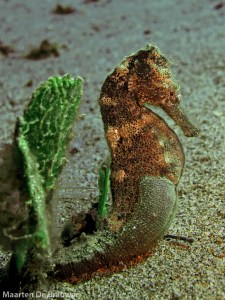
Hippocampus taenopterus, getting ready to growl

Another quirky thing seahorses do, is that they make noise. They make two distinct types of sounds: “clicking” and “growling”. I absolutely love the idea of a growling seahorse! It seems they do this when they are stressed out and it might even be some sort of escape mechanism to startle predators. Most likely because those predators would be laughing too hard because a seahorse just growled at them… The clicking sounds are mostly used during courtship and mating, so not only do seahorses growl to chase away predators, they also serenade their partners to get them in the right mood. Strange little critters indeed.

To keep up with the strangeness, have you ever wondered how strange the tail of a seahorse actually is? Probably not, I definitely hadn’t before reading this article.  The tails of most animals are round, but nearly all seahorses have square tails. As it turns out, this square shape is better at grasping and holding items. At the same time it offers a higher resistance to crushing than a round tail would. So perfect for a camouflaged critter which spends most of its time clinging on to objects, pretending to be something it is not to avoid getting eaten by predators.

Seahorse tails

Different 3D printed models of seahorse tails (Source)

Best of Dauin_Seahorse thorny_MDB

Hippocampus histrix

The objects seahorses hold onto can be anything, usually they cling on to objects like seagrass, algae, gorgonian seafans, etc. But they do not seem to be very picky at all. This article showed how seahorses living in areas with a lot of plastic actually use that plastic as camouflage. The seahorses even changed their colour to resemble the colour of the plastic and the spots on it. Unfortunately I cannot put the original pictures online due to copyright issues, so if you want to see them, follow this link. Since seahorses don’t really mind what they hold on to, artificial structures can be used to provide habitat for them when their natural habitat has been destroyed. This way populations can continue to exist until the natural vegetation has recovered.

Loss of habitat is one of the risks that endanger seahorses, the trade for traditional Chinese medicine is another big threat to them. IUCN has listed 7 species as Vulnerable and one species as Endangered, but most species have either not been assessed or we lack the data to assess whether or not they are endangered. To combat the illegal trade and offer some means of protection, all seahorses are listed with CITES, which means trading them is strictly controlled. One of the simple rules used to do this, is a size limit of 10cm. This size ensures that most traded seahorse species are mature individuals who can reproduce and that juveniles are left alone.

Hpontohi_MDB

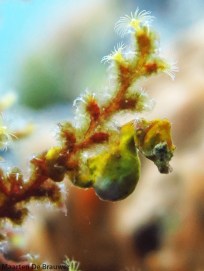
Hippocampus pontohi

The fact that we don’t really know how many species of seahorses exist, makes protecting them hard. Estimates of the number of seahorse species range from 40 to 48 species. It is quite likely new species are still waiting to be discovered, though the opposite might happen as well. Two species of pygmy seahorses (Hippocampus severnsi and Hippocampus pontohi) were described in 2008. But recent genetic analyses showed that they are actually the same species which comes in different colour variations.


If you want to know more about seahorses or just have a good laugh, check out this great video from Ze Frank with some more true facts about seahorses.

Psychedelic nightdiving fun!

I have been doing quite a lot of night dives recently. Those who know me from when I was still working as a dive instructor might be a bit surprised by this, as I never use to be the biggest night dive enthusiast around. There are two reasons I’m swimming around in the dark a lot recently:

  1. Night diving in Lembeh Strait (and Indonesia in general) is pretty amazing
  2. I’ve been playing with a new toy that makes it all a bit more interesting: a high intensity blue light torch. This torch, combined with a yellow filter allows a diver to see “biofluorescence
Zombie Seahorse (Hippocampus histrix)

Thorny seahorse – zombie version

So as an excuse to post some very psychedelic photos, let me tell you a bit more about biofluorescence under water.

It is important to realise that biofluorescence is NOT the same as bioluminescence. The former needs an external light source (the sun, a dive torch,…), the latter means that the animal itself produces light. For more info on the differences, check out the site of the Luminescent labs.

Devil Scorpionfish

Devil Scorpionfish (Scorpaenopsis diabolus)

Biofluorescence under water has been described as early as 30 years ago and was first noted in corals and anemones. It has been used for years in coral research that looks at coral growth, diseases and bleaching. More recently however, people have started noticing that many more animals than just coral are fluorescent. A paper in 2008 described how many goby species show red fluorescence. Other publications have described fluorescence in many invertebrates such as mantis shrimps, crabs, worms, nudibranchs,… But I really got interested last year when a paper was published that described how fluorescence in fish was much more widespread than previously assumed. The reason it caught my attention is because it seems to be particularly common in “cryptically patterned species”, many of which happen to be the camouflaged little critters I’m so interested in.

Juvenile Whiptail (Pentapodus emeyrii)

Juvenile Whiptail (Pentapodus emeyrii)

Fluorescent nudibranch (Trapania scurra)

Fluorescent nudibranch (Trapania scurra)

So I got myself the necessary equipment and now I am trying to figure out what exactly fluoresces here in Lembeh, and maybe even getting a clue about why they fluoresce as well. There are a few theories out there: it could be used as a form of communication, it might be some sort of camouflage, it could even just be pure coincidence and we might be looking at a cool, but irrelevant quirky thing that evolved but serves no real purpose (I highly doubt this). Fish see the world differently than we do and many species can actually observe UV-light and fluorescence, which would lead me (and other researchers) to believe there is some function there. To prove these functions however, a lot more research and experiments are needed.

Shrimp trying to hide behind algae

Shrimp trying to hide behind algae

What matters most for this blog post, is that it looks rather amazing and that it shows a different, little known side of the underwater world. In case you were wondering, or doubting what you are seeing, none of the pictures in this post have been photoshopped beyond cropping and cleaning up some backscatter.

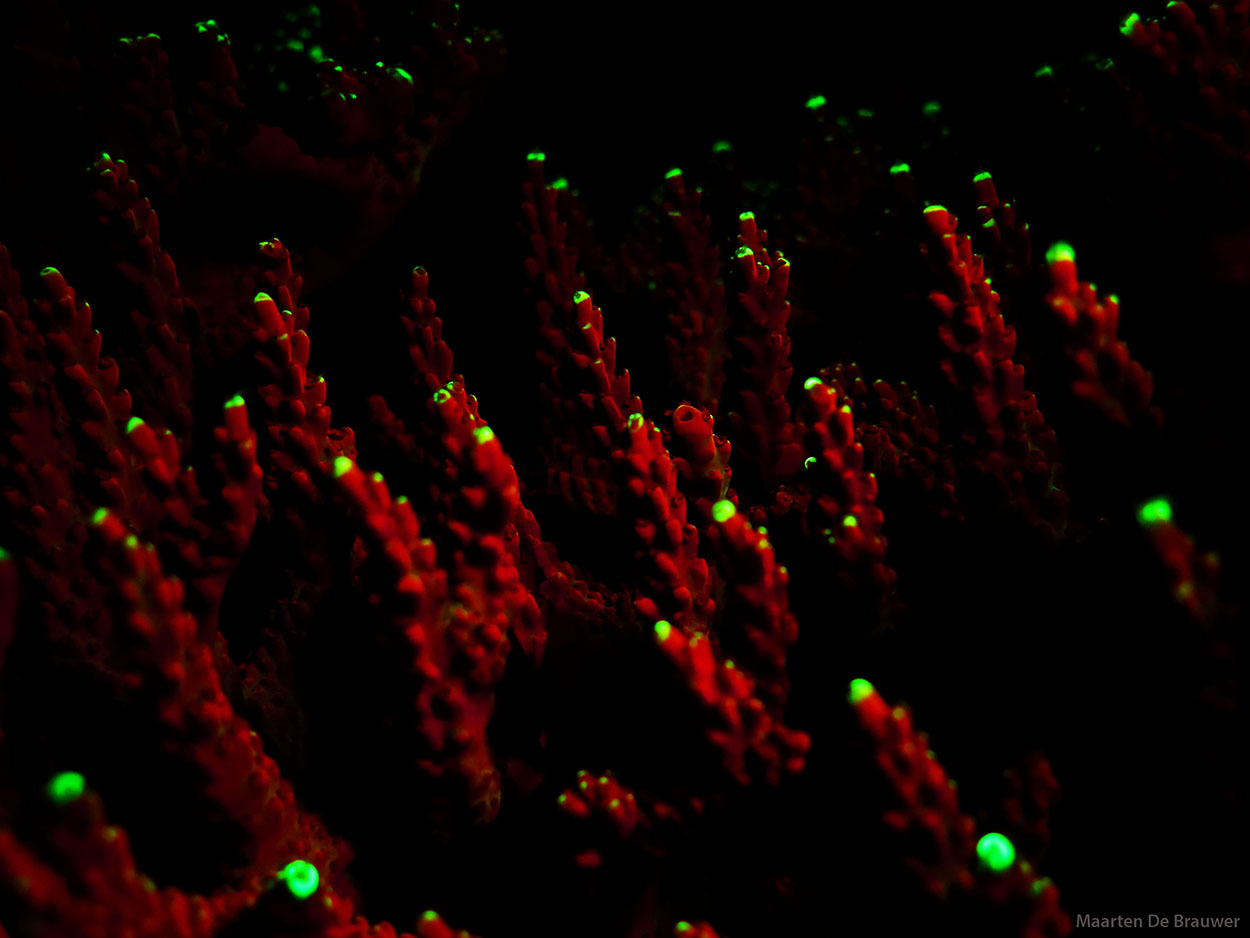
Acropora coral

Acropora coral

Copepod constellation

Copepod constellation

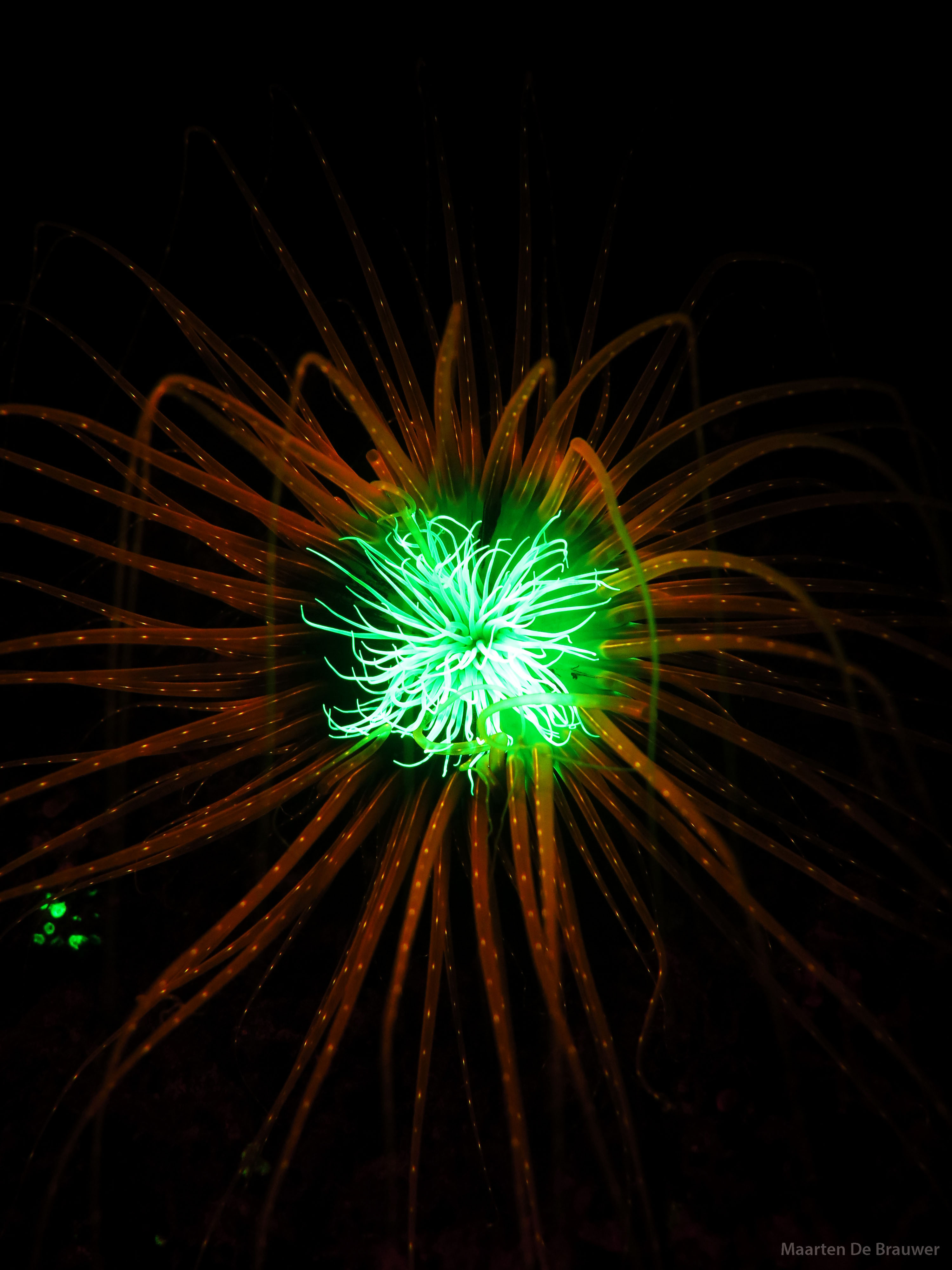
Tube anemone

Tube anemone

If you want to know more about how fluorescence works and how to take fluoro pictures yourself, this site is a good place to get started.

Thorny seahorse (Hippocampus histrix)

Thorny seahorse (Hippocampus histrix)