What is a species?

As promised in a previous blogpost, it is time to get into another hotly debated topic in biology that most non-biologists wouldn’t even think was an issue at all. This is a big one, as it underpins pretty much all biology: “What is a species?”. I would argue that this question needs two important additional questions: “Why does it matter?” and “To whom does it matter?”. Since I am only human and like postponing difficult tasks at hand, let’s start with the follow-up questions.

speciesTo whom does it matter that we are capable of telling one species from another? Besides looking like a smart cookie when telling your fellow divers/birdwatchers/plant enthusiasts which species you’ve just seen, it doesn’t matter very much to be honest. We are no longer hunter-gatherers, so being able to tell which species you can eat, and which ones will will eat/kill you, doesn’t matter that much anymore. In other words, the discussion in the rest of this blog is mostly an issue for taxonomists, but it gives an interesting insight in how simple concepts can be quite complicated when you look closer.

Why does it matter then? For two reasons:

  1. People in general and scientists in particular like putting labels on objects around them, it helps us structure and understand the world we see.
  2. Being able to tell two species apart that look very similar can have big consequences for conservation action: Two birds/fish/plant might look similar, but they could be different species, one of which reasonably common, but the other one rare and on the brink of going extinct. If we don’t realise they are different, we might lose that species.

A logical follow-up question (in my mind) would be: “what does it matter if one species that looks a lot like the next goes extinct?”. This is a valid question, but would require a long (and interesting) scientific and philosophical discussion.

charlesdarwin1

Struggling to define what a species is? Don’t worry, so did Charles Darwin (photo source: www.brainpickings.org)

Back to the species concept, which seems obvious, but really is not. The question has been asked for centuries by many renowned scientists. Two of which were none other than Charles Darwin and Alfred Russel Wallace. It could even be claimed that this question is what eventually led to the theory of evolution, which essentially tries to explain how different species come into existence. It is obvious that you need to know what a species is before you can answer that question. Sometimes it is easy: the majority of people can tell the difference between a cat and a dog, but it becomes a lot more difficult when species look very similar. Try asking a marine biologist what the difference is between a Slingjaw wrasse (Epibulus insidiator) and a Latent slingjaw wrasse (Epibulus brevis), or between a Thin Ghostpipefish (Solenostomus leptosoma) and a Robust Ghostpipefish (Solenostomus cyanopterus). Go on, give it a go, it’ll be fun to see them struggle! (Smart-ass tip: a spot on the dorsal fin & smaller adult size / No difference, they are most likely the same species).

chi_dane

They might look different, but are the same species. Photo source: www.dogguide.net

The problem is how do you define a species? At what point is an individual that looks different than “the norm” a different species, rather than just natural variation? Dogs can look as different as Danish dogs and (rats) Chihuahuas but are all the same species. Compared to those two, lions and tigers look much more alike, yet they are very different species. The classic definition of a species (if they cannot have fertile offspring they are different species) works in most cases. Lion + Tiger = Liger, but ligers are infertile. I don’t know what Danish dog + Chihuahua would look like and I wouldn’t get ethics approval from my university to test it, but presumably the result would be a fertile dog.

So far the normal situation, but what happens when different species mate and have fertile offspring (hybrids)? This is surprisingly common in the ocean. Hybridising fish are not that rare if you know what to look for. I have personally seen it in Clownfish and Surgeonfish and almost certainly in Frogfish and Ghostpipefish. But is has also been recorded in groupers, manta rays, butterflyfish, angelfish and wrasses.
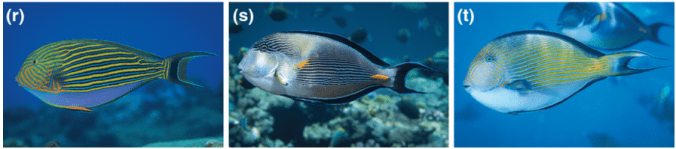
hybrid_surgeonfish

Hybridising surgeonfish: r: Acanthurus lineatus s: Acanthurus sohal t: A. lineatus x A. Sohal hybrid (Source)

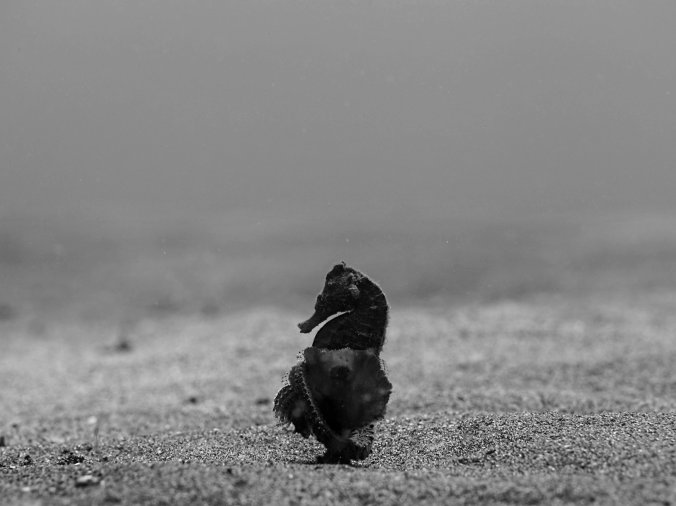
In this case, can we say the parents are different species because they look different, behave differently, and typically live in different regions? Or are they a single, highly variable species, the way dogs are? Traditional taxonomy focused on what species looked like, would say they are different species, but not everyone agrees with this. A recent example from the pygmy seahorse world: Hippocampus severnsi and Hippocampus pontohi were described as two different species. However, new (yet unpublished) research shows that they are genetically identical, so the name H. severnsi was removed and they are now all called H. pontohi. I’d imagine much to the annoyance of Mike Severns, who no longer has a cool animal with his name on it.

Is genetics the solution to the problem? Depends on who you ask. Geneticists tend to say yes, old-school taxonomists tend to be a bit less convinced. Each side has very valid arguments, one of which is how genetically different do individuals have to be before they are considered different species (sound familiar?). Different cut-offs have been proposed, but as far as I know, there is no real consensus (please correct me if I am wrong geneticist-readers). Another serious issue is how to classify small life forms like microbes, this article has a great summary on that if you are interested.

If you think this is getting too complicated, it might be best not to become an evolutionary biologist or taxonomist, because things actually get a lot more complicated than what I described. Suffice to say, for biologists the term “species” is still not a clearly defined concept. But luckily for non-specialists, the essence of the debate is about such fine details that it really shouldn’t be keep you up at night.

What’s in a (species) name?

A recent publication about the family tree of manta and mobula rays got quite a lot of attention on my social media feeds, inspiring me to explore the topic a bit further. I’ll try to keep this blog as jargon-free as possible, but I apologise in advance if I occasionally veer off into technical terminology.

Manta and me

Manta-selfie in younger days

Before I get going in earnest, a quick introduction to scientific names (or “binomial nomenclature“). Scientific names consists of two parts, the first part is the genus of the species (a bit like your surname), the second part the actual species name (like your first name). A few examples: Antennarius pictus, Homo sapiens, Wunderpus photogenicus. Names are usually in Latin or Greek, or anything that vaguely sounds like either one of those. Unlike common names, the scientific names for species are the same wherever you go in the world, which is helpful when talking to scientists who speak a different language than you do.

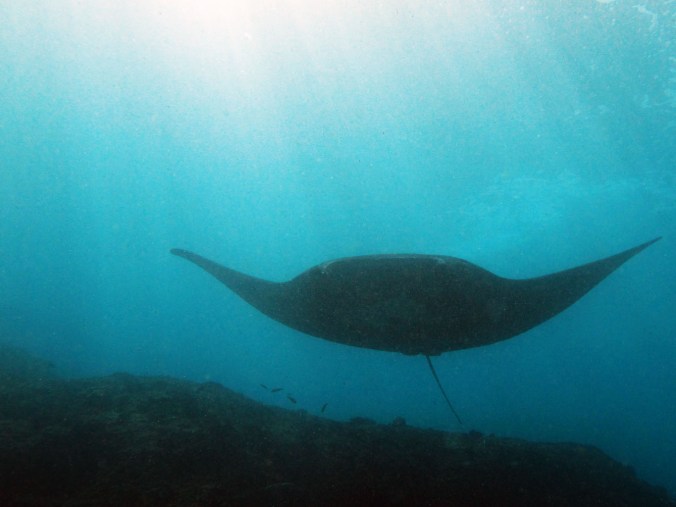
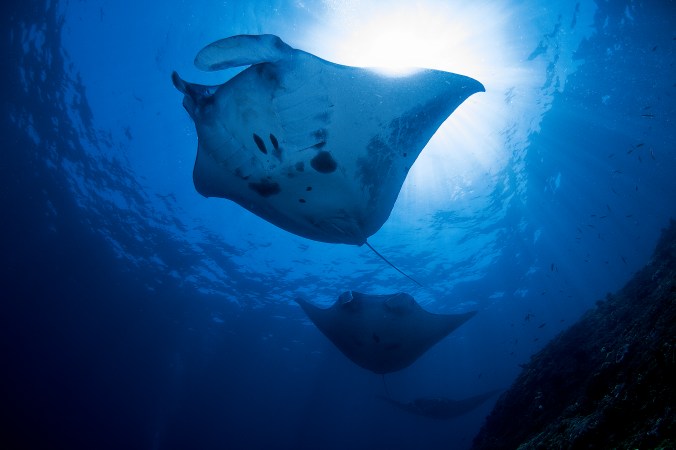
So what is the manta vs. mobula article all about? Manta rays are large, charismatic fish that grow up to 7m wide who look and feel a bit like stealth bombers when they glide over your head during a dive. Until recently, two species of manta rays were recognised: Oceanic manta rays (Manta birostris) and reef manta rays (Manta alfredi). Mobula rays look very similar to manta rays, but are smaller and differ from mantas in a few other ways. The newly published paper did genetic research to see just how closely mantas and mobulas are related, and they turn out to be a lot closer related than we previously thought. To put it into human perspective, as a species manta rays were thought to be something like a cousin to mobulas, but they turn out to be more like a brother/sister. In biology-slang: manta rays are now seen as belonging to the same genus as mobula rays. Which in turns means that their scientific name changes from Manta to Mobula, so Mobula birostris and Mobula alfredi. A bit like an adopted child getting a new last name.

_MG_1792 as Smart Object-1.jpg

Reef manta rays (Mobula alfredi) – Photo by Luke Gordon

What the article does NOT claim, is that manta rays are now suddenly a different species. It just means they are classified differently by taxonomists (and that they might get more invitations to Mobula social events). The common names will remain the same, manta ray species do not suddenly disappear or behave differently. It will take a while before ID guides will pick up on the name change and a lot longer (if ever) before the majority of ocean enthusiasts will notice.

A good point made by a friend, is that a different scientific name means certain official documents concerning the trade in protected species might have to be adjusted. Luckily the statute of manta rays as a species is not questioned, so existing conservation laws should not need to be changed.

But how does this happen? Why do scientists decide that a species has a different family tree than we’ve always thought? This is actually not an uncommon event, in the last years many species (including nudibranchs and frogfishes) received different names and classifications. One reason is that science is constantly evolving and as we learn more, we update our knowledge and correct mistakes from the past (or make new mistakes which might in turn be corrected later). In the manta/mobula-case: by using modern methods we found out that the family-relations were different than we assumed from only looking at the anatomy of these animals.

Manta coming up

Manta ray (Mobula alfredi) making its stealth bomber-like approach

Another (more surprising) reason, is that we still don’t have a good definition of what a species is. Human nature impels us to order the world around us into categories with different names, initially very broad (animal / plant / rock), then more detailed (fish / mammal / bird), more detailed still (ray / shark / frogfish), until you reach the scientific naming system (Mobula birostris / Mobula alfredi / Mobula mobular). But sometimes it is difficult to decide where one species stops and another one ends.

I know that at school you get taught that two species are different when they can’t produce fertile offspring (Horse + Donkey = Mule, but mules are infertile, so horses and donkeys are different species). To a large extent this definition works, but it breaks down when you start looking closer, especially when you look in the ocean. The question on how to define a species is a surprisingly hot topic in biology! I will explore the species-definition problem in a different blog later (promise!), but it would make this one a bit too long.

In the meantime, you can call manta rays Mantas, Devil rays, Big-ass mobulas, or anything else that floats your boat. As long as you have a great time watching them and try to protect the environment they live in I’m happy!

_MG_1802 as Smart Object-1

Does it really matter what these beautiful animals are called? Photo by Luke Gordon

Answering questions

During the last three months, I have been lucky enough to be based in Lembeh Strait in Indonesia. While most of my time there was spent writing, I also managed to get a fair few dives in so I wouldn’t forget why I started this PhD-project in the first place. What motivated me to go back to university after 7 years of working across the world, was curiosity about the marine life I love so much.

Bobbit worm_MDB

What is a Bobbit worm’s (Eunice aphroditois) place in the food chain?

While working as a dive instructor, I would constantly wonder about what I saw. Why did certain animals only appear in some spots or at certain times of the year? How long do frogfish/pygmy seahorses/other-fish-of-choice live? Do camouflaged fish choose a place to live depending on their own colour, or do they change their colour depending on where they live? What eats nudibranchs? What do nudibranchs eat? …? A few guide books offered answers to some of my questions, but most remained unanswered. Over the years, it slowly became clear that the answers were not locked up in some dusty university-dungeon or inside an even dustier professor’s brain. The truth is, science didn’t know the answers to many of the questions I had.

Many divers would be astonished by how little we really know about the ocean. As anyone who has heard me talk about my research will tell you, I answer a lot of questions with “I don’t know”. Even many of the most basic questions still haven’t been answered. There is a lot of great research going on, but there is even more ocean out there to be studied. When it started to dawn on me that hardly anyone was trying to find the answers to my questions, I decided to try to find them myself.

Froggie yawn_name

Why do frogfish (Antennarius spp.) yawn?

Of course it wasn’t as quick and straightforward as I write it here. But in the end (mostly through stubbornness and dumb luck) I managed to get myself into a project where I could spend multiple years trying to find out some answers myself. Turns out finding answers isn’t as easy as you’d think! But it also turns out that it is an even better way to spend one’s time than traipsing across the world as a dive instructor. The result is that after 3 years I have answered a fraction of my initial questions, while simultaneously tripling (quadrupling? quintupling?) the number of questions I had in the start!

What I am planning to do with those new questions is a matter for another post, but this final field trip definitely motivated me to keep searching for answers…

Ghostpipefish_MDB
Do Ghostpipefish (Solenostomus spp.) change sex? These are 3 males together


New publication: Big bucks for small critters

One of the most important chapters of my research has recently been published in the journal Marine Policy. The paper explains that scuba dive tourism focused on small critters (“muck diving”) has a very high value and how muck diving can be a sustainable alternative to more destructive uses of the environment. This is the link to the paper, but since it is behind a paywall, is rather detailed and perhaps a bit to dry for those of you who are not economists, below is a summary that is easier to digest.

Seahorse_muck

A typical muck diving scene: a sandy bottom with few defining features. In the foreground an Estuary seahorse (Hippocampus kuda) holding on to algae (Photo by Dragos Dumitrescu).

If you don’t know what muck diving is, I invite you to have a look through this site to get a feel for it. But in short: muck diving is scuba diving in sandy areas, usually without coral or other landscape features. The goal is to find weird critters (like flamboyant cuttlefish or hairy frogfish)  that you’d rarely see on normal dive sites. It is very popular in places like Lembeh Strait and Dauin in Southeast Asia, but it is done by divers and photographers all over the world.

Typical for muck diving is that the people doing it are very experienced, with an average of 580 logged dives. Most of them (73.5%) use underwater cameras, often the expensive dSLR cameras, to photograph all the weirdness down there. Many of the divers are well-educated and have a high yearly incomes. Importantly, most divers would be willing to pay for marine conservation if it benefits the species they come to see.

So what does it matter if some fanatic divers like to spend their holidays rooting through the sand instead of cruising by pretty coral reefs? Well, for starters, those fanatic divers spend a combined whopping $152 million per year in Indonesia and Philippines alone. The real value is probably much higher, as this estimate is only for dive centres that specialise in muck diving, and does not include liveaboards or more general dive centres that visit muck dive sites. The real value could be over $200 million per year! Also bear in mind that this number is for Indonesia and Philippines only, it does not include muck dive tourism in Malaysia, Papua New Guinea, or the rest of the world. With more than 100,000 divers visiting Indonesia and the Philippines to go muck diving, you would expect to get the attention of people managing tourism or ocean resources. Especially since many of the divers said they would not have visited the region, or even the country, if they could not muck dive.

OrnateGhostPipe_RedBlack_Diver

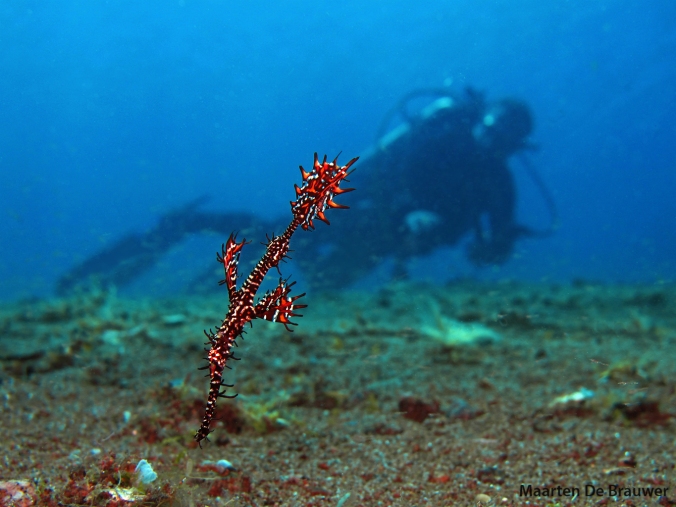
Diver and Ornate ghostpipefish (Solenostomus paradoxus) in Dauin, Philippines

While these numbers might not change anything in your life, they make a huge difference for the thousands of local people that work in this branch of the dive industry. Muck diving is often done in remote locations with limited other forms of income besides fishing. Working as a dive guide and looking at fish is not only more sustainable than catching fish, it also pays a lot better. Roughly $51 million is paid in wages to the local staff working in muck dive tourism annually, and dive guides can earn nearly 3 times more than the minimum wages in the area….

Just stop and think about that for a minute. Imagine the minimum wage in your own country, now triple it. Got the number? OK, now imagine this choice: you can either make that amount by showing cool animals to divers, or you can work your ass off in a factory or risk your life fishing for a third of that amount. Small wonder that many people prefer the first choice, which is great news for marine life in the area, because it means less people fishing and more people trying to protect this valuable source of income.

photo-05

The future generation of muck dive guides? Not without a healthy ocean (Photo: Luke Gordon)

That is what it comes down to in the end, protecting these extremely interesting and valuable ecosystems. Make no mistake, muck sites can be threatened as well. Coral reefs might bleach because of climate change, mangroves might be cut to make space for shrimp ponds and seagrass might be dredged to mine for sand, but sandy habitats could face other risks with equally bad consequences. All the habitats above receive far more research and conservation attention than the “barren” sandy sites in the tropics. If this paper proves anything, it is that soft sediment habitats have a very high value, and that it should get more attention to avoid loosing amazing biodiversity and the subsequent loss of income for the thousands of people that depend on it.

And that does not even consider loosing that feeling of pure joy when you finally find a critter you’ve dreamed of seeing for years 😉

Luke_Snoot_Black Hairy

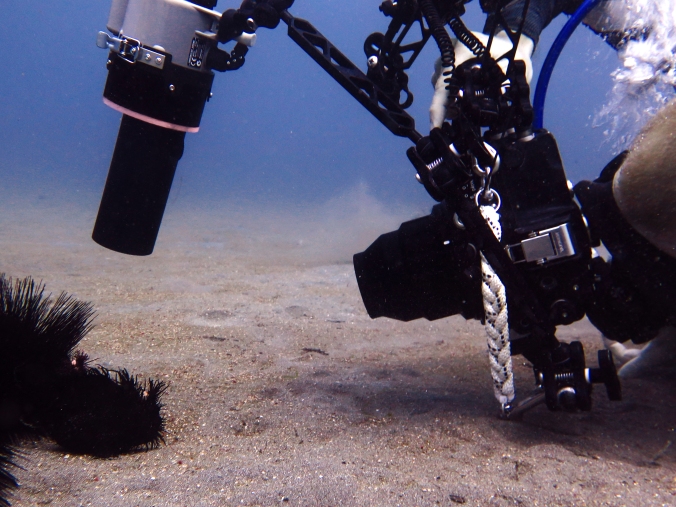
Muck diving scene: a diver (the science hobbit) taking a picture of a frogfish (black Hairy frogfish – Antennarius striatus)