I frequently talk to divers who are very enthusiastic about marine life and want to learn more about their favourite critters. It often comes as a surprise to these critter-lovers that hardly any research is done on most of the animals they’ve just seen. There are quite a few reasons for this, but one of them is: Science is Bloody Expensive! There might be many people out there wanting to do research on your favourite fish, coral, bird, tree, … But more often than not, the reason they’re not doing that research is lack of money to pay for it. When I say paying for research, I mean paying for all research costs and those often run very high, very quickly.
In my case, the most obvious cost might be fieldwork, but that includes more than just boat hire, accommodation and food. Fieldwork also means flights, visas, permits, insurance, specialised equipment, other transport costs,… Not just for me, but also for any volunteers or supervisors that come out to help. As much as I am passionate about what I do, I also need to live, so I need to be paid a salary. When I am not doing fieldwork, I need an office, desk, computer, specialised software, access to scientific journals, equipment to do analyses, etc. Again, I don’t work alone but get help from supervisors, administrative staff at the university, etc. all of which need to get paid as well. It’s not hard to see how this can get expensive, but even I was surprised to learn that the global cost for all research is estimated to be as high as 1 trillion dollar!!!

So who pays for all of this? Where does the money come from to develop a cure for cancer, send people to space or let me look at weird fish? As you might expect, it’s complicated. A lot of it is funded by governments, so actually by yourself through paying taxes (Thanks!). Applied research such as engineering or chemistry is often partially funded by industry partners to find direct solutions to problems. Then there is a part of funding that comes through NGOs, rich benefactors, etc.
The next question is, who decides which research gets money? The most common way is through the process of scientific grants. The baseline of grants is: you write a proposal of the research you want to do, submit it to the agency who gives the grants (can be any of the funding bodies mentioned earlier) and they decide which project deserves the money most. As you might imagine, this process is VERY competitive and success rates tend to be relatively low. There are many different types of grants (lots of money, little bit of money, small projects, long-term projects,…) and in general a higher value means more competition and lower success rates. Having to apply for grants and the insecurity of continued funding is often cited as one of the most stressful things about scientific research.
 In case you were wondering, my research funding is a merry mix of all of the above. The biggest part is paid by a scholarship I got from Curtin University (so indirectly the Australian government). Most of my fieldwork is funded through the lab of my supervisors (which itself is funded by a variety of grants), or by in kind donations from the divecentres I do fieldwork with. Recently I was also awarded a grant from the Society of Conservation Biology. The grant I received was to assess the population status of pygmy seahorses in Bangka Island in North-Sulawesi, Indonesia. This island is under threat from mining, but turns out to be rather rich in pygmy seahorses. I am currently preparing a publication on this research, so I should be able to tell you more about it in the near future.
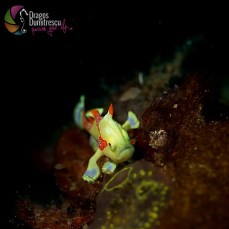 Some of you might have already heard about Dauin. You might have heard/read me ranting on about how great the muck diving is, dived there yourself or maybe you’ve seen some of the many underwater photos appearing on various social media. For those of you who haven’t heard of it, Dauin is a small town of about 25000 inhabitants in the south of Negros. The place is close to the city
  The beaches of Dauin are mostly made up of volcanic sand, though they are not as black as the ones you find in Lembeh. While there are a few small coral patch reefs, the real treasures are found in the sand. It’s muck diving at its best: you’ll find


 Critter Research