Explosions of colour in the centre of marine biodiversity

IMG_0346

Sea Safari 6

I recently returned from another liveaboard trip, this time in Raja Ampat. I’m writing this blog in Sorong, after just having disembarked from the Sea Safari 6. We spent 10 days diving both the south and north of Raja and it was pretty spectacular. I was lucky enough that Safari Bali saved me a free spot on the boat again, allowing me to do research. The only thing I had to do in return, was talk about fish, since I do that all the time anyway, I consider this to be a pretty sweet deal.

The Raja Ampat region is found in the east of Indonesia, in the province of West Papua. The name “Raja Ampat” means “Four Kings” and comes from a local legend. The legend tells of 6 eggs that were found and from which 4 kings, a woman and a ghost hatched. In marine biology circles, the area is known as the global centre of marine biodiversity. It lies in the very centre of the Coral Triangle and is home to nearly 600 coral species and 1600 fish species. For comparison, the entire Caribbean has less than 70 species of coral.

IMG_0133

Raja Ampat: Painemu Lagoon


Unknown to most people, the Birds of paradise found here and in the Halmahera region further west also played an important role in publishing the theory of evolution. Between 1854 and 1862 Alfred Russel Wallace traveled and conducted research in Borneo, Sulawesi, Halmahera. He was collecting specimens of all kinds of animals, amongst others the birds of paradise found in the region. His observations of these birds helped him develop his own theory of evolution, parallel to Darwin. Darwin had been working on his manuscript for many years, but was hesitant to publish any of it. A letter from Wallace to Darwin, in which Wallace explained his ideas, sparked Darwin to finally publish his magnum opus. Darwin presented the article “On the Tendency of Species to Form Varieties; and on the Perpetuation of Varieties and Species by Natural Means of Selection” in 1858 at the Linnean Society as a joint work from himself and Wallace. Once Darwin’s “On the Origin of Species” was published, Darwin ended up getting all the credit for the theory, but if not for Wallace and his birds of paradise, things could have turned out very different indeed.

While the birds of paradise are pretty amazing (we did go on land for a few hours to try and spot a few), the reason for this trip was to observe the diversity under water. This was the second time I dived Raja Ampat, and I can tell you it is fantastic. I’ve never dived anywhere else where the colours are so…everywhere, just everywhere. The quantity of soft coral, gorgonian seafans, corals, sponges, ascidians, etc is just staggering. You’ll find shades of every colour everywhere, some sites are so overwhelming that you’d almost forget to look for small critters and instead just float around to try and take it all in. Especially when there is a lot of sunlight and strong currents ensure all soft corals look like pink, orange, yellow, purple or white balls of fluff spread out over the reef. One such dive prompted the comment “This must be the campest divesite ever!”, and I couldn’t agree more. Many of the divesites around Raja Ampat look like the marine equivalent of letting a 6 year old kid decorate the Christmas tree…

soft coral

Explosions of colour (source)

Of course the diversity extends beyond corals, the fish life is just as great. It might be harder to find critters than Komdo or Lembeh, but there is a lot to make up for that. One of my favourites are the wobbegongs you find everywhere, especially at the northern divesites. But it’s also great to see all the schooling fish, and a very healthy amount of predators. We’ve seen a fair few sharks, tunas, Spanish mackerels, and other pelagic predators you don’t see very often in Indonesia. It’s also great to see lots of large groupers, since they are a very popular food-species, having a lot around means that protection is working and fishing pressure is not too high.
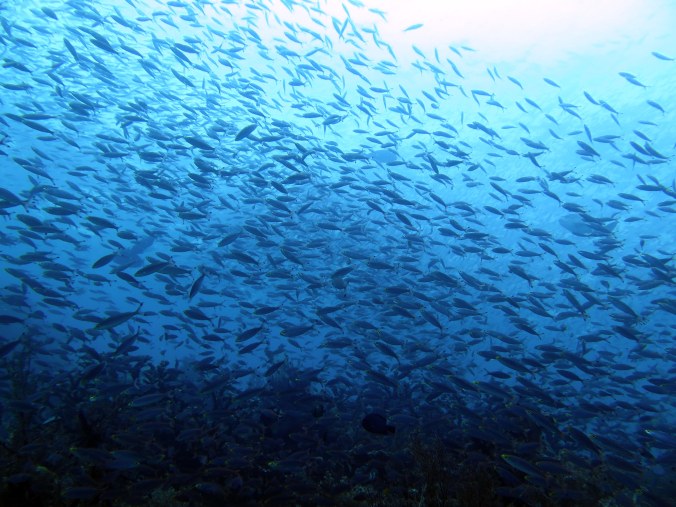
Fish soup

Fish soup in Pulau Daram

This protection can be credited to the efforts of many local and international NGOs working in the region. Their work helped motivate local and national governments to establish Indonesia’s first MPA (Marine Protected Area) network. Raja’s 15 MPAs protect nearly 6 million hectares of marine habitats. The area is also a shark sanctuary where capture and killing of sharks, rays, dugongs and turtles is prohibited. To me, knowing that this beautiful area is being protected in the best possible way makes diving it an even more rewarding experience.

Dragons, Currents and Hidden Gems

Komodo tripThere hasn’t been much activity on the blog recently, mostly since I’ve been stowed away on various boats exploring the marine life around the Komodo Islands. I just got back from a very comfortable liveaboard trip ran by Safari Bali, who have been kind enough to let me hop on the Sea Safari 7 as resident marine biologist. In return for the trip I do presentations for the guests, help them identify creatures they’ve seen, or generally answer any ocean-related question they might have. A great deal if you ask me, since it gives me the chance to do research in one of the best dive destinations in the world.

Komodo has been one of my favourite spots since I dived it the first time six years ago. The enormous diversity in marine life and dive sites is hard to find anywhere else. Raja Ampat might have more species, but to me Komodo is more interesting. There are more muck sites, stronger currents, lots of weird critters and they’ve got dragons…it’s hard to top dragons.

Komodo Dragon

Komodo Dragon (Photo by Jennifer Tambosco)

Komodo national park was established in 1980 and was declared a World Heritage Site in 1986. The park was originally designed to protect the endemic Komodo Dragons. They are the world’s largest reptile and are only found in the Komodo National Park and a few areas on the west coast of Flores. It was quickly recognised that the diversity in the surrounding ocean was a lot bigger than on land and protection was put in place for the marine environment as well.

Ghostpipefish party, six Solenostomus paradoxus hanging out

Ghostpipefish party, six Solenostomus paradoxus hanging out

Life under water is governed by the strong currents around the islands. The Komodo islands form a passage between the Pacific and Indian Ocean, the water flowing between them causes the famous currents in the area. These currents bring in important nutrients on which the marine life depends and it doesn’t take many dives in the area before you realise just how much of an effect they have. Diving in Komodo is always exciting, not just because you’re often flying around under water at exhilarating speeds, but also because of the enormous diversity of life that is created by these currents.

Pygmy Seahorse (Hippocampus bargibanti)

Pygmy Seahorse (Hippocampus bargibanti)

Explaining just how diverse and exciting diving in Komodo is very difficult. To make life easier for myself, here is an excerpt from my logbook from the trip: manta rays, sharks, eagle rays, frogfishes, octopuses, turtles, napoleon wrasses, seahorses, ghostpipefishes, giant trevallies,… On top of that reefs are generally very healthy, with huge clouds of reef fish hovering around them. From the boat we’ve seen at least 3 different species of dolphins and a whale. In this crazy fish soup I spent most of my time looking for pygmy seahorses, which greatly confused some of the other divers on board. Why bother with critters 1cm in size if you’ve got manta rays and sharks flying overhead? This is a fair point, but I am trying to get an idea of how many pygmy seahorse are out there, so the manta rays will have to wait… In all fairness, I might have gotten distracted a few times, but who can blame me for that?

Selfie time with the local kids :) (Photo  by Jennifer Tambosco)

Selfie time with the local kids 🙂 (Photo by Jennifer Tambosco)

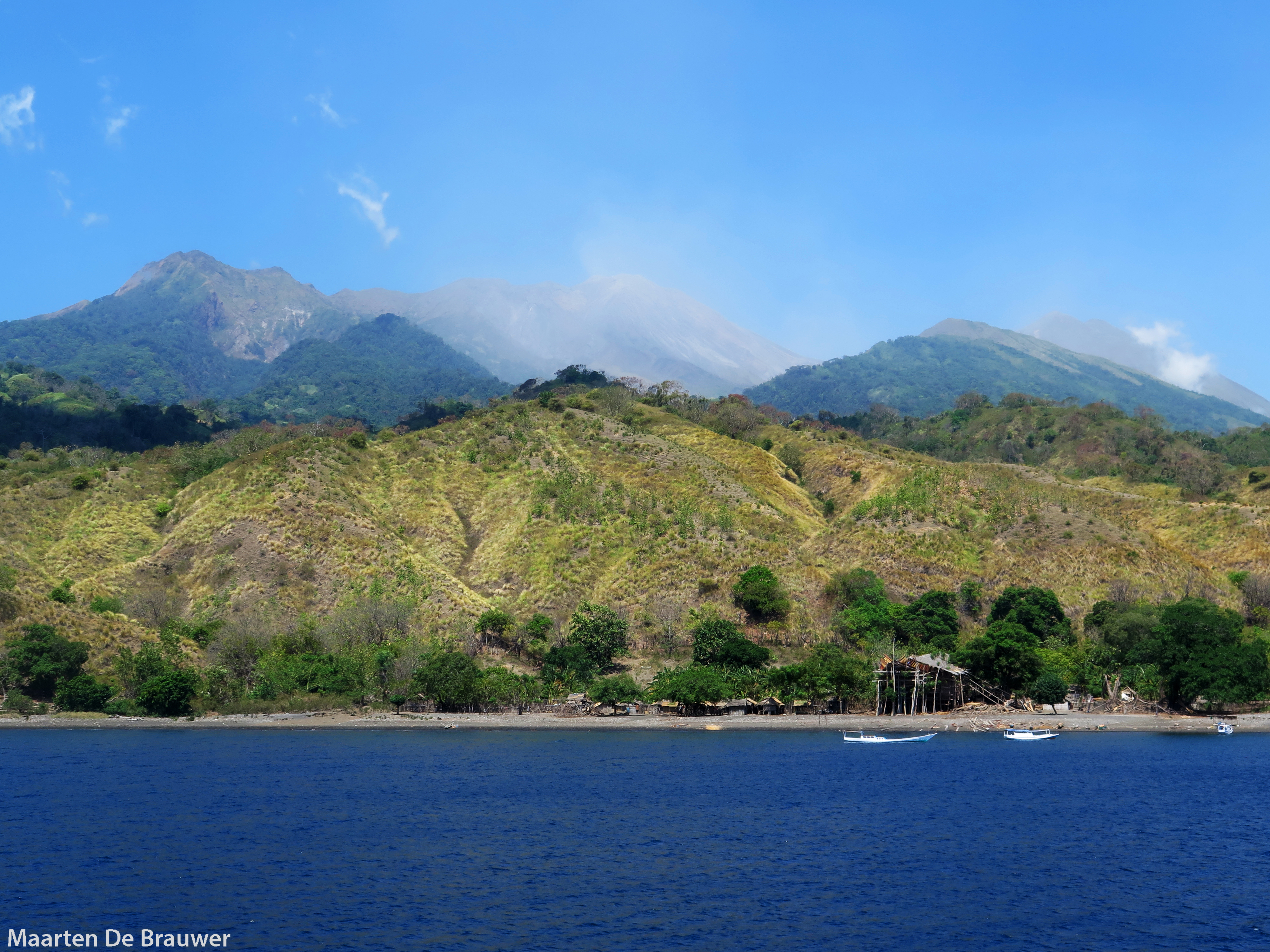
I am also using these trips to explore other sites in the area for critters. There are over 17000 islands in Indonesia and the best way to explore them is by boat. Some of the places we dived at along the way are absolutely beautiful and still pretty unexplored. One of my favourites was Sangeang, an active complex volcano (it has 2 cones) with 2 small villages on its slopes that specialise in traditional boat building. The dive sites around Sangeang are phenomenal; great muck diving, loads of critters, and mostly unexplored. Another gem (though better known) is the south of Komodo. The waters around Nusa Kode are cold (20°C) but very rich, it had some of the highest concentrations of anemonefishes I’ve seen in Asia. A night dive in the bay made it in my top 3 of best night dives ever, I won’t bore you with details, but if you like weird and wonderful critters it’s an absolute must!

Bontoh village, Sangeang volcano in the background

Bontoh village, Sangeang volcano in the background

Surveys: What do we actually do?

So far I have mostly been writing about muck diving, critters, dive sites, but I haven’t really explained how researching all of this works. What do we get up to when we are diving? Do we look at weird critters and think “that’s pretty cool!” or do we actually do something more?

Perks of the job: Air ajo 3, one of the survey sites

Perks of the job: Air ajo 3, one of the survey sites

First off: Yes, Luke and me very often think, talk and even shout under water about how very cool our critters are. We do however, try to get a bit more scientific than that. Since May this year we finished nearly 200 transects on 20 different sites, besides that we have also been collecting sediment samples and we took many, many pictures of the bottom of the sites we surveyed.

Running a transect

Running a transect

Surveying sites by running transects (we are actually doing “belt transects”, but that’s a technicality that’s not important now) is a way to try to tell how many fish there are in that area. The idea is to have a fixed measuring unit, so you can compare your counts to other sites. It would not make sense to just swim for a while, counting fish if you don’t know how much area you have covered. Without a measuring unit you might swim 500m in one dive, 300m on the next one and 900m in yet another one, making comparisons impossible. One way to deal with this, is by simply taking a measuring tape with you so you know how much you area you have covered. Before you do this, you have to decide how long your transects will be and how far away from the tape measure you will count fish. This way I know that with every transect, I cover an area of 50m2, and per site I investigate 500m2 of seafloor(10 transects).

Doing this on every site we investigate allows us to make comparisons. For example, at one site I found 3 Scorpionfish, but at another site I found 35 Scorpionfish. Since I used the same methods (both covered 500m2), I can conclude that there really are more Scorpionfish in one site than the other.

Benthic cover???

Benthic cover???

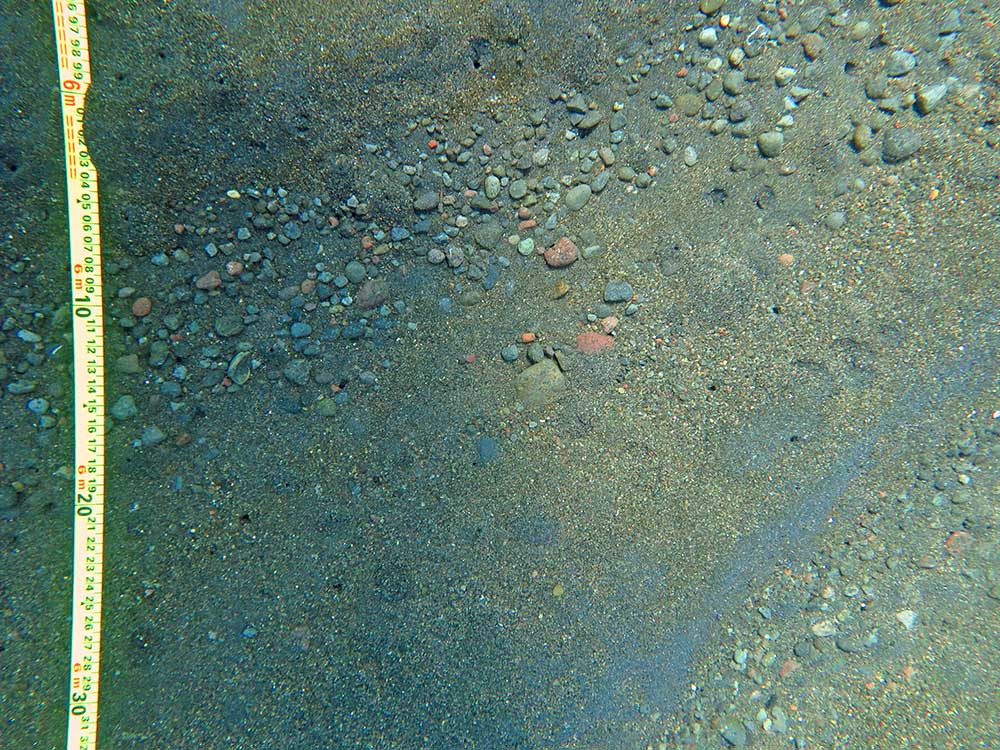
This obviously does not explain WHY there are more fish on one site than another. To try and explain some of the differences, we gather data on a few other things per site. Besides noting the depth we found species, we look at a few more environmental factors that might vary. The main two are benthic cover and the actual sediment. Benthic cover is just a fancy way of saying “stuff that covers the bottom”, to investigate this we take multiple photos of the bottom at each transect. Afterwards the photos get analysed to decide how much of the bottom was sand, algae, coral,…

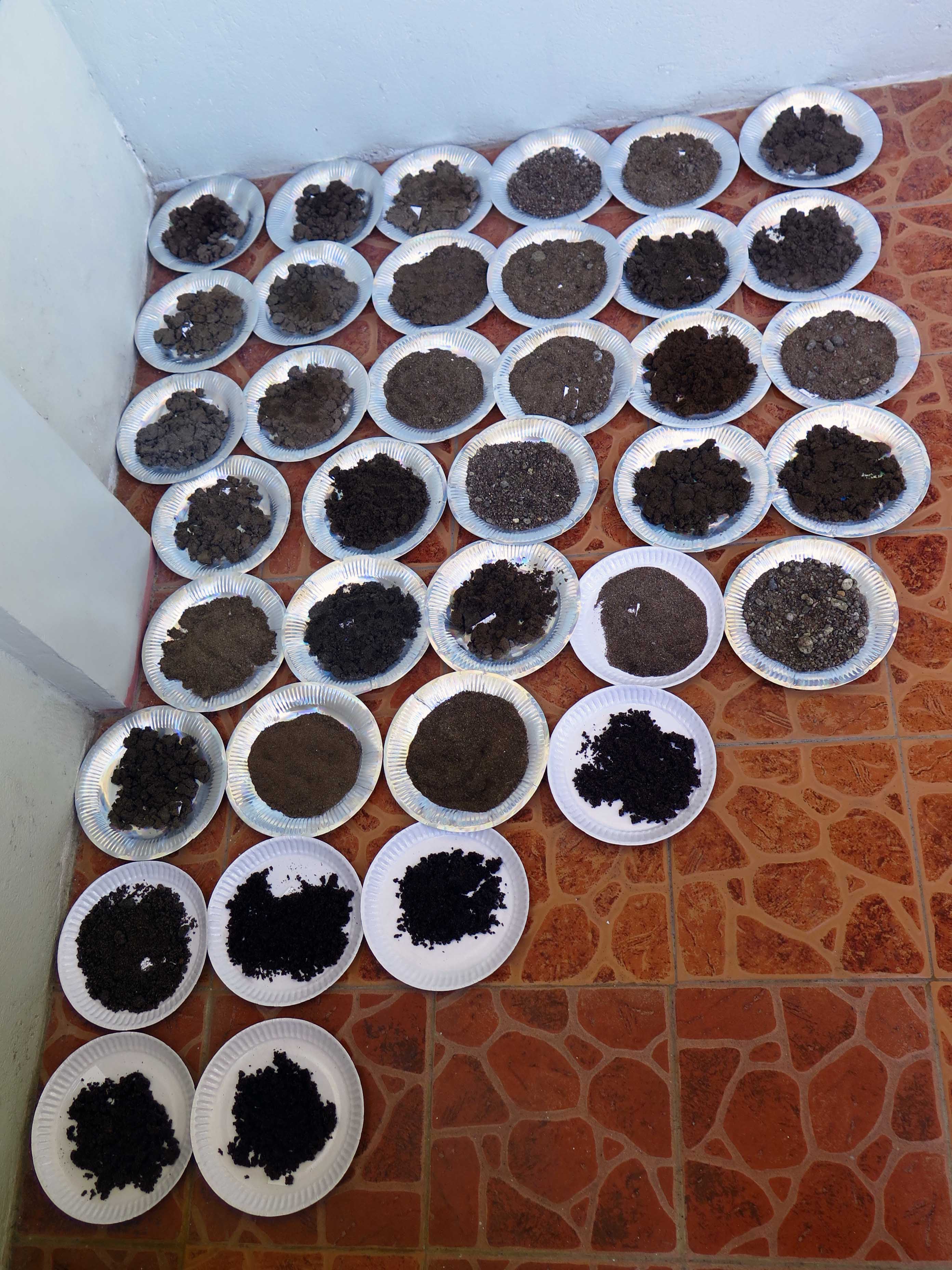
Initial sediment drying

Initial sediment drying

Sediment sampling is a bit more intensive. First step is easy, scooping up about sand at each transect under water. Next the samples have to be dried, packed and transported to the lab. In the lab it all gets wet-sieved, dried again, and then I can start the actual analysis. By the end of this month we will have collected about 200 samples, each of which take about an hour to process (+48 hours drying time). So a lot of hours of playing with sand ahead of me, let’s just hope it results into something useful 😉

Sediment collecting

Sediment collecting

Bad luck and How to find a frogfish

A few days ago, I prepared a blog post about a very interesting experiment we had started. It had everything to be cool (at least in my mind): interesting, sciency and a nerdy acronym to go with it! Luke and I were deploying SMURFs (Standard Monitoring Unit for Recruitment of Fish) to look at the habitat preference of baby fishes. The reason it did not get published, is the ocean. The night after successfully deploying the first 15 units, the waves picked up and destroyed all of our work… Marine biology fieldwork can be pretty amazing and it can be rather challenging as well. But that’s the beauty of the ocean: it’s unpredictable. Which can be frustrating at times, but can mean fantastic surprises as well.

Cartoon life_eggs

Baby froggie

Baby froggie

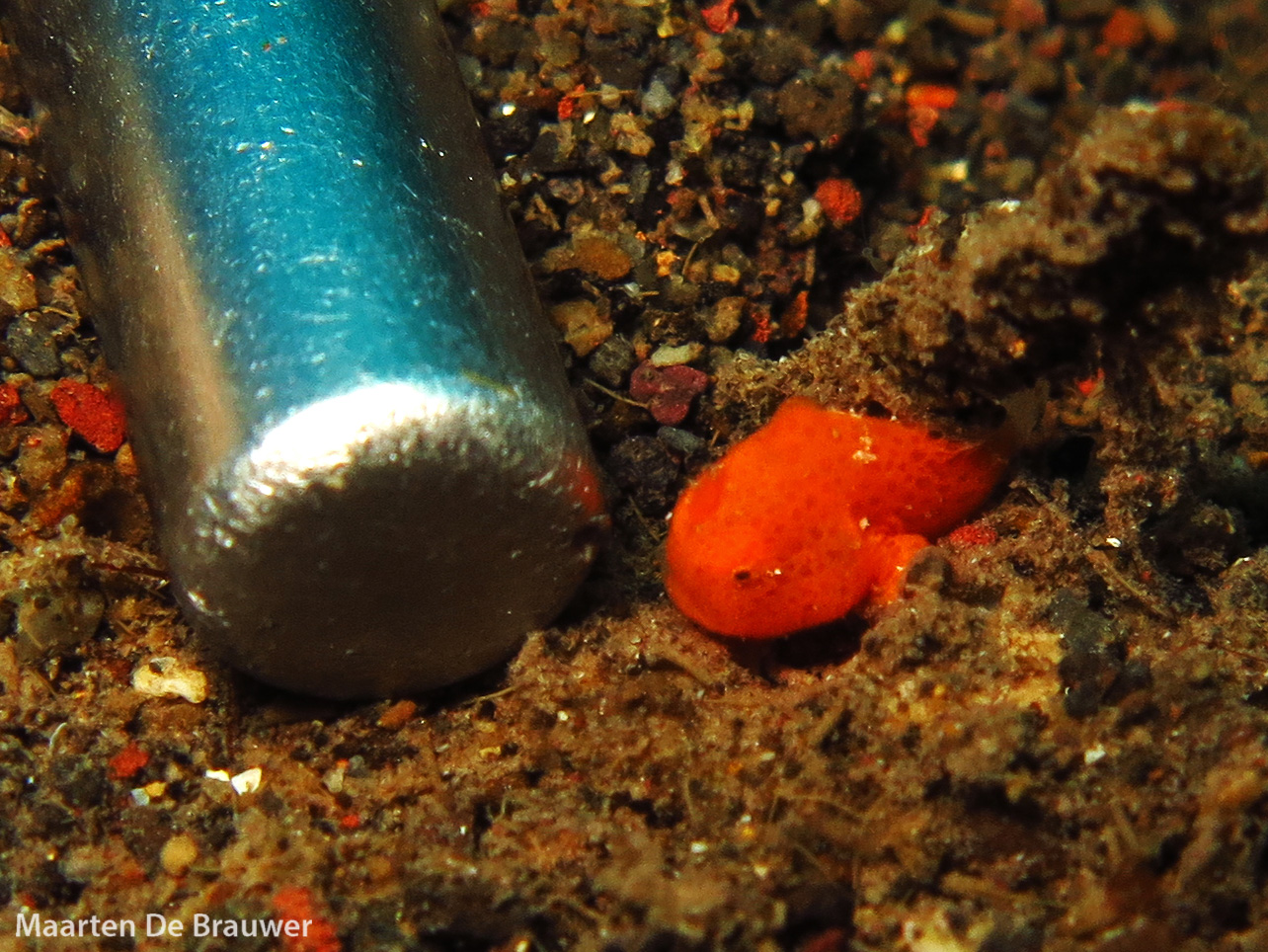
Which was proven once again when we found this very cute little baby Frogfish after assessing the damage to our equipment. We don’t know which species it is, since it was still tiny (less than 5mm). It was bright red, which would lead one to falsely believe they are easy to see on black sand. Think again! Next time you dive (or snorkel, or walk) over volcanic black sand, take a close look at the sand and you’ll notice there is a surprising amount of red grains in there. An unexpectedly efficient form of camouflage…

So how do you find a Frogfish? Or other cryptic critters for that matter? They have been evolving for millions of years to be invisible and most of them are very small, so spotting them is something that takes a while to learn. Here are a few tips to make it easier:

  • Movement: Your average Scorpionfish or Frogfish does not move very much, but every now and then they do. Whether it’s a small shifting of the fins, an eyeball that rolls to follow potential prey, or a full swim, our eyes are fantastic at spotting movement. So if you see an unexpected twitch or you think you might have imagined seeing something shift in the corner of your eye, investigate it!
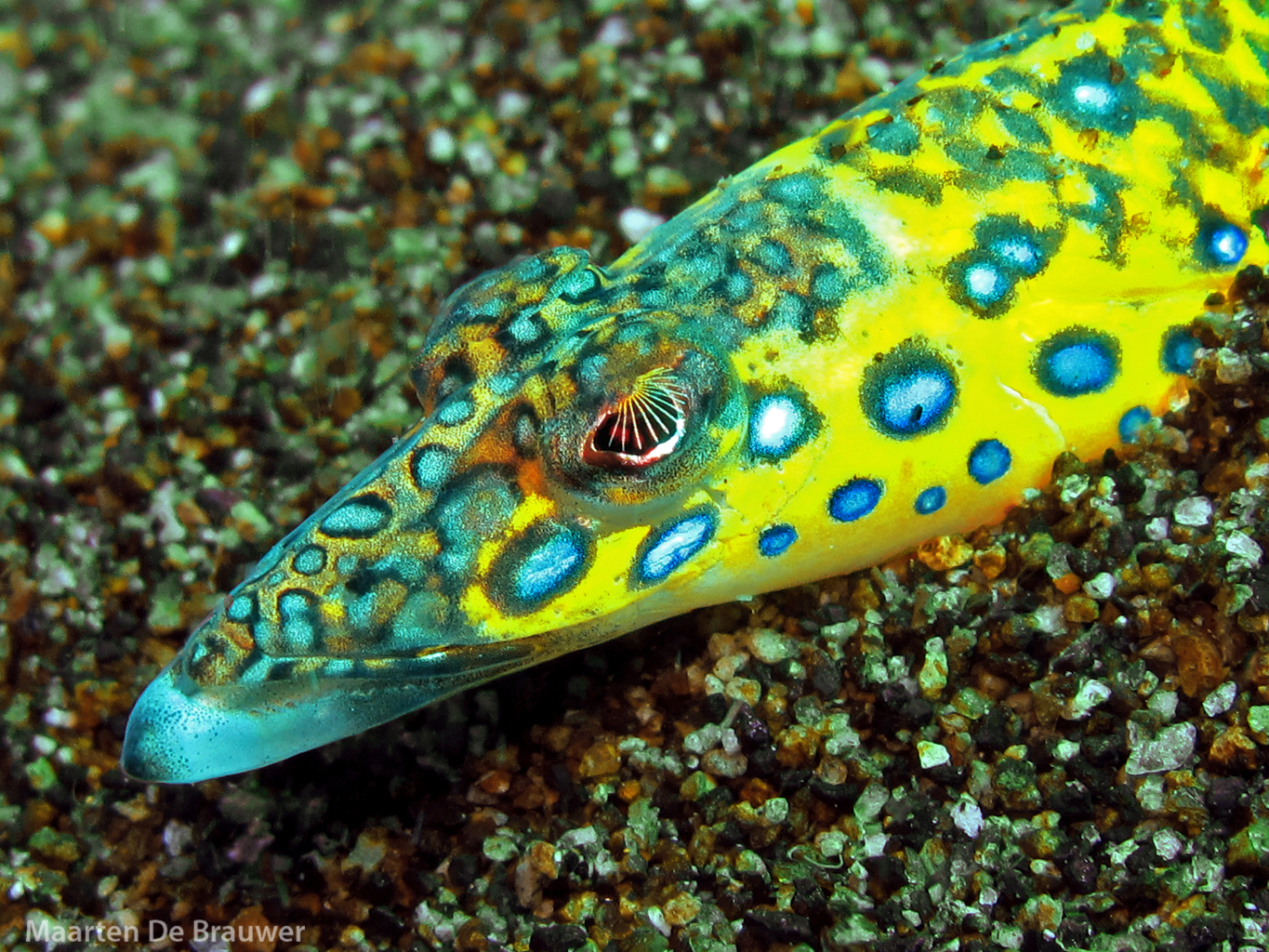
  • Habitat: The critters I am investigating here are usually found on sand, but there are A LOT of different types of sand. Not just the type of sand, but also what’s on it, whether it’s algae, sponges, featherstars, logs, mooring blocks or anything else that offers a minor difference in structure. Certain species of frogfish (eg. Giant Frogfish) are nearly exclusively found on sponges, while other (eg. juvenile Hairy Frogfish) like to hang out in areas with a lot of shell fragments. Sand Divers (Trichonotus sp.) love very loose sand, while Thorny Seahorses seem to prefer coarse sand with plant debris. In this post I explain where to find different species of scorpionfishes.
Sand Diver (Trichonotus elegans)

Sand Diver (Trichonotus elegans)

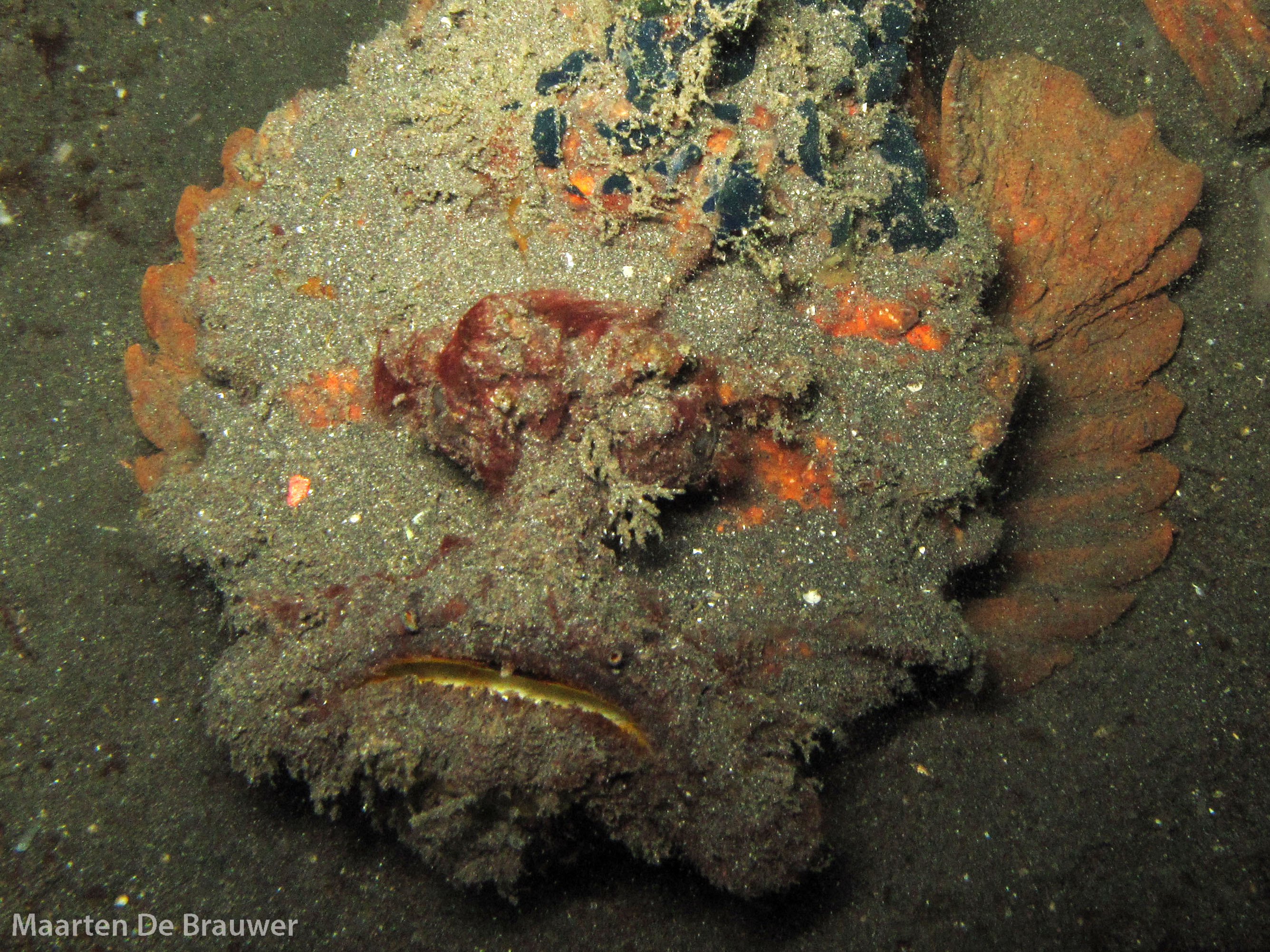
  • Shape: Even with their amazing camouflage, fish will be fish, which means they have (most of) the parts normal fish have. These shapes can help you find them. The distinctive thick pectoral fin of Stonefish are one of the best ways to recognize them. Pygmy seahorses are tiny and hide in big seafans, but they use their tails to hold on, which is one the things you can look for to try and find them.
Stonefish are easiest to find by looking at their pectoral fins (orange in this individual)

Stonefish (Synanceia horrida) can be found by looking for their pectoral fins (orange in this individual)

  • Position: your own position makes a massive difference when trying to spot cryptobenthic fauna. If you are high above the sand, everything blends in, these species evolved to hide from most top-down predators. Get close and get low, if there is a slope, look up the slope instead of down, silhouettes often stand out this way.
Robust ghostpipefish (Solenostomus cyanopterus) mimick decaying leaf litter. Getting close and low makes finding them easier

Robust ghostpipefish (Solenostomus cyanopterus) mimick decaying leaf litter. Getting close and low makes finding them easier

  • Luck: In the end, good portion of luck can play a big role in finding that elusive critter you’re looking for. If anyone knows how to get better at this particular method of finding critters, please tell me!