Critter getaway in Bangka

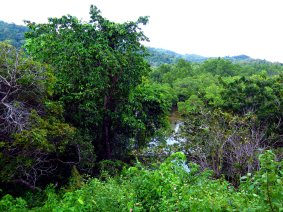
Mangrove view

Mangroves at Bangka Island

At the moment I am back in Lembeh Strait for what will be the last visit to Indonesia during my PhD. So I am making the most of it, enjoying every moment and taking time to visit friends spread out across the archipelago. A few days ago I went to Bangka Island to visit Sophie and Simon, who own Nomad Divers, a very pleasant small dive resort. I wrote about Bangka before, so check it out here if you want to know what the island is all about.

I enjoyed a few very relaxed days, playing (and losing ) board games, teaching their kids how to behave badly and philosophising about science while enjoying gin-tonics. But I also got to appreciate the abundant critters that live in the mangroves and jungle of Bangka Island. Those few days of not working (not a single dive done and no computer in sight), and just enjoying nature reminded me why I fell in love with the tropics in the first place. The beauty of Indonesia (and much of the tropics by extension) is that there is so much wildlife all around you, as long as you just keep your eyes open…or just get plain lucky.

Tarsier_nom

Tarsier in the ceiling! I never realised how long their tails were…

On my first night, while we were catching up and sharing stories about science hobbits, a small tarsier decided to have his dinner in the restaurant. These small primates are rare and vulnerable to extinction, they are only active at night and are usually very shy. If you want to see them in the wild, your best bet is to find yourself a good guide who knows where they roost during the day, so you can see them waking up and moving out to hunt when night falls. Just seeing one is great, having one sitting just above you, while eating a gecko is dumb luck and freaking amazing. For Sophie and Simon, this was a first in 4 years on Bangka!

Tarsir

Nomnomnom. Tarsier (Tarsius Tarsier) eating a gecko (Hemidactylus frenatus) in Bangka Island

There was plenty to see by day as well. I had a great time wandering through the mangroves, looking around for interesting crittersAs you may or may not know, mangroves are important nursery areas for all kind of fish, so it was no surprise to see lots of baby snappers, damsels and other small fish darting around in the shallows. But there was a lot more, loads of mudskippers (skipping around in the mud, as they do), kingfishers in the trees, and the always busy fiddler crabs in the intertidal zone.
Fiddler_faceoff

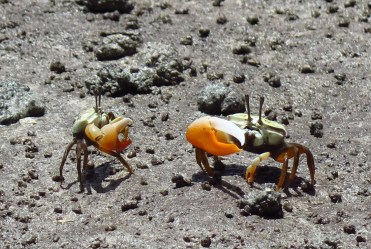
Two male fiddler crabs facing off

Fiddler crabs are colourful little crabs, and are named for the males’ disproportionally large claw. One claw is small and used like any other crab uses its claws, the huge claw is used to show off (what did you expect?). The males wave their big claw around to get the attention of females, and to ward of other males encroaching on their territory. If you  ever find yourself in a mangrove with plenty of time on your hands, I can highly advise watching these little guys at work for a while, it’s pretty captivating and highly entertaining.

While I didn’t go into the jungle, there were plenty of little lizards to spot while strolling along the beach or heading to my room. Apparently, there are quite a few snakes to find in the jungle, and legend has it there’s even deer around, maybe I’ll have to bring shoes next time and go have a look.  If mangroves or jungle or jungle trekking aren’t your thing, you can always just chill out, have a beer and watch the geckos on the wall eating bugs or fighting each other. The tropics really are accommodating for any life style 😉

Sophie_Max.jpg

Sophie and Max enjoying the ocean view

Ocean pretenders: Eat or be eaten

Pipefish_winged_name

Algae or  a pipefish pretending to be algae?

At some point or other, all of us have pretended to be something that we are not. From trying to look old enough to buy alcohol as a teenager, to keeping your head low and pretending to be a pot plant in the corner of the office when the boss is looking for someone to take notes during a meeting. Some people might pretend more often than others, people might have good reasons for wanting to look like someone (or something) they are not, and some individuals might have less than innocent intentions when hiding their true identity. The same thing happens in the oceans but the stakes are usually higher than (trying to) look cool with a beer, or the tedium of having to take notes. A critter’s skill at pretending often means the difference between getting dinner or being dinner…

The ocean-pretending I am talking about is more commonly known as camouflage and mimicry. The terms are frequently mixed up or even assumed to be synonyms, but they are two different concepts. To distinguish between the two, it helps to know that the goals of camouflage and mimicry are opposite from each other. Animals using camouflage are trying very hard not to be seen, like you trying to be a pot plant instead of a potential scribe. Mimicry attempts to do the opposite: wanting to be seen, while hoping observers will believe you are someone else, like our teenager bluffing he’s old enough to drink.

Usually when biologists (who know their shit) talk about camouflage, they are thinking of mobile animals that are pretending to be objects or animals that don’t move; these objects could be plants, rocks, sand, sponges, etc. When those same biologists talk about mimicry, they mean active animals that pretend to be different species of active animals. But that is just the start of it, the obvious question is why? What are the reasons behind camouflage and mimicry? As a rule, fish don’t like alcohol, so there must be some other cunning plan.

For camouflage it boils down to two options: defensive or aggressive. People tend to intuitively understand defensive camouflage: hiding so you don’t get eaten or killed. Two ocean examples are seahorses pretending to be seafans or crustaceans looking like sponges. Aggressive camouflage is when an animal tries not to be seen, so it can eat unsuspecting animals coming closer. Frogfish are masters at this, so are most scorpionfish, and many other species. It is perfectly possible for an animal to use both defensive and aggressive camouflage at the same time. Think about the human version: soldiers wearing camouflage do not want to get shot, while aiming their guns at the enemy.

Mimicry has similar uses, depending on what the animal mimics. Unlike camouflage, mimicry needs a distinctive “model species”, which is imitated by the “mimic”. Depending on the nature of the model and the mimic, we distinguish three kinds of mimicry. Batesian mimicry has a dangerous model, but a harmless mimic. Mullerian mimicry has a dangerous model and a dangerous mimic. The last type, Peckhamian mimicry, has a harmless model, but a dangerous mimic.

Batesian mimicry can be compared with our teenager trying to buy alcohol. He might try to look like the real deal, but really is not. A great ocean example is the (non-toxic) baby pinnate batfish (Platax pinnatus), which look like a toxic flatworm. Or baby sea cucumbers pretending to be toxic nudibranchs. Predators assume the mimic is toxic, so they avoid eating it, good news for the mimic!

In Mullerian mimicry both mimic and model are “the real deal”.  This is very common in nudibranchs of the Phyllidiidae family. Most species in this family are very toxic and they all look very much alike. When a predator tries to eat one species, he’ll learn to avoid the other similar looking species as well. A bit like the leather-clad members of different motorbike gangs which look equally dangerous to outsiders. The bikers can tell the difference between other gangs, but I would advise against picking a fight with any of them.

Peckhamian or aggressive mimicry happens when the mimic pretends to be a harmless model, usually to get close to prey. This method is used by predators like dottybacks, who pretend to be harmless damselfish so they can get close enough to juvenile damselfish to eat them. A (purely hypothetical) human example could be a person living in a fancy white house, who pretends to be a silly orange clown, but in reality is a dangerous would-be dictator. As it turns out, land is no different than the ocean: the animals that believe in the illusion are most likely to suffer from it.

Best of Dauin_Lizardfish eating Dragonet

Aggressive camouflage in action: this dragonet failed to see the lizardfish hiding in the sand.

Flamboyant Cuttlefish

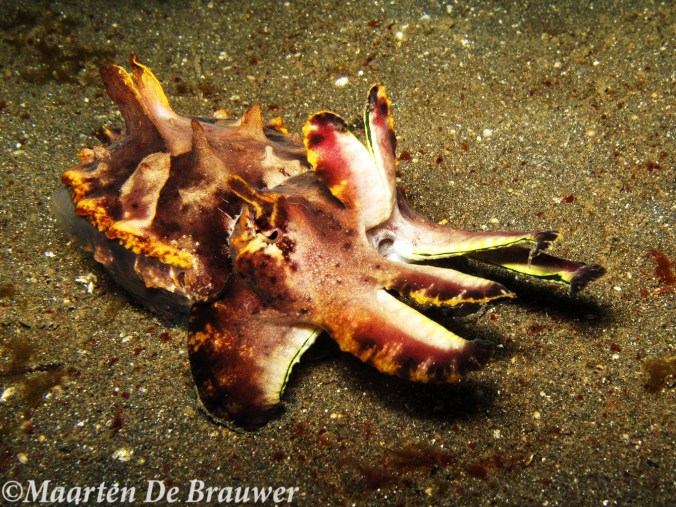
It’s been a long time since I put a critter in the spotlights, so it’s time for one of my personal favourites: the Flamboyant Cuttlefish! I am definitely not the only one to like this amazing little animal, for most divers it is high in the top 10 of critters to see. With good reason as well, Flamboyant Cuttlefish are one of the most beautiful and intriguing inhabitants of sandy dive sites.

flamboyant-cuttlefish2

Flamboyant Cuttlefish (Metasepia pfefferi) striking a pose

The small cephalopod many divers call “Flamboyant Cuttlefish” are in fact two species: the Flamboyant Cuttlefish (Metasepia pfefferi) and the Paintpot Cuttlefish (Metasepia tullbergi). The first one lives in Malaysia, Indonesia, Papua New Guinea and the north of Australia. The Paintpot Cuttlefish is found further north, from the Gulf of Thailand all the way up to southern Japan. Both species are classic muck dive critters, they only occur on muddy or sandy bottoms, so you will have to move away from coral reef to encounter them.

flamboyant-cuttlefish3So why does this animal deserve the effort of searching sandy plains for days on end, in the hope catching a glimpse of it? To start with (the name is a bit of a give-away) they are very flamboyant critters. We are talking yellows, pinks, blacks and whites, all at once! If that wasn’t enough, they often change their colours into “traveling waves”, even more so than normal cuttlefish or octopuses. From my experience, smaller Flamboyant Cuttlefishes have the brightest colours and make the most extravagant displays. When I write small, I do mean really small: adults do not grow much bigger than 8cm. They ideally sized Flamboyant Cuttlefish for the best colour-show  would be around 3-5 cm!

If finding an animal that size seems difficult, you might also want to consider the following. When they are not disturbed, hunting, or mating, Flamboyant Cuttlefish are anything but flamboyant. In their “standard” state, they blend in perfectly with their background, so they will be a mottled grey, brown, or black. For this reason some divers or photographers are tempted to disturb the animal to better see its colours. It is obvious that this is a bad idea, as it will stress out the cuttlefish. Be patient  instead, observe it for a while and you might even be rewarded by seeing it hunt small shrimp, lay eggs, or even mate!

Another thing that is special about them is that they do not swim, but walk across the bottom. To do so they use two of their arms and an adaptation of their mantle. They can swim, but only do so when they’re startled and over short distances. I could easily spend an entire dive watching these guys wander across the seafloor, little blobs of colour on a quest to eat as many shrimp as possible. It might be because of the awkward way they walk, but I always imagine them to be mildly grumpy animals. A bit like an old man with stiff joints who can’t walk that well, grumbling to himself about how the terrible weather…

flamboyant-cuttlefish4

A juvenile Flamboyant cuttlefish (M. pfefferi) walking across the rubble

An interesting mystery surrounding these animals is whether or not they are toxic. Their colours would suggest some form of aposematic colouration, in the same way nudibranchs advertise their toxicity with bright colours. Some authors have even suggested flamboyant cuttlefish might mimic nudibranchs such as the Ocellate Phyllidia (Phyllidia ocellata). I have however, not read a single bit of conclusive evidence of this. It seems to be one of these “facts” people have assumed, written about and then it just got copied. To date there seem to be no papers out their describing whether or not Flamboyant Cuttlefish really are toxic, and which toxin they would produce. If anyone would have come across that information, I would be very grateful if you could share it with me and the rest of the world.

As is often the case with small critters, we don’t know very much about them. But that doesn’t have to stop us enjoying looking at them. Which is why I couldn’t resist adding a video of one of these guys. The title is a bit too sensational, but the footage is great, enjoy!


Cleaning mutualism on the reef: It’s a Hip-Hop World!

simon3

Dr. Simon Gingins

This month’s guestblog is by Dr. Simon Gingins, who currently does research on damselfish at the department of Collective Behaviour in the Max Planck Institute, in Konstanz (Germany). Simon and I met a few years ago at the Lizard Island Research Station, where he was doing research on the behaviour of cleaner wrasses. His blog describes some of his cleaner wrasse research….and hiphop. Besides being a good researcher, Simon is also a great photographer, so make sure to have a look at his site.


cleaner_anthias

An anthias gets cleaned by a bluestreak cleaner wrasse

I know this is old school, but do you remember Eminem’s song Lose yourself? Well, to my big surprise, I recently realized that the lyrics fit very well with the ecology of cleaners. Let me show you by quoting the relevant parts of this song throughout the text. But first, let me start with the beginning. What is cleaning? Cleaning is a behaviour that implies the removal of parasites or dead tissues off another animal. It is widespread, particularly on coral reefs. Many species engage in cleaning, including shrimps and crabs, but it is mostly performed by fishes, as diverse as surgeonfishes, triggerfishes, jacks, butterflyfishes, gobies, and many more. Most fishes only clean occasionally, mainly as juveniles, and get most of their food by other means. However, a handful of species are “professional cleaners” and get all of their food through cleaning. Here, I will focus on the most studied of these species, the bluestreak cleaner wrasse Labroides dimidiatus. This species can have more than 2000 cleaning sessions per day, and client fishes actively visit their territories, called “cleaning stations”. They also give massages by vibrating their pectoral fins on the body of their clients, which was shown to decrease cortisol levels in client fishes. Cortisol is a proxy to measure stress, and thus this additional service is beneficial for clients as is calms them down.

So the cleaner gets a meal and the client gets its nasty parasites removed and a massage. Sound like everybody’s happy, no? Well, the situation actually gets more complicated because the cleaner wrasse prefers to bite client fishes and get a mouthful of yummy mucus, rather than focus on the parasites. Biting client fishes is cheating, but mucus appears to be like crack for cleaners. Or as Eminem puts it:

If you had, one shot, or one opportunity,
To seize everything you ever wanted. In one moment.
Would you capture it? or just let it slip?”

Well, it depends, because of course client fishes don’t visit cleaners to be exploited, and they’re not really happy when they get cheated. So how do clients respond to cheating cleaners? Imagine a client fish with a large territory. Large enough that it has access to many cleaning stations.

“He’s known as the globetrotter”

If it’s not happy with the service of one cleaner, it can just leave and look for another one. Basically, it can play the competition.

 “They moved on to the next schmoe”

This is what my ex-supervisor Redouan Bshary referred to as “big city life”: If you’re not happy with your hairdresser, just go to another one. But some client species don’t have choice options. The size of their territory is more like a village than a big city, and these fishes often have access to only one cleaning station, if any. Cleaners appear to be aware of these differences, and give priority and a better service to big city clients than to villagers. But the villagers still have one trick up their sleeve to make cleaners more cooperative: they punish. When they get cheated, they often chase the cleaner and try to bite it:

“No more games, I’m a change what you call rage”

And it was shown that the next time they meet, the cleaner will be more cooperative with the individual that punished it.

cleaner_grouper

Bluestreak  cleaner wrasses cleaning a grouper

Finally, there is one category of clients with whom cleaners behave very, very nicely: predators. A predator striking at a cleaner during a cleaning interaction has never been witnessed so far. Nevertheless, it’s pretty obvious why cheating a predator might not turn out to be a good idea. To quote Eminem again, in interactions with predators:

“Success is my only m*********ing option, failure’s not!”

In summary, when a cleaner is interacting with a client, eating its preferred food has negative consequences. The client might just leave, but it might also try to punish it, or even potentially eat it. Cleaners thus came up with very strategic behaviours in order to determine who they can cheat, and when it’s best to cheat.

“I’ve got to formulate a plot or I end up in jail or shot”

As already mentioned, they vary the quality of the service they provide according to the category of clients. But it doesn’t stop there, they also adjust their behaviour depending on whether they are being observed by potential clients or not. If a client waiting to be inspected witnesses the cleaner cheating other clients, it might decide to leave and search for a more cooperative partner.

“His hoes don’t want him no more, he’s cold product”

As a result, cleaners behave more cooperatively in the presence of an audience. This ability is quite surprising for such a small fish, since thus far the only evidence that the presence of an audience increased cooperation came from humans. While humans benefit from the computing power of a large brain to take decisions, it appears that the cleaner wrasse L. dimidiatus managed to acquire quite sophisticated behaviours without a large brain. Recent evidence suggests that their exceptional performance might be limited to situations linked to cleaning, and fall short outside of their domain of expertise. It seems that the highly social nature of cleaners and the conflicts associated with it drove cleaners to acquire the skills to deal with these specific situations. But it did not select for increased brain size or some kind of general intelligence. So the next time you go on the reef, I invite you to take some time to observe cleaners and to imagine what it’s like to deal with all these clients coming and going.

“This is my life and these times are so hard”

I’d like to conclude by pointing out that for a guy who claims to have read only one book in his entire life, Eminem proved to have great insights when it comes to cooperative behaviour in fishes. And from what he confesses in another song (Without me), he considers himself an important contributor to fish conservation too:

“No matter how many fish in the sea it’d be so empty without me”

Dr. Simon Gingins

simon2

Simon during fieldwork

Postdoctoral Fellow

Department of Collective Behaviour

Max Planck Institute

Twitter: @SimonGingins

Email: simongingins@hotmail.com