Finding the Knysna Seahorse: Mini-blog 6

I feel like I only just arrived in South Africa to look for endangered seahorses, but instead I am flying to Johannesburg where I will catch a connecting flight to Perth. This trip was no different than other fieldwork trips in that regard: what looks like a long time of sampling at the planning stage just flies by before you know it.

Louw and me have been busy since the last mini-blog. Most importantly, we successfully finished sampling! The last locations were less explored areas than the first ones, which is very exciting. Even if we do not find seahorses in these spots, they give inspiration to come back for new research projects.

IMG_1921

Cormorant in Jongensfontein

After wrapping up the sampling we visited Stellenbosch University. The university is the home to the von der Heyden Lab, which specialises on genetic research for conservation and biodiversity planning. They also have an eDNA project which investigates fish diversity in South Africa. During our visit I gave a talk about my own research to the marine students in the university. It was great to share my love for strange critters, especially since the students had some very relevant questions at the end of the talk. As much as I enjoy talking (or writing) about my research, it’s even more fun to have a conversation about it and getting a fresh look through someone else’s eyes.

IMG_2043q

South African penguins (Spheniscus demersus) taking a stroll

In the last two days of the trip we relaxed, caught up with friends, and explored Cape Town and False Bay. The highlights were definitely diving in the kelp forests of Simonstown and visiting the nearby African penguin (Spheniscus demersus) colony. While I have dived in cold water before, I never had the pleasure of seeing this particular ecosystem. If you ever have the opportunity, I can highly recommend it!

IMG_2164

Kelp diving

If a coral reef dive is like swimming through an underwater flower garden, kelp diving would be the equivalent of walking through a forest. There’s something very special about weaving your way through underwater plants that reach from he bottom all the way to the surface. The sunlight is filtered and the canopy above creates shadows you just do not get in other kinds of diving. On top of that, the bottom is very rich with all kinds of life. There are plenty of invertebrates like sea urchins, featherstars and nudibranchs. The fish life is very different than what I am used to, the small pufadder shysharks (Haploblepharus edwardsii) only live in South Africa area and are the cutest little things. To top it off, two southern right whales passe by close to shore as we were exiting the water. Louw even managed to snorkel out and catch a glimpse of them!

I guess it’s safe to say that this trip has been a successful one. It will be another few months before we will have all the results, but I am very excited to discover in which places we found the elusive Knysna seahorse!

IMG_2134

Not a bad spot for a dive…


Finding the Knysna Seahorse: Mini-blog 5

It’s already been a week since I arrived in South Africa to study the endangered Knysna seahorse with Dr. Louw Claassens from the Knysna Basin Project. Together we are testing if environmental DNA (eDNA) can be used to find rare seahorses and pipefishes.

38875489_206756850187960_5584208399702163456_n

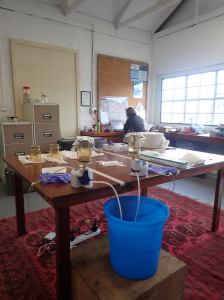
eDNA filtering in progress

To do this, we have been travelling along the southern coast of South Africa, taking water samples along the way in estuaries where our focal species lives, where it used to live, or where it might live. Yesterday we left Knysna to sample water in Klein Brak and Groot Brak. We are especially interested in the Klein Brak estuary, since there are multiple anecdotes that the Knysna seahorse (Hippocampus capensis) used to live here. Nobody has checked recently if it really was the Knysna seahorses and it seems that the most recent sighting has been many years ago. Because of this, it is usually assumed that there are no more Knysna seahorses in Klein Brak.

This brings me to a very important (maybe the most important?) question about this whole endeavour: WHY are we actually doing this? It’s all good an well to say that we want to help these endangered animals, but what exactly are we hoping to achieve? What will our results mean for managing the endangered Knysna seahorse, the critically endangered Estuarine pipefish, or any other endangered small fish for that matter?

IMG_1835

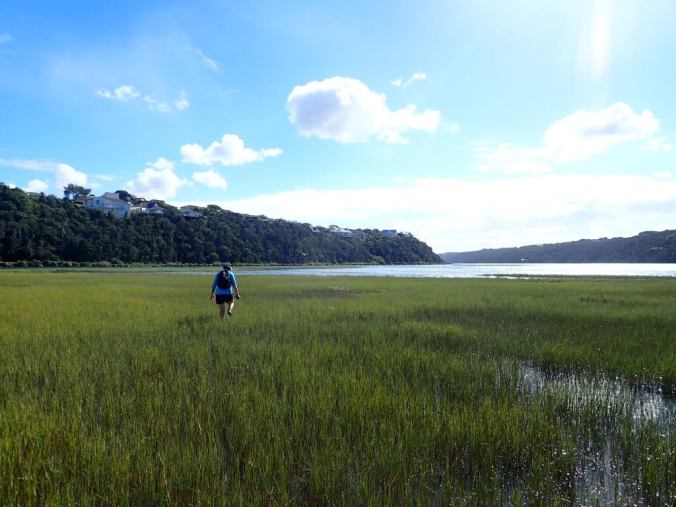
Knysna estuary, just imagine all the seahorses down there!

What we are hoping to achieve can be summarised in three main points.

  1. We want to test if the eDNA method can really be used to find small, endangered fishes (particularly seahorses and their relatives). So far, previous research has shown that eDNA work on large fishes such as sawfish, but it is not sure yet if this will work for seahorses, which are obviously much smaller.
  2. The best case scenario would be that we could also find seahorses in estuaries where it was thought to have disappeared. This would be great news for the conservation status for the species, as it would mean that it occurs in a wider area than we thought, which would mean that it is less likely to go extinct.
  3. If this would happen, it would mean two things. First of all, the new locations would have to be studied, so we can find out how many live in these estuaries. It would also mean that those new places need extra protection and monitoring to ensure the species do not disappear from their newly discovered homes.

Ultimately, if the eDNA method works for small, endangered seahorses (or their relatives), it could be used to monitor small fishes worldwide. This would help solving one of the biggest problems with studying small species, especially those that are rare or hard to find.

LouwKnysna (1)

Louw looking for Knysna seahorses in the Thesen Island Marina (she found 3!)

Finding the Knysna Seahorse: Mini-blog 3

IMG_1714

Kleine Monde

Today was busy, so not enough time to properly write. Instead, to give you an idea of what I do all day,  here is the schedule of today’s fieldwork.

  • 6:00 – Wake up
  • 6:30 – Drive to first site (Kleine Monde)
  • 7:50 – Collect samples (Kleine Monde West, 2 locations)
  • 8:10 – Collect samples (Kleine Monde East, 2 locations)
  • 10:00 – Back at room, start filtering samples
  • 12:30 – Drive to site (Bushmans estuary)
  • 13:15 – Collect samples (Bushmans, 2 locations)
  • 14:50 – Back at room, start filtering samples
  • 19:30 – Realise samples contained more sediment than expected and that filtering will take twice as long as planned, eat food, drink some wine
  • 21:40 – Still filtering, drink tea, lots of tea
  • 23:25 – Finished filtering samples, time to clean up
  • 23:50 – Off to bed!
38704899_290774851475043_3374615427203203072_n

Louw on her way to sample Bushmans estuary


Finding the Knysna Seahorse: Mini-blog 2

IMG_1677

Sunrise in Kariega

Today was the first day of collecting samples in South Africa and the first sampling location was the Kariega estuary, near Kenton-On-Sea. We were joined by two researcher from SAIAB (South African Institute for Aquatic Biodiversity), who study a relative of the Knysna seahorse: the estuarine pipefish (Syngnathus watermeyeri). A species which is critically endangered, it is in fact so rare, that it was thought to be extinct in the early nineties until it was re-sighted in 1995. Since we are collecting environmental DNA (eDNA) samples in this area, we decided to temporarily team up with Paul and Nikki to see if this rare species can be detected with eDNA.

But what exactly is eDNA, or more precisely, how does it work?

The basis of this method is that all living beings contain DNA in their cells, and that all living beings “shed” this DNA in their environment. On land this can for example be through hair or feces, for fish this can happen through mucus, excrement, scales, etc.  These tiny bits of DNA then float in the environment (the water in our case), which brings us to the actual sampling.

38777316_2086748234922179_5249979198688198656_n

Kariega estuary, full of tiny bits of environmental DNA

Collecting eDNA is pretty simple, we just scoop up water. That’s it. Really. But the actual work begins after the water is collected. The first step is to filter the water using a very fine filter which (hopefully) traps all the DNA in the water. At this point there is a LOT of DNA on the filter paper, most of which will be from bacteria, or larger species you may or may not be interested in.

38668211_1926695760728222_5584027590168936448_n

Filtering water, exciting stuff!

The tricky next step (which will be done in the TrEnD laboratory at Curtin University), is to find the DNA you are looking for, which is very much like searching for a needle in a haystack. But both the hay and the needle are so small you can’t actually see it with a microscope. Scientists much smarter than me found a very clever solution to this: they invented a kind of magnet that basically pulls out the needle.

This magnet is called a “primer” and is based on how the DNA of different species (or families, or genera) is different from each other. These differences make it possible for geneticists to develop primers (=magnets) that can detect different things. Some primers are used to detect multiple species, for example: there are primers that will detect (almost) all bony fishes, others could be used to detect sharks. Other primers are more specific, like in our case, where we try to detect only 1 species. Alternatively, another project at Curtin University is currently working on a true “seahorse-magnet”: a primer that will detect all seahorse DNA in the water, regardless which species of seahorse.

As you can imagine, eDNA is a very exciting method with lots of potential uses. It is also a relatively new method, so lots of finer details still need to be studied to make the most of this technique.