Bad luck and How to find a frogfish

A few days ago, I prepared a blog post about a very interesting experiment we had started. It had everything to be cool (at least in my mind): interesting, sciency and a nerdy acronym to go with it! Luke and I were deploying SMURFs (Standard Monitoring Unit for Recruitment of Fish) to look at the habitat preference of baby fishes. The reason it did not get published, is the ocean. The night after successfully deploying the first 15 units, the waves picked up and destroyed all of our work… Marine biology fieldwork can be pretty amazing and it can be rather challenging as well. But that’s the beauty of the ocean: it’s unpredictable. Which can be frustrating at times, but can mean fantastic surprises as well.

Cartoon life_eggs

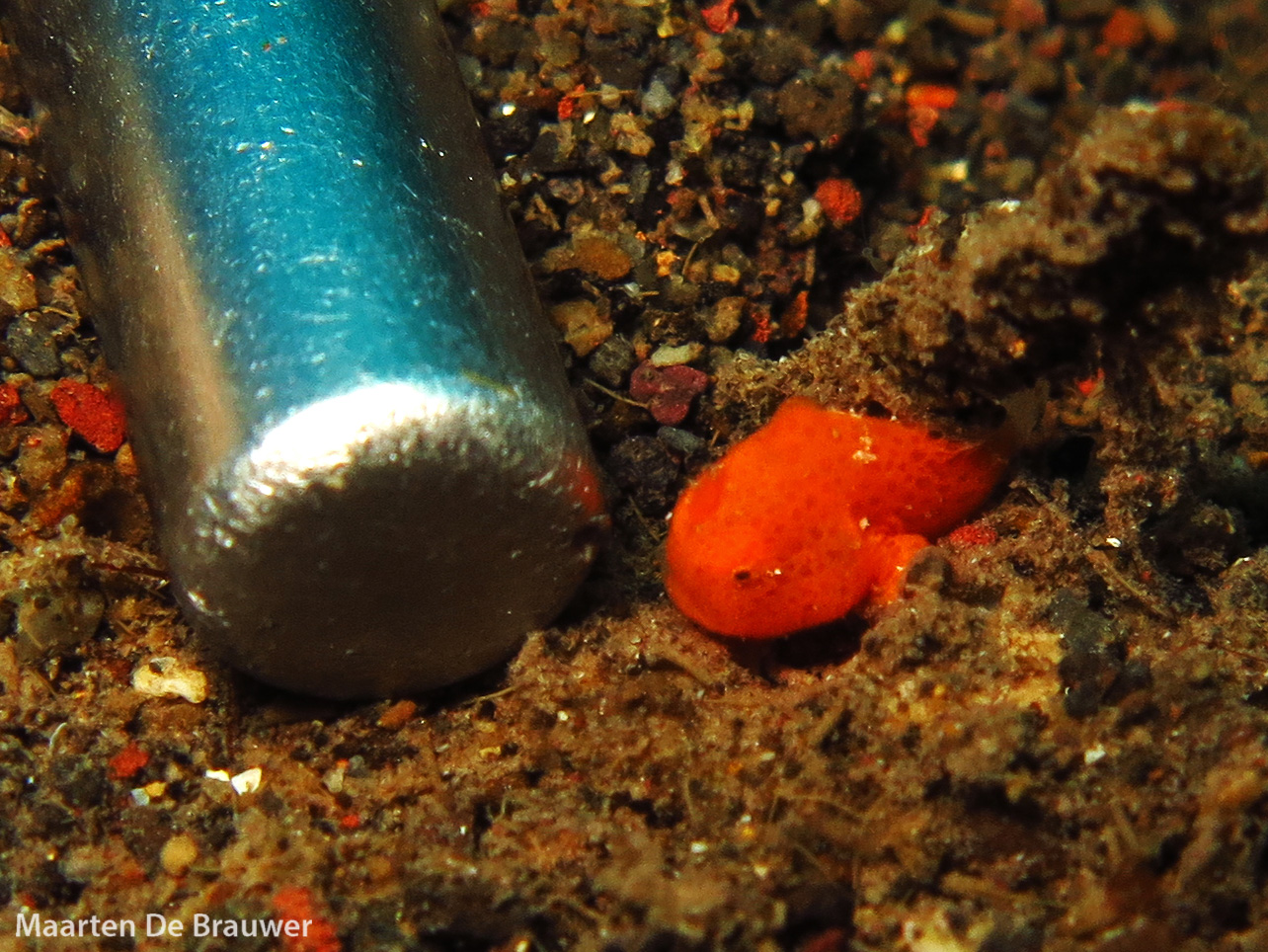
Baby froggie

Baby froggie

Which was proven once again when we found this very cute little baby Frogfish after assessing the damage to our equipment. We don’t know which species it is, since it was still tiny (less than 5mm). It was bright red, which would lead one to falsely believe they are easy to see on black sand. Think again! Next time you dive (or snorkel, or walk) over volcanic black sand, take a close look at the sand and you’ll notice there is a surprising amount of red grains in there. An unexpectedly efficient form of camouflage…

So how do you find a Frogfish? Or other cryptic critters for that matter? They have been evolving for millions of years to be invisible and most of them are very small, so spotting them is something that takes a while to learn. Here are a few tips to make it easier:

  • Movement: Your average Scorpionfish or Frogfish does not move very much, but every now and then they do. Whether it’s a small shifting of the fins, an eyeball that rolls to follow potential prey, or a full swim, our eyes are fantastic at spotting movement. So if you see an unexpected twitch or you think you might have imagined seeing something shift in the corner of your eye, investigate it!
  • Habitat: The critters I am investigating here are usually found on sand, but there are A LOT of different types of sand. Not just the type of sand, but also what’s on it, whether it’s algae, sponges, featherstars, logs, mooring blocks or anything else that offers a minor difference in structure. Certain species of frogfish (eg. Giant Frogfish) are nearly exclusively found on sponges, while other (eg. juvenile Hairy Frogfish) like to hang out in areas with a lot of shell fragments. Sand Divers (Trichonotus sp.) love very loose sand, while Thorny Seahorses seem to prefer coarse sand with plant debris. In this post I explain where to find different species of scorpionfishes.
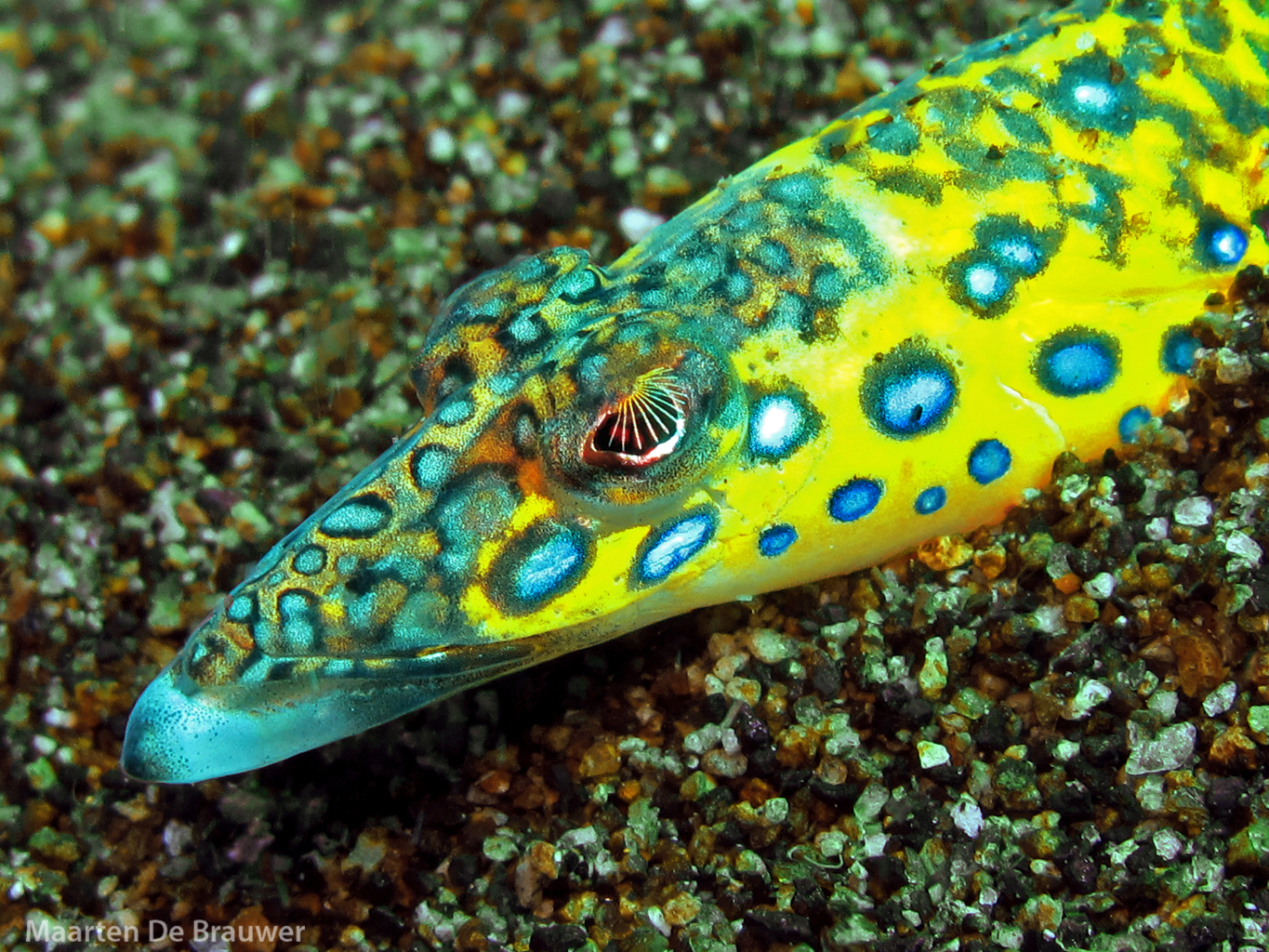
Sand Diver (Trichonotus elegans)

Sand Diver (Trichonotus elegans)

  • Shape: Even with their amazing camouflage, fish will be fish, which means they have (most of) the parts normal fish have. These shapes can help you find them. The distinctive thick pectoral fin of Stonefish are one of the best ways to recognize them. Pygmy seahorses are tiny and hide in big seafans, but they use their tails to hold on, which is one the things you can look for to try and find them.
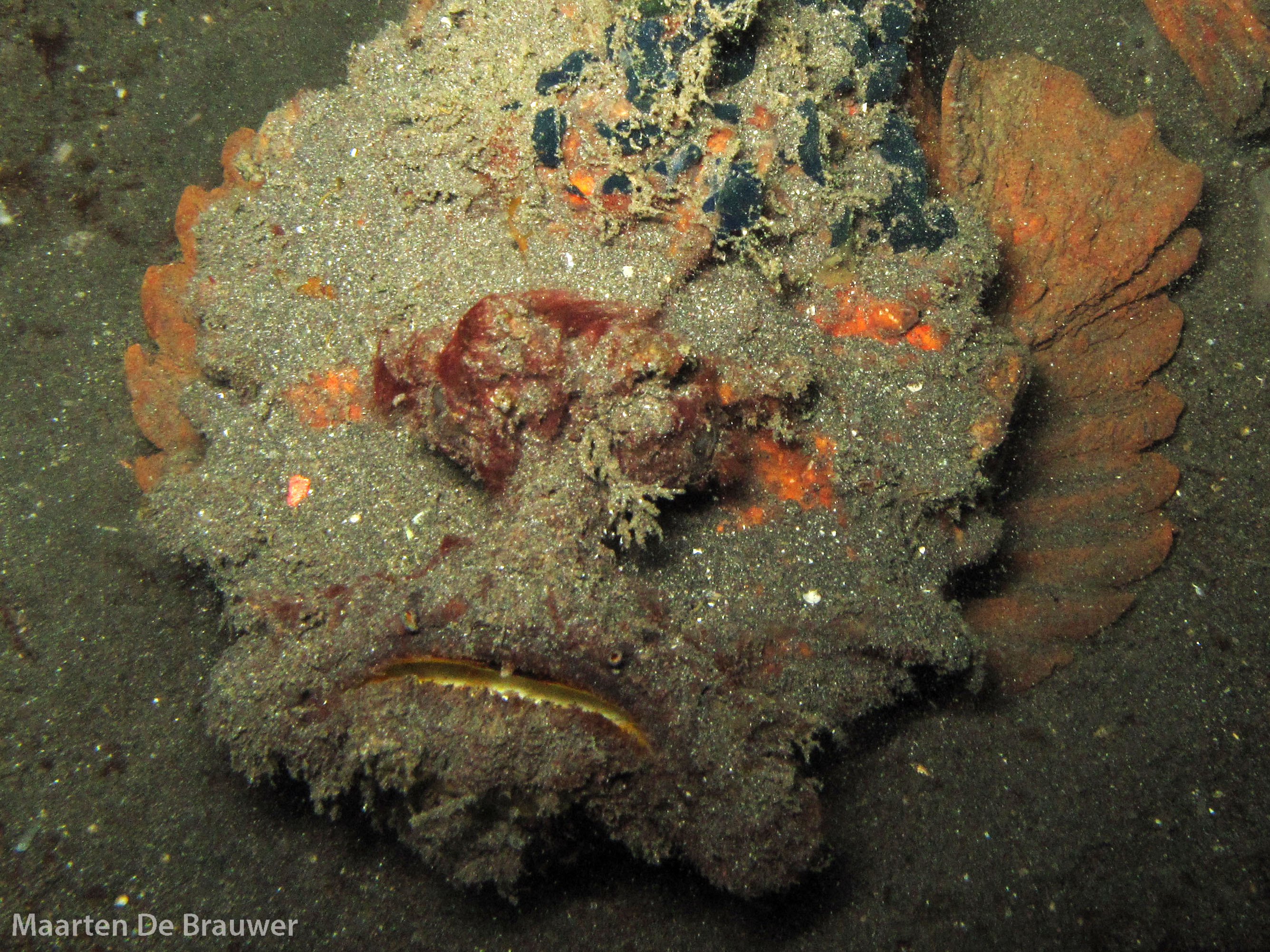
Stonefish are easiest to find by looking at their pectoral fins (orange in this individual)

Stonefish (Synanceia horrida) can be found by looking for their pectoral fins (orange in this individual)

  • Position: your own position makes a massive difference when trying to spot cryptobenthic fauna. If you are high above the sand, everything blends in, these species evolved to hide from most top-down predators. Get close and get low, if there is a slope, look up the slope instead of down, silhouettes often stand out this way.
Robust ghostpipefish (Solenostomus cyanopterus) mimick decaying leaf litter. Getting close and low makes finding them easier

Robust ghostpipefish (Solenostomus cyanopterus) mimick decaying leaf litter. Getting close and low makes finding them easier

  • Luck: In the end, good portion of luck can play a big role in finding that elusive critter you’re looking for. If anyone knows how to get better at this particular method of finding critters, please tell me!

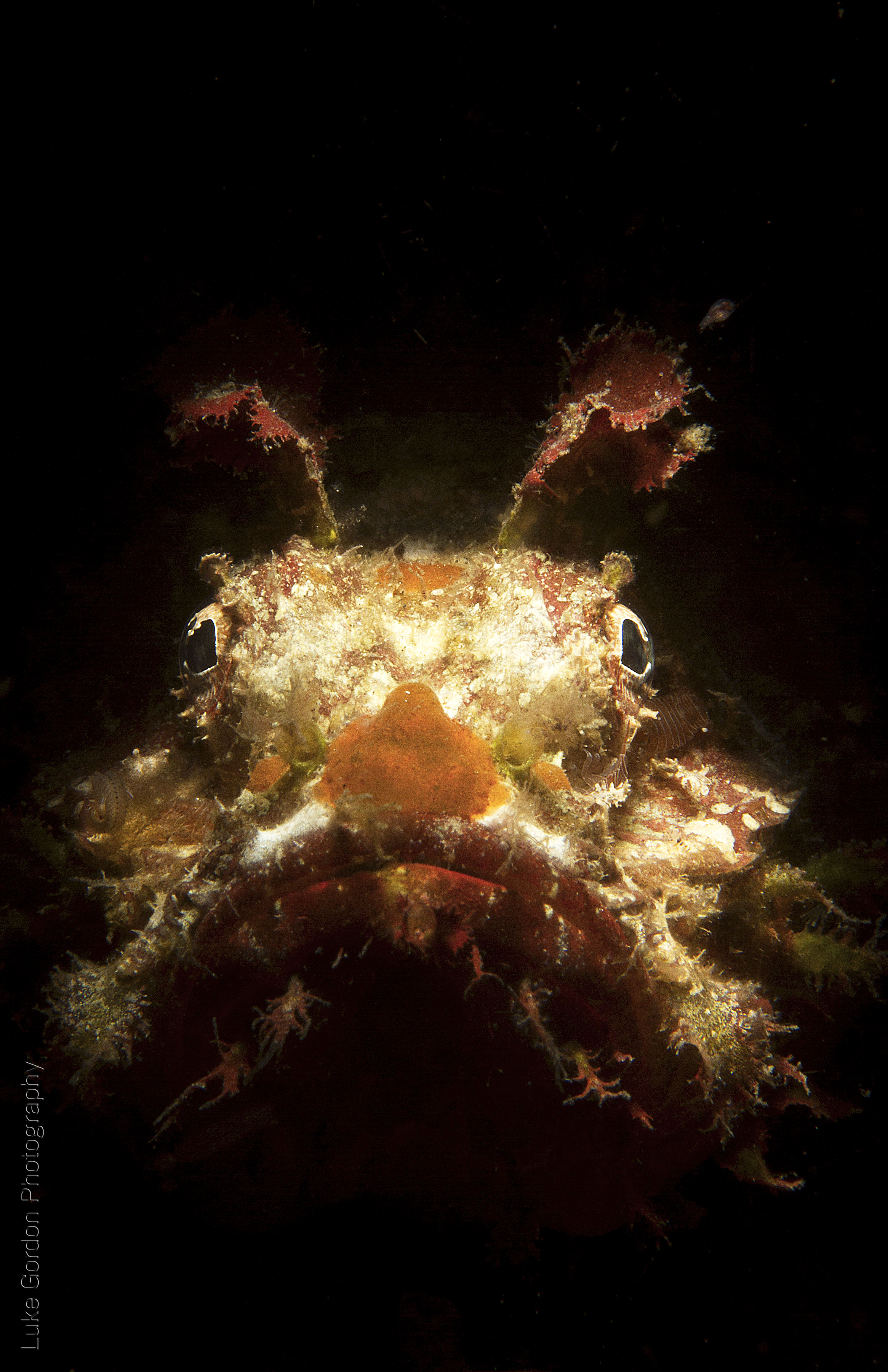
The beauty of Scorpionfishes

Time to ramp up the critter section after the Winged Pipefish and juvenile Batfish. Both of the previous critters are generally considered to look pretty or at least kind of cute, which is often not the case for members of the Scorpionfish family.

Flasher Scorpionfish (Scorpaenopsis macrochir)

Flasher Scorpionfish (Scorpaenopsis macrochir)

Ever since I’ve started diving I’ve been intrigued by Scorpionfishes and I never get bored looking at them. They are well camouflaged predatory fishes that lay on the bottom (true “benthic” critters!), waiting for unsuspecting prey to pass by. Or maybe they just use that as an excuse to chill out most of the time. The benefit of this lazy behaviour is that they are easy to photograph, provided you can find them of course.

What I’d like to do with this post is prove to you how beautiful Scorpionfishes can be. They often get a bad reputation because of their venomous spines and (supposedly) ugly looks, which is demonstrated by some of their common names: Devilfish, Dragonhead-fish (in German: “Drachenkopf”), Stingfish, Waspfish, … While it is undeniably true that you’d best avoid planting your feet or hands on species of the Scorpaenid-family, they are not aggressive at all. So if you keep a safe distance, you can take all the time you want to watch and/or photograph them.

Algal growth anyone?

Flasher Scorpionfish

Once you start really observing them, you will find out that they are absolutely amazing. There are many species (>300 worldwide), but you’ll commonly encounter about 10 of them while diving in the Coral Triangle. Lionfishes are also a part of this family, but they already get loads of attention, so I won’t talk about them here. Scorpionfishes are well camouflaged, but that does not mean they look boring or always have drab colours. I’ve seen them in all shades ranging from white, to red, green, yellow, pink and black. Most species rely on their colour (which they can change) to blend in with their environment. Others grow filaments resembling algae or get covered in actual algae and/or hydroids to blend in even better.

All of this would already be enough to classify them as pretty cool critters, but there is more. The main reason I like them so much is that they look as if they have very strong and (at least so I imagine) cantankerous personalities. Their big heads and grumpy, down-turned mouths just give them that extra charisma that most fish lack. Combined with their armoured heads that have spines all over them, it makes them look like rather bad-ass bottom crawlers.

Very tired looking baby Scorpionfish

Very tired looking baby Scorpionfish

Here are some of the more commonly fond species and how to tell them apart. There is quite a lot of text, so if you don’t have time, just watch the pretty pictures:

  • Tasseled Scorpion Fish (Scorpaenopsis oxycephala): A large fish (up to 35cm), pronounced skin tassels on the chin and a long, “humped” snout. Usually found close to corals, or even laying on top of them.
Tasseled Scorpionfish (Scorpaenopsis oxycephala)

Tasseled Scorpionfish (Scorpaenopsis oxycephala)

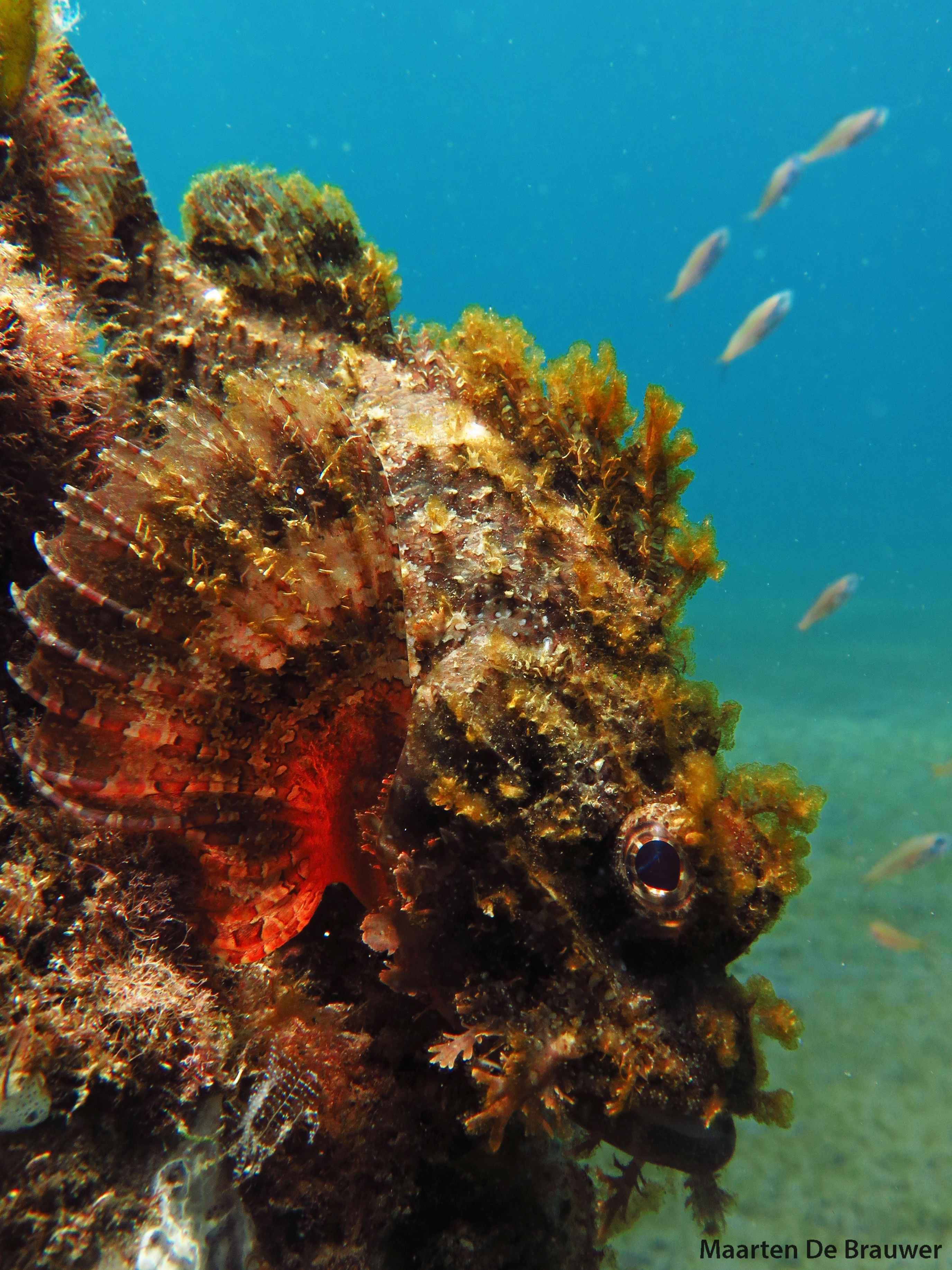
  • Raggy Scorpionfish (Scorpaenopsis venosa): Similar to the Bearded Scorpionfish, but smaller (up to 20cm). The Raggy Scoropinfish has a lot more filaments growing over its body, and usually has big cirri (skin filaments) above the eyes. Furthermore, their snouts are not as long as those of their bearded cousins. They are often found near or on algae covered objects such as mooring blocks, ropes or wrecks.
Raggy Scorpionfish (Scorpaenopsis venosa)

Raggy Scorpionfish (Scorpaenopsis venosa)

  • Flasher Scorpionfish (Scorpaenopsis macrochir): Flashers are smaller still (up to 15cm) and have a pronounced hump on their back. Devil Scorpionfish share this feature, but are larger and have an even bigger hump. The inner surface of the pectoral fins of Flashers are bright yellow to orange with a dark, black band on the edge (which also sets them apart from the Devil Scorpionfish). You’ll find Flasher Scorpionfishes on sandy and rubbly areas.
Flasher Scorpiofish (Scorpaenopsis macrochir)

Flasher Scorpiofish (Scorpaenopsis macrochir)

  • Whiteface Waspfish (Richardsonichthys leucogaster): A small scorpaenid (max 10 cm), which is often red to brown, with a white face. Their dorsal fins have deep incisions, setting them apart from other Waspfishes. They are usually found on sand or mud bottoms.
Whiteface Waspfish (Richardsonichthys leacogaster)

Whiteface Waspfish (Richardsonichthys leacogaster)

  • Ambon Scorpionfish (Pteroidichthys amboinensis): These guys take camouflage to the next level, with even more algal growth and hairlike filaments growing on them than the Raggy Scorpionfish. They have very long, arching cirri above the eyes, and big pectoral fins, which are often transparent. Ambons are small (up to 12cm) and are only found on sandy and muddy substrates, often in areas with a lot of algal growth.
Ambon Scorpionfish

Ambon Scorpionfish (Pteroidichthys amboinensis)

  • Indian Ocean Walkman / Spiny Devilfish (Inimicus didactylus): This is one of my favourites, it is a medium sized (max 18cm) fish mostly made up of spines and other sharp bits, with a big, upturned mouth and eyes that are elevated. The front of their pectoral fins has evolved into 3 “fingers” which they use to walk over the bottom. Like the Flasher Scorpionfish, the inside of their pectoral fins is brightly coloured and used as a warning signal to potential predators. They spend a lot of time buried in sand or rubble near reefs, with only the eyes, mouth and spines sticking out.
Indian Ocean Walkman (Inimicus didactylus)

Indian Ocean Walkman (Inimicus didactylus)

  • Stonefish (Synanceia verrucosa): Stonefishes often get confused with Scorpionfishes, but there are some key differences. To start with, they are WAY better camouflaged than any Scorpionfish around. Chances are, if you found it yourself (as opposed to your diveguide), it was mostly likely NOT a Stonefish. They get a larger than most scorpionfishes here (up to 35cm). The best ways to ID them are: a completely upturned mouth on the TOP of its head, a shape that does not even closely resemble a normal fish (a crumpled up cardboard box or a big blob are better comparisons), and very large, thick pectoral fins. To make finding them even harder, they often bury themselves in the sand, just like the Spiny Devilfish. Stonefishes are found on sand and rubble close to coral reefs.
Stonefish (Synanceia verrucosa)

Stonefish (Synanceia verrucosa)

Enjoy the selection of photos (most of them by Luke Gordon) and next time you go diving, take your time to really look at any scorpionfish you might find.

The value of muck dive critters

One of the benefits of doing fieldwork from a dive resort instead of a research station, is that I get to talk to a lot of people who aren’t scientists, but are still interested in the species I am investigating. I frequently get questions that are very relevant, but that you’d rarely get from professional researchers.

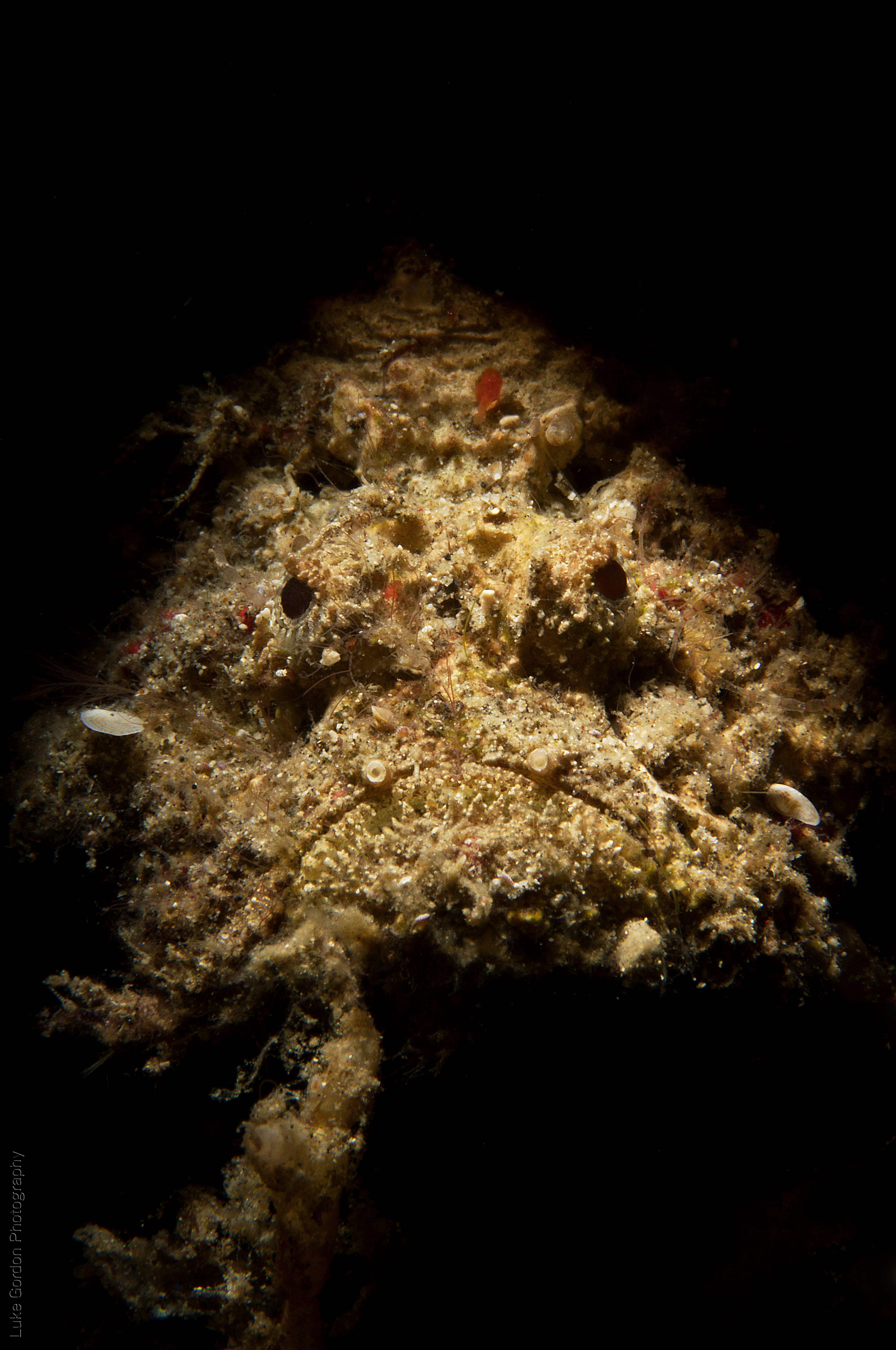
Is it a sponge? Is it a rock? It's a Warty Frogfish! (Antennarius maculatus)

Is it a sponge? Is it a rock? It’s a Warty Frogfish! (Antennarius maculatus)

One of those returning questions is: “WHY are you doing this research?”. What is the point of spending over 3 years of your life looking at animals that most people have never heard about, let alone care about? Experienced divers are usually interested in the results, but non-divers can be baffled by the fact that I would like to know everything there is to know about animals that look like sponges and move about as much as well. What is more, I’m not just interested in their biology, I also want to know how much they are worth economically.

As divers and photographers, assigning an economic value to the species we like to observe might sound like a strange idea. Finding, watching and photographing amazing underwater life is an experience that is invaluable to many of us. It’s more than just ticking boxes, it is an experience that takes us out of everyday life and inspires us. It is something to talk about and share with fellow divers, friends and family. Putting dollar signs on that might seem like selling out, until you realise divers are not the only ones using the marine environment.

The protection of species or ecosystems frequently competes with other economic interests, such as palm oil plantations and fishing. While these are important sources of income, they can decrease the value and health of the natural environment. Determining the monetary value of dive tourism allows us to make comparisons with other industries and with different uses of marine resources. Case studies show that tourism can be a valuable, sustainable alternative to more destructive uses of the natural environment.

A good example is shark diving in Palau, which has been estimated to be worth about US$ 18 million per year. Harvesting the Palauan shark population for fishing instead would be worth less than US$ 11,000. In the light of these numbers, it is clear why it was a good idea from the Palauan government to declare the waters around Palau as shark sanctuary. When practiced in a sustainable manner, dive tourism offers an alternative income for fishing communities, while simultaneously increasing awareness in those communities and the tourists diving in the region.

As part of my PhD, I am investigating the economic value of muck dive tourism in Southeast Asia. Results will hopefully stimulate conservation and research interest in the species that are important to divers, but are often poorly understood by science. Besides interviewing divers, dive guides and dive centre owners, I have also developed an online survey to investigate which species are most popular with muck divers.

If you would like to help out (and haven’t done so already) please take the survey. It should take you no more than 5 minutes. To access the survey please follow this link. If you want to learn more about reason why we should protect endangered species and how economic value plays an important role, this article on BBC Earth is a great read. It explains better than I ever could why I am spending my days looking at critters in the sand.

This is an adapted version of an article I wrote last month for Wetpixel, if you’d like to read more, you can find the full article here

Indian Ocean Walkman (Inimicus didactylus)

What would the value be of this adorable fish? (Indian Ocean Walkman -Inimicus didactylus)

Baby Zebra Batfish

The next species which I think deserves more attention than it currently gets, is the (baby) Zebra batfish (Platax batavianus). It is also known as the Batavia batfish, Humphead spadefish and probably a dozen or so other names. The reason I’ve taken a liking to this little guy is not just because it is an awesome little critter, but also because I finally got to see it after having it on my wish list for about 7 years.

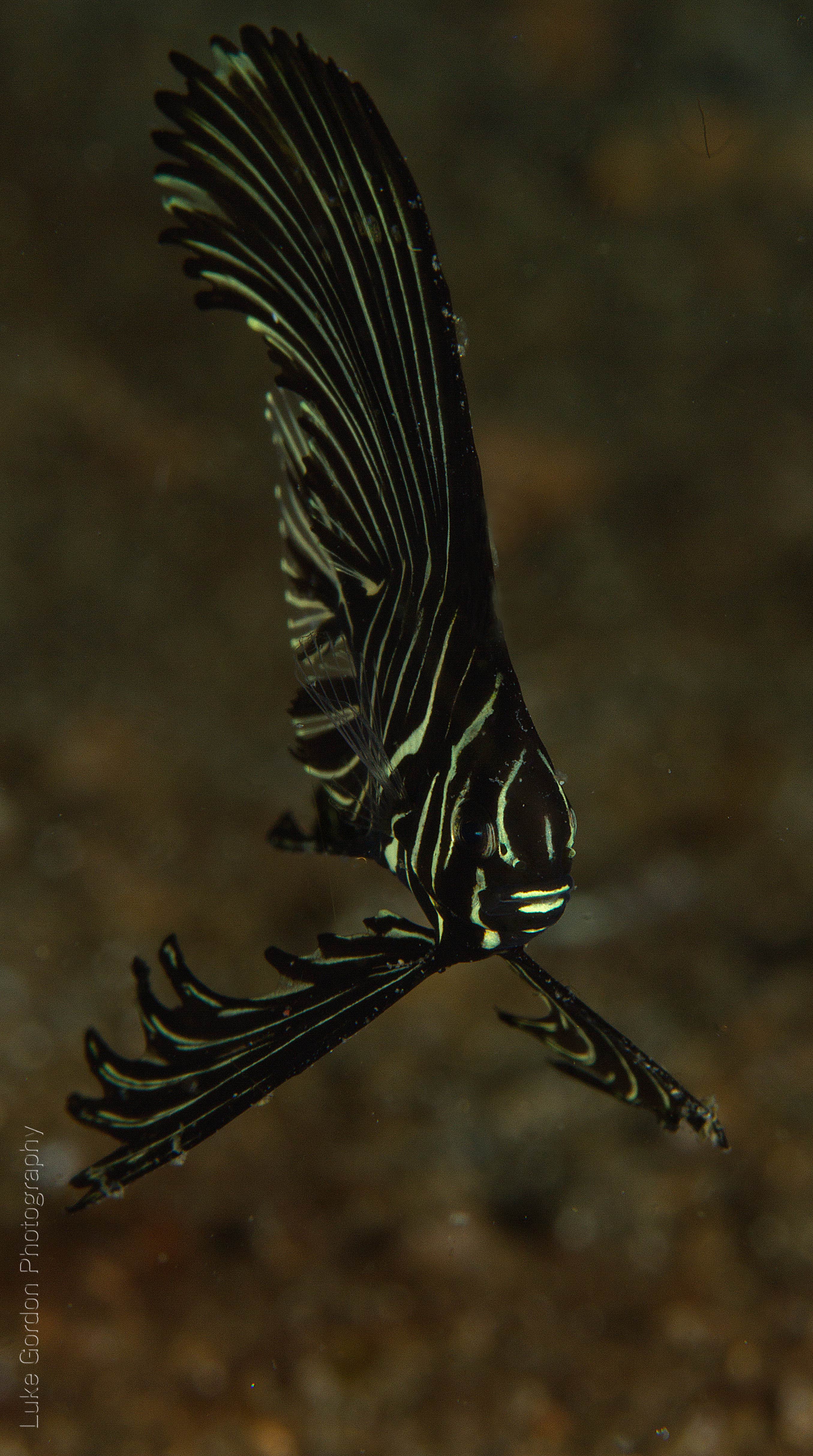
Batavia batfish adults are not very different than most other batfishes, if possible they might actually be a bit uglier, in any case, they don’t really stand out. They do stand out however in the juvenile phase, and they do so rather magnificently! Check out this great picture Luke took a few days ago:

Zebra batfish (Platax batavianus)

Zebra batfish (Platax batavianus)

In the batfish genus, it is quite a common occurrence for the juveniles to differ greatly from the adults. As not to distract you in this post dedicated to the Batavia batfish, here are links to the juvenile Orbicular batfish and Pinnate batfish. They are almost as amazing as the Zebra batfish, so I do encourage to have a look at them after reading this post!

Zebra batfish are named for their juvenile pattern, which helps distort their outline, again providing camouflage to the rather slow moving fish. Very little is known about the ecology of this species (surprise surprise!) but these are a few things I managed to find from the literature:

Zebra batfish, large juvenile (12 cm)

Zebra batfish, large juvenile (12 cm)

  • Baby batfishes tend to settle on the reef (change from open water swimming, transparant larvae to coloured fish living on reefs) when they are between 1.5 cm and 3 cm. Before they settle on the reef, batfish larvae mostly swim close to the surface of the water.
  • Baby batfishes seem to be mostly attracted to the base of the reef (where the reef meets the sand) or to mangroves.
  • Baby Zebra batfish are usually found on the sand, hiding close to feather stars, sponges or soft corals.
  • Batfishes are mostly herbivores, feeding on algae by day. Some species also feed on zooplankton (small animals floating in the water) at night.
  • Juvenile batfishes (all species) are popular in the marine aquarium trade, but they are very hard to keep alive, so most die within a few days/weeks. If they do survive to adulthood, the often get to big for their tank (over 50 cm) and are subsequently “discarded”. Which is why some batfish species are now an invasive species off the coast of Florida
Baby Zebra Batfish (Platax batavianus)

Baby Zebra Batfish (6 cm)

Conclusion for this little critter? It is better to be patient and go to the right places to see it in the wild instead of getting it in your aquarium. Not only will you be doing reefs a favour, seeing these gorgeous fish in the wild makes for a much more rewarding experience than just buying one.

Oh, and if you were wondering where it got its scientific name, Batavia is the old name for Jakarta (the capital of Indonesia). When Cuvier described the species (1831), this was how Jakarta was known, so I am guessing the original specimen he used to describe this species was either caught or shipped from anywhere near Jakarta.