New publication: Finding fluorescent critters

Great news! I can finally share the reason why I was playing around with fluorescent torches for the last three years. The main biofluorescence paper I have been working on was published two weeks ago in the journal Conservation biology, happy days!

Previously I have written blog posts about funky biofluorescing fish, publications on frogfish that might be using fluorescence to attract prey, or just some funky fluo pictures to keep you you entertained. This particular story is about why I started working on biofluorescence in the first place and how the results of the research might help to protect little critters.

A pictus_fluo profile_MDB

Biofluorescent painted frogfish (Antennarius pictus)

As anyone who has ever tried to find small or camouflaged critters during a dive will be able to tell you, the little guys are pretty hard to find! This isn’t just a problem for a dive guide who wants to show pygmy seahorses or small frogfish to his divers, it is also a very real and well-known problem for marine biologists trying to study them. Finding these “cryptic” critters might be a headache for divers, but there is much more at stake when you are trying to collect data about critters that might be endangered with extinction.

If you are trying to figure out if an animal is endangered, the obvious first thing you want to know is “how many of them are out there?”. All good and well when you are studying elephants or giraffes, but slightly more tricky when you’re studying pygmy seahorses or a tiny goby that’s less than 3cm long! Not finding any pygmy seahorses or gobies could just mean that you didn’t look hard enough.
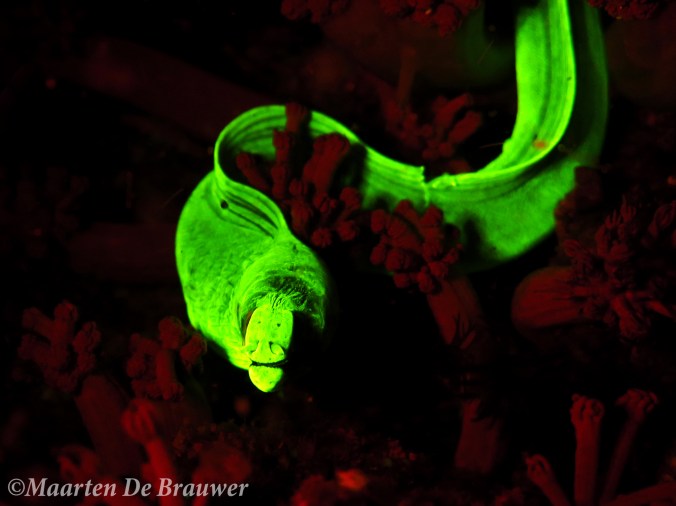
Moray_MDB

Biofluorescent moray eel (Gymnothorax zonipectis)

Scientists have three different ways of coping with this issue:

  • First option: Ignoring the problem by not counting small, cryptic animals when doing surveys. After all, if you weren’t looking it’s only normal you didn’t find any.
  • Second option: Adapting standard “visual surveys”. Usually by going slower or looking harder at a smaller area than when looking for big fish. This way you find more cryptic critters, but a lot still depends on how good a researcher is at spotting small fish.
  • Third option: (you might not like this one) Using chemicals that either stun or kill all the fish in a small area, after which all the fish are collected and counted. This method is very efficient and gives a good idea of which fish were living in that area. Unfortunately using methods that kill fish are not ideal, especially when you might be dealing with rare species.
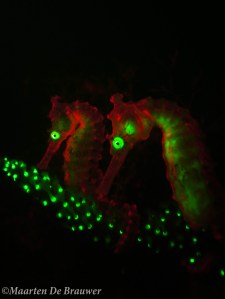
Hippocampus subelongatus_couple_MDB

Two fluorescent seahorses (Hippocampus subelongatus)

This is where biofluorescence could come in to help. If you are confused about what biofluorescence is, definitely check out this post or this website. But briefly, biofluorescence happens when fish first absorb light and then reflect it in a different colour. Importantly, biofluorescence is  not the same as bioluminescence, where animals produce their own light.

So what has biofluorescence to do with finding cryptic fishes? A few years ago, a paper was published that stated that biofluorescence is common in camouflaged fishes. The work looked into evolutionary history, but the main idea triggered a little light bulb. I had previously seen coral researchers use biofluorescence to find baby corals (which are tiny, transparent, and VERY hard to see), so I wondered if the same technique could be used on cryptic fish.

Bandtail_MDB

The same bandtail scorpionfish (Scorpaenopsis neglecta), with and without fluorescence

So I decided to test it as a part of my PhD. I was very lucky to get support from multiple divecentres which helped me to go fluo-diving all across Indonesia and the Philippines. In the last 3 years I did over 200 dives observing, investigating, counting, and cursing fluo-and non-fluorescent fish. The results are published here, but the answer is: Yes, you can use biofluorescence to count cryptic fishes.

The vast majority (87%) of cryptic fishes I tested showed biofluorescence, compared to a small fraction (9%) of the non-cryptic fishes. A cryptic fish is 70.9 times more likely to be biofluorescent than a non-cryptic one! When comparing normal surveys with fluorescence surveys, I found three times as many triplefins (a small cryptic fish species) when using fluo surveys than during comparable normal surveys.

What was also really exciting (to me at least) is that I discovered that pygmy seahorses are fluorescent as well! Using fluorescence I found twice as many Bargibant’s pygmy seahorses than without the fluo torch. As if they weren’t cute enough already, these little guys are fluo pink when you look at them with the right tools!

Fluorescing seahorses are not the only reason why I am excited about this new publication…although it probably plays a bigger role than it should in order to call myself a serious scientist 😉 The great thing is that this is an easy and cheap technique that could help researchers study and conserve small fishes more efficiently than before. And in the end, that’s what it’s all about for me, making sure the oceans remain an amazing place full of critters to enjoy looking at…
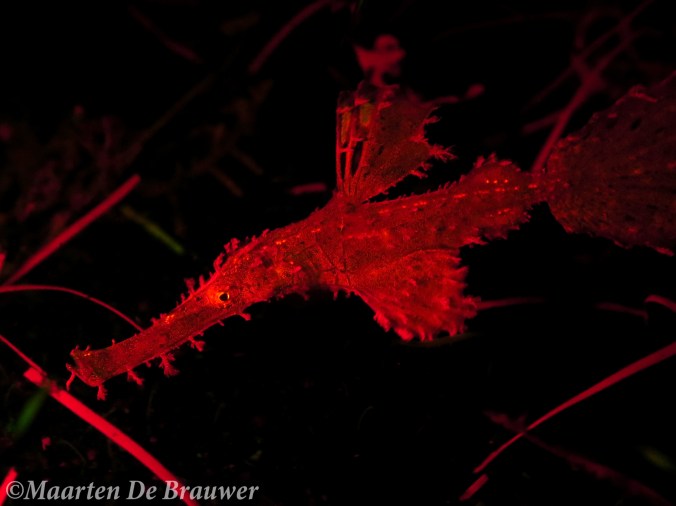
Solenostomus cyanopterus_Fluo_MDB

Robust ghostpipefish (Solenostomus cyanopterus) are biofluorescent too!

 

Guest blog: Big brother is watching – Spying on the secret lives of endangered seahorses

Louw_CroppedIt’s time for a new guestblog, this one is by the amazing Louw Claassens. Louw is a South-African marine scientist at the Knysna Basin Project and a member of the IUCN Seahorse specialist group. She studies one of the world’s most endangered seahorses, part of her work involves studying their behaviour, which recently resulted in a very interesting publication (go check it out!). In this guestblog she gives you the most important findings of that paper and shares some fantastic video footage. Enjoy!


A big part of ecological research is based on observations – where do animals occur, what do they eat, what do they do. Some of these questions can be answered by using standard scientific methods e.g. a population survey can tell you where animals occur (although why is a whole other kettle of fish!). The tricky part sets in when you want to find out what an animal is doing. Conventionally, this entails going to the animal in question and watching it (sounds pretty simple, right?!). But it is here where observational effect (the act of observing has an effect on behaviour) and observational bias (researcher bias as to expected behaviour) creeps in.

GoPro

I spy with my little…GoPro? (Photo: Louw Claassens)

One of the 21st century solutions to these observational problems, is using cameras to study animals, and we are now even able to use cameras to study animals under water (thank goodness for relatively cheap action cameras such as GoPro’s!). Most fish research uses cameras to look at fish diversity, abundance, and habitat use – with limited work on actual fish behaviour. One of the reasons for this is probably owing to the highly mobile nature of most fish species.

So, is there a place for action cameras in fish behavioural research?

We focused on seahorses to answer this question. The conventional way to study seahorse behaviour entails getting in the water and watching the seahorse go about its business. Or, getting some seahorses and conducting observational research in the lab. The first method is problematic owing to two reasons: 1) Observer effect (the seahorse might act differently when you are watching it), and 2) seahorses move quite slowly most of the time, so detecting a behavioral pattern is quite difficult. Not even to mention the costs and time involved in doing this. The latter method might make sense, but it is well known that animal behaviour in captivity is rarely authentic.

H. capensis_cropped

A very well camouflaged Knysna seahorse (Hippocampus capensis) (Photo: Louw Claassens)

Our aim was to test the efficacy of using video cameras to study the natural behaviour of a seahorse, and we had the perfect opportunity to do this! During a recent population survey of the endangered Knysna seahorse (Hippocampus capensis) in the Knysna estuary (South Africa) we found a stable population within a residential marina estate. The seahorses were found to use artificial Reno mattresses (wire cages filled with rocks). We had the seahorses, we had a relatively protected area to deploy cameras, and we had a sturdy structure to attach the cameras to.

In the first instance, we wanted to see if seahorse behaviour changed throughout the day e.g. between the morning, midday and afternoon. To add to this, we had an opportunity to see what happens to seahorse behaviour during the busy December holiday season. To do this, we used boat noise as a potential stressor (as occupancy of the residential marina estate increases from ~30 % to 100 % over the holiday period).

Video: Aggressive behaviour in the Knysna seahorse (Hippocampus capensis) – main action starts at 0:45.

But first we had to see if cameras successfully captured seahorse behaviour and if they could be used in behavioural assessments. We conducted a short trial period to test this, and found that 49 % of footage recorded contained seahorses. Using this data, we created an ethogram (a catalogue or table of all the different kinds of behaviour or activity observed in an animal) for H. capensis:

  • Feeding: the seahorse is actively searching for prey animals.
  • Irritation: identified by increased clicking and tail adjustments.
  • Moving from holdfast to holdfast: seahorse moves around without any feeding behaviour in-between.
  • Interaction: interaction behaviour can either be between a male and female as part of courting or between seahorses of the same sex and might entail aggression.
  • Stationary: seahorse remains completely still.

Video: Knysna seahorse (Hippocampus capensis) feeding

The next step was to deploy the cameras throughout the day (morning, midday and afternoon) and across the longer time periods (Pre-holiday, Holiday and Post-Holiday). To assess behaviour we used 10-min video sections as a sample and timed all observed behaviour for a single focal animal during the sample.

We recorded hours of footage, of which 57 hours contained suitable footage of seahorse behaviour. Seahorses spent 82 % of their time feeding and we noted courting behaviour exclusively in the morning. This courting behaviour entailed grasping of the female’s tail by the male in an attempt to position himself face to face with the female, followed by swaying movements. We also found that seahorses were more visible and fed more during the morning. There were no differences between the behaviour of males and females.

Graphic footage! Video of a cormorant catching a seahorse (H. capensis)

We observed quite a few cuttlefish, rays and cormorants, but only noted predation by the latter (check out the video above!). Seahorses were also observed happily living side by side with octopus, although octopus are known to eat seahorses in Australia. We also noted some other curious fish, like our temperate butterfly fish (Chaetodon marleyi) (video below) – can you spot the seahorse?

A cold water butterfly fish (Chaetodon marleyi) checking out Louw’s GoPro setup

When we looked at behavioural changes across the longer-term periods, we noted a decrease in visibility and feeding activity of the focal seahorse, with an increase in irritation behaviour, during the holiday period. No courting behaviour was noted during the holiday period – which is a bit concerning, seeing that this species breeding season is from September to March.  Feeding activity and seahorse visibility increased again during the post-holiday period.

So, what does all this tell us? Action cameras are pretty useful in studying natural behaviour of seahorses. Recorded footage can be watched on fast-forward mode which enables a clear view of the behavioural pattern of the animal (something that is quite difficult to see whilst diving, as these guys move so slowly). For H. capensis, it was the first time that natural behaviour was studied, and we gained some valuable information with regards to feeding and interaction behaviour. In addition, it seems that boat noise has a negative effect on the natural behaviour of this species – an aspect which does need further research (preferably, a controlled experimental approach is needed here, to control the vast number of confounding factors that might have played a role!). The use of cameras in natural seagrass habitat also needs to be tested, as visibility might be problematic in dense vegetation.

In the past, the world of underwater research was exclusively meant for the eyes of the researcher/diver. Now, we are able to bring what we experience to the surface and to the lay person. And perhaps the real power of doing this is to create and instill that love and passion for the underwater world that all divers and water lovers have, in all people. I mean, who cannot fall in love with two seahorses doing their morning courting dance?

The secret sex lives of seahorses: mating dance of the Knysna seahorse

What’s in a (species) name?

A recent publication about the family tree of manta and mobula rays got quite a lot of attention on my social media feeds, inspiring me to explore the topic a bit further. I’ll try to keep this blog as jargon-free as possible, but I apologise in advance if I occasionally veer off into technical terminology.

Manta and me

Manta-selfie in younger days

Before I get going in earnest, a quick introduction to scientific names (or “binomial nomenclature“). Scientific names consists of two parts, the first part is the genus of the species (a bit like your surname), the second part the actual species name (like your first name). A few examples: Antennarius pictus, Homo sapiens, Wunderpus photogenicus. Names are usually in Latin or Greek, or anything that vaguely sounds like either one of those. Unlike common names, the scientific names for species are the same wherever you go in the world, which is helpful when talking to scientists who speak a different language than you do.

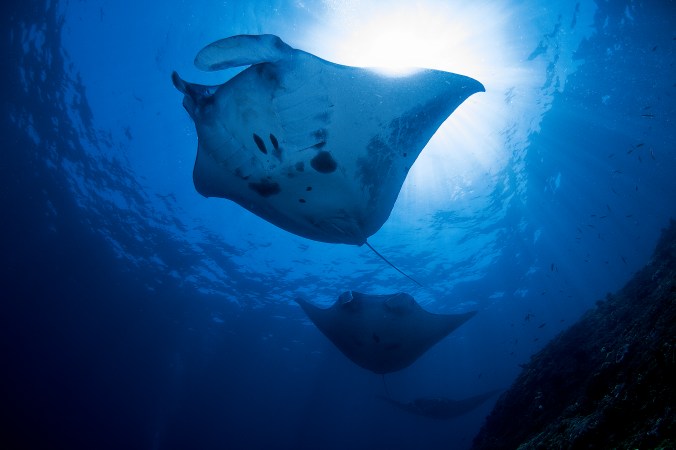
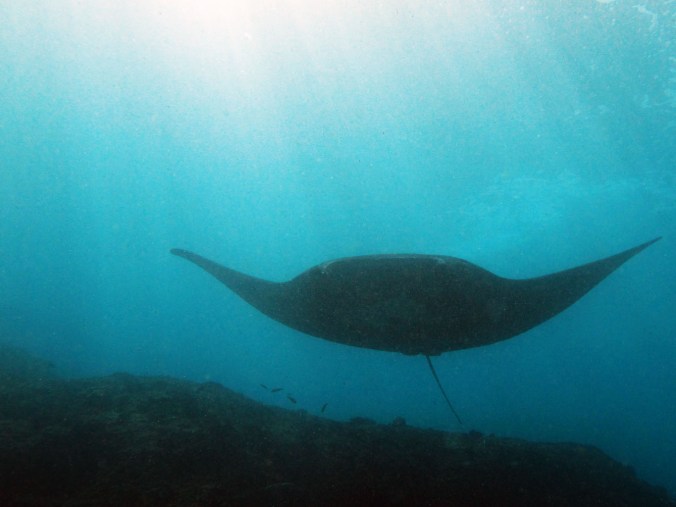
So what is the manta vs. mobula article all about? Manta rays are large, charismatic fish that grow up to 7m wide who look and feel a bit like stealth bombers when they glide over your head during a dive. Until recently, two species of manta rays were recognised: Oceanic manta rays (Manta birostris) and reef manta rays (Manta alfredi). Mobula rays look very similar to manta rays, but are smaller and differ from mantas in a few other ways. The newly published paper did genetic research to see just how closely mantas and mobulas are related, and they turn out to be a lot closer related than we previously thought. To put it into human perspective, as a species manta rays were thought to be something like a cousin to mobulas, but they turn out to be more like a brother/sister. In biology-slang: manta rays are now seen as belonging to the same genus as mobula rays. Which in turns means that their scientific name changes from Manta to Mobula, so Mobula birostris and Mobula alfredi. A bit like an adopted child getting a new last name.

_MG_1792 as Smart Object-1.jpg

Reef manta rays (Mobula alfredi) – Photo by Luke Gordon

What the article does NOT claim, is that manta rays are now suddenly a different species. It just means they are classified differently by taxonomists (and that they might get more invitations to Mobula social events). The common names will remain the same, manta ray species do not suddenly disappear or behave differently. It will take a while before ID guides will pick up on the name change and a lot longer (if ever) before the majority of ocean enthusiasts will notice.

A good point made by a friend, is that a different scientific name means certain official documents concerning the trade in protected species might have to be adjusted. Luckily the statute of manta rays as a species is not questioned, so existing conservation laws should not need to be changed.

But how does this happen? Why do scientists decide that a species has a different family tree than we’ve always thought? This is actually not an uncommon event, in the last years many species (including nudibranchs and frogfishes) received different names and classifications. One reason is that science is constantly evolving and as we learn more, we update our knowledge and correct mistakes from the past (or make new mistakes which might in turn be corrected later). In the manta/mobula-case: by using modern methods we found out that the family-relations were different than we assumed from only looking at the anatomy of these animals.

Manta coming up

Manta ray (Mobula alfredi) making its stealth bomber-like approach

Another (more surprising) reason, is that we still don’t have a good definition of what a species is. Human nature impels us to order the world around us into categories with different names, initially very broad (animal / plant / rock), then more detailed (fish / mammal / bird), more detailed still (ray / shark / frogfish), until you reach the scientific naming system (Mobula birostris / Mobula alfredi / Mobula mobular). But sometimes it is difficult to decide where one species stops and another one ends.

I know that at school you get taught that two species are different when they can’t produce fertile offspring (Horse + Donkey = Mule, but mules are infertile, so horses and donkeys are different species). To a large extent this definition works, but it breaks down when you start looking closer, especially when you look in the ocean. The question on how to define a species is a surprisingly hot topic in biology! I will explore the species-definition problem in a different blog later (promise!), but it would make this one a bit too long.

In the meantime, you can call manta rays Mantas, Devil rays, Big-ass mobulas, or anything else that floats your boat. As long as you have a great time watching them and try to protect the environment they live in I’m happy!

_MG_1802 as Smart Object-1

Does it really matter what these beautiful animals are called? Photo by Luke Gordon

Seahorse and pipefish blog collection

syngbioI am currently in Florida at the University of Tampa, to attend Syngbio 2017. Syngbio is the global conference about Syngnathidae. “Syngnathidae” is the scientific name for the group of animals that consists of seahorses, pipefishes, etc. The conference is being attended by over 100 experts from across the world, who are discussing topics ranging from behaviour, to genetics, husbandry and conservation.

Once the conference is over, I will write a blog about the main conclusions of the conference. But since I am currently in a syngnathid mind-set, I figured it made sense to have a look at previous blog posts I wrote about seahorses and their relatives and combine them for anyone interested to learn more about these fascinating animals.

  • Little known seahorse facts: an overview of interesting facts about seahorses you might not have heard of before
  • Winged pipefish: one of my favourite pipefish species that I feel deserves more attention
  • Seadragons and other critters found in the cold waters around Sydney
  • Ruby seadragons, deep sea seahorses and other critters beyond the reach of divers
  • Keeping seahorses in tanks: a rant on how I struggled keeping West Australian seahorses in tanks. Read this blog if you are considering keeping seahorses in tanks yourself
  • Ornate ghostpipefish: ghostpipefishes are gorgeous animals, but very understudied. This blog is an overview of what we know about the ornate ghostpipefish.
  • Fluo seahorses: A photo compilation of some of the fluoresence work I’ve done, including fluo seahorse shots

Seadragon