Now the main holiday madness is over, we are all starting to take stock of the damage done by the excessive eating and drinking we’ve been doing. Or at least I am doing so… In this time of year, we can all relate to the feeling of being way too full after that unnecessary third helping of dessert. Compared to other animals we’ve got it easy, all we have to do is cook or order our food and start stuffing ourselves. It’s slightly different with the critters we find in the ocean.

Lizardfish eating a dragonet
While there is a lot of active hunting happening in the ocean, many of the species I study are ambush predators. This means they are even lazier than we are when it comes to getting food. They spend nearly all of their time lying down on the ocean floor, waiting for dinner to swim by and then gulp it down. The plus side of this is they can’t get annoyed with themselves for not ordering the more delicious looking plate their neighbour is wolfing down. The downside is that they sometimes have to wait a long time until dinner swims by.
When you are an ambush predator, being camouflaged is particularly important. If you look like what you really are (a hungry fish), no tasty morsels will be tempted to swim anywhere near your mouth. Camouflage that helps animals hunt is called “aggressive camouflage” and sometimes “aggressive mimicry”. The difference between the two is that camouflage refers to animals pretending to be a plant or dead object like a stone. Mimicry refers to pretending that you (or a part of you) are a harmless or tasty living animal such as a herbivorous fish, worm, …
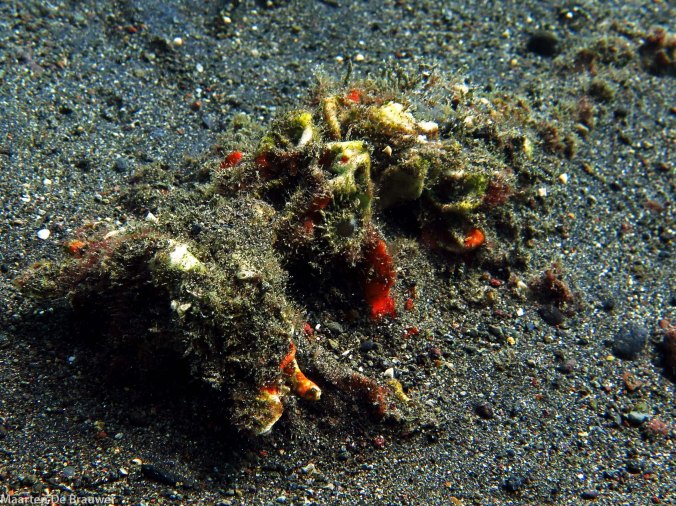
Aggressive camouflage: Estuarine Stonefish (Synanceia horrida) looking like a rock covered in algae and sponges
Good examples of critters using aggressive camouflage are stonefishes and lizardfishes. They pretend to be rocks or blend in with the sand, waiting for a bite sized morsel to swim by. Aggressive mimicry is used by many species, but it is perfected by frogfishes. They use a modified fin ray as a fishing rod, the bait on top of it (or “esca” if you want to sound all sciencey) has evolved to resemble a small animal like a shrimp or worm. This bait is wiggled around until an unsuspecting fish gets too curious for its own good and ends up as prey. In one species, Antennarius hispidus the esca (=bait) has even been found to contain bioluminescent bacteria, great for luring in snacks at night. Frogfishes are not the only fish using a bait to attract meals, this technique is also used by some flounders and stargazers.
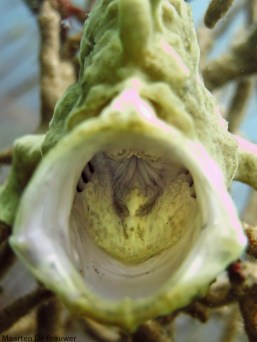
The inside of the mouth of a giant frogfish (A. commersoni)
If you have ever had a fish tank and tried to catch your fish bare handed while cleaning it, you will know that no matter how nearby a fish is, it’s hard to catch one. So ambush predators have a number of adaptations to make this easier. Most of them have a huge mouth that sucks in a lot of water when they open it quickly. This suction feeding causes the fish to get sucked into the predators mouth together with the water. On top of that, the teeth of most of these predators are pointed inward, making it easier to hold slippery prey. Another funky adaptation are “pharyngeal teeth”, small teeth on the inside of the throat that hold the prey when the predator opens its mouth to get a better grip on it. You’ve read that correctly, as if frogfish weren’t weird enough already, they also have teeth in their throat.
While most of us only binge eat on special occasions and then feel guilty about it, frogfishes and other similar predators really don’t care. They eat whenever they can, as much as they can. When you think you’re exaggerating, remember this: the mouth of a frogfish can expand to 12 times its normal size when eating. The equivalent of this would be you fitting an entire chicken in your mouth when eating. Frogfishes can also eat prey that are up to 1,5 times bigger than themselves! For us, this would be roughly the equivalent of eating a whole pig for Christmas, which would make for some interesting scenes around the dinner table…

A Scarlet Frogfish with prey in its stomach (source)
So next time you’re feeling stuffed at holiday eating fests dinners, remember it could be worse 😉


 Critter Research