Using SMURFs to catch baby fish

Luke and I have been in Dauin for a few days now. We are here to investigate the recruitment of cryptobenthic fish. If you’ve read this blog before, you’ll know that I am interested in camouflaged, small critters that live on the seafloor (=cryptobenthic). You might not, however, have heard about “recruitment”. This is the term used to describe the process of larval fish (which usually swim in the open ocean) “settling down” on the reef. When fish larvae settle, they change rapidly from small, transparent, weird oddballs to colourful reef fish. Or in the case of the critters I study, to camouflaged weird oddballs.

histriohistrio_with_adult

Larvae and adult Sargassum Frogfish (Histrio histrio) Source: http://nfchroniclesnoaa.blogspot.com

There are many reasons why I would like to know more the recruitment of the species I study. The most important one is that nobody really knows why some of these baby fishes show up where they do. If you don’t know this information, it is really hard to protect the right places that would be a suitable habitat for baby fish. Another reason is that this process is vastly different from anything we see on land, making it fun and challenging to try and figure out what is going on.

So how does one best study tiny baby fish? In the case of my critters, looking for the small adults is already hard, so how do you even begin to try and find the even tinier versions? The slightly disappointing answer is: “We don’t really know”. There are multiple techniques to find new recruits or larvae that are about to settle down (light traps, visual surveys, crest nets, …). But most of those don’t seem to be very effective for camouflaged critters. One method did show promise in a study in the Caribbean, the benthic “SMURF”.  If at this moment you are imaging little blue creatures with scuba tanks, catching baby fish with lassos and you don’t want to spoil that mental picture, please stop reading now.

SMURF

SMURF at sea (Photo Luke Gordon)

Since you’re still reading, I can now disappoint you about my SMURFs, they are not the ones you have seen on tv (no ethics clearance possible). SMURF stand for “Standard Monitoring Unit for Recruitment of Fishes”. It is a mesh-basket you fill with any substrate you want (pebbles, sand, coral rubble, plastic,…) which you then place in the ocean for a set time. After that time you collect the basket and see how many baby fish were attracted to your unit. Not quite the blue man-option, but you are the one who kept reading.

Luke and me made a whole bunch of units, which we deployed around Dauin. To deploy the units we had the help from my supervisor Euan Harvey, who decided to drop by to see what we are up to in Philippines. Euan is an expert in remote sampling using video cameras, but he definitely seemed to enjoy setting up experiments on baby critters as well. This could be due to the fact that on his very first muck dive here, we found Flamboyant cuttlefish, Blue-ringed octopus, a bunch of Frogfish, Ghostpipefishes, Seahorses and loads more critters.

_MG_6706

Euan photographing Ghostpipefish (Photo Luke Gordon)

This is the second time I am trying this experiment, the first attempt was thwarted by the ocean. Conditions are looking better now, so with some luck the units will survive the next weeks. By the end of the SMURF-project, we will hopefully know if this method  works well for the species I study. With some luck, I will even be able to tell you if baby cryptic fish prefer sand, pebbles, or rubbish. The method can then be used in the future for other people wanting to study the recruitment of cryptic species, so we can start to unravel some of the bigger questions about these poorly studied animals.

New publication: For clownfish sharing means caring

Best of Bali_Clownfish and Periclemens shrimp_MDBWhile I am currently immersed in an amazing project investigating muck critters, I have done research on more conventional fish in the past. One of those conventional fish, is the ever popular clownfish (aka “Nemo”). Clownfish might not be quite as amazing as Frogfish or Rhinopias, but they are pretty interesting and funky fish nonetheless.

Last week the research I did 2 years ago in Wakatobi got published. When I write the research “I” did, what I really mean is the research my good friend Emma Camp and me did with the help of a great bunch of people of Operation Wallacea. Besides these great people, there were some terribly clever people from the University of Essex and Curtin University who helped to make this a really neat paper. If you are interested, you can find the paper here,  but I’ll assume you haven’t got much time so here is the short version of what we found out.

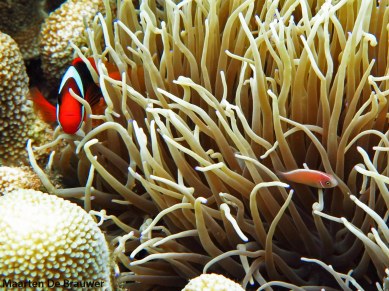
As you probably know, clownfish live in anemones. What you might not realise is that there are 28 species of clownfish and only 10 species of anemones that can be used as a “host” (aka house). Usually you’ll only find one species of clownfish per host anemone. In places where lots of different species of clownfish live, you would expect a fierce competition for their hosts. But what we found in the Coral Triangle, is that clownfish instead share their hosts. The higher the diversity, the more often clownfish share their host anemones. What this means is that house sharing helps to create and sustain the high diversity we find in the Coral Triangle.

melanopus_perideraion

Amphiprion melanopus (large fish) and A. perideraion (small fish) sharing an anemone

What is more, the species that shared their anemones were less aggressive towards each other than in anemones with only one species. This is probably because different species don’t have to compete over mates or (in some cases) over food, a win-win for all fish involved. After all, anyone who ever shared a house knows it’s easier to get along when  you don’t steal each other’s food or partner.

If you want to read more about this research, you can have a look at the media release or this summary. Or you can ask me whatever you want about it in comments below, certainly in case you can’t access the original paper. I’m planning to add a publications section to this blog in the near future, so stay tuned.

Melanopus_premnas

Amphiprion melanopus (large fish) and A. perideraion (small fish) sharing an anemone


Who pays for science?

I frequently talk to divers who are very enthusiastic about marine life and want to learn more about their favourite critters. It often comes as a surprise to these critter-lovers that hardly any research is done on most of the animals they’ve just seen. There are quite a few reasons for this, but one of them is: Science is Bloody Expensive! There might be many people out there wanting to do research on your favourite fish, coral, bird, tree, … But more often than not, the reason they’re not doing that research is lack of money to pay for it. When I say paying for research, I mean paying for all research costs and those often run very high, very quickly.  

In my case, the most obvious cost might be fieldwork, but that includes more than just boat hire, accommodation and food. Fieldwork also means flights, visas, permits, insurance, specialised equipment, other transport costs,… Not just for me, but also for any volunteers or supervisors that come out to help. As much as I am passionate about what I do, I also need to live, so I need to be paid a salary. When I am not doing fieldwork, I need an office, desk, computer, specialised software, access to scientific journals, equipment to do analyses, etc. Again, I don’t work alone but get help from supervisors, administrative staff at the university, etc. all of which need to get paid as well. It’s not hard to see how this can get expensive, but even I was surprised to learn that the global cost for all research is estimated to be as high as 1 trillion dollar!!!

PhD Grant

So who pays for all of this? Where does the money come from to develop a cure for cancer, send people to space or let me look at weird fish? As you might expect, it’s complicated. A lot of it is funded by governments, so actually by yourself through paying taxes (Thanks!). Applied research such as engineering or chemistry is often partially funded by industry partners to find direct solutions to problems. Then there is a part of funding that comes through NGOs, rich benefactors, etc.

The next question is, who decides which research gets money? The most common way is through the process of scientific grants. The baseline of grants is: you write a proposal of the research you want to do, submit it to the agency who gives the grants (can be any of the funding bodies mentioned earlier) and they decide which project deserves the money most. As you might imagine, this process is VERY competitive and success rates tend to be relatively low. There are many different types of grants (lots of money, little bit of money, small projects, long-term projects,…) and in general a higher value means more competition and lower success rates. Having to apply for grants and the insecurity of continued funding is often cited as one of the most stressful things about scientific research.

Genie grantsIn case you were wondering, my research funding is a merry mix of all of the above. The biggest part is paid by a scholarship I got from Curtin University (so indirectly the Australian government). Most of my fieldwork  is funded through the lab  of my supervisors (which itself is funded by a variety of grants), or by in kind donations from the divecentres I do fieldwork with. Recently I was also awarded a grant from the Society of Conservation Biology. The grant I received was to assess the population status of pygmy seahorses in Bangka Island in North-Sulawesi, Indonesia. This island is under threat from mining, but turns out to be rather rich in pygmy seahorses. I am currently preparing a publication on this research, so I should be able to tell you more about it in the near future.


Want to become a marine biologist?

Funny read about great and not-so-great reasons to become a marine biologist, text by Dr. Milton Love.  This is the link to the full text, but here’s a preview:

“Okay, here’s the bottom line. By federal law, marine biologists have to take a vow of poverty and chastity. Poverty, because you are not going to make squat-j-doodly in this job. And just how squat is the doodly we are talking about? Well, five years after finishing my PhD I was making slightly less than a beginning manager at McDonalds.

And chastity? Well, who’s going to date someone who persistently smells like a thawed haddock with an attitude? Not even a dolphin.

But there are two really, really good reasons to want to become a marine biologist.”

Enjoy the read 🙂