Critter getaway in Bangka

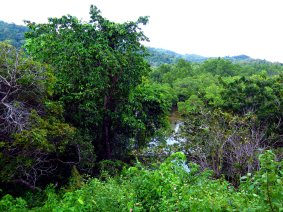
Mangrove view

Mangroves at Bangka Island

At the moment I am back in Lembeh Strait for what will be the last visit to Indonesia during my PhD. So I am making the most of it, enjoying every moment and taking time to visit friends spread out across the archipelago. A few days ago I went to Bangka Island to visit Sophie and Simon, who own Nomad Divers, a very pleasant small dive resort. I wrote about Bangka before, so check it out here if you want to know what the island is all about.

I enjoyed a few very relaxed days, playing (and losing ) board games, teaching their kids how to behave badly and philosophising about science while enjoying gin-tonics. But I also got to appreciate the abundant critters that live in the mangroves and jungle of Bangka Island. Those few days of not working (not a single dive done and no computer in sight), and just enjoying nature reminded me why I fell in love with the tropics in the first place. The beauty of Indonesia (and much of the tropics by extension) is that there is so much wildlife all around you, as long as you just keep your eyes open…or just get plain lucky.

Tarsier_nom

Tarsier in the ceiling! I never realised how long their tails were…

On my first night, while we were catching up and sharing stories about science hobbits, a small tarsier decided to have his dinner in the restaurant. These small primates are rare and vulnerable to extinction, they are only active at night and are usually very shy. If you want to see them in the wild, your best bet is to find yourself a good guide who knows where they roost during the day, so you can see them waking up and moving out to hunt when night falls. Just seeing one is great, having one sitting just above you, while eating a gecko is dumb luck and freaking amazing. For Sophie and Simon, this was a first in 4 years on Bangka!

Tarsir

Nomnomnom. Tarsier (Tarsius Tarsier) eating a gecko (Hemidactylus frenatus) in Bangka Island

There was plenty to see by day as well. I had a great time wandering through the mangroves, looking around for interesting crittersAs you may or may not know, mangroves are important nursery areas for all kind of fish, so it was no surprise to see lots of baby snappers, damsels and other small fish darting around in the shallows. But there was a lot more, loads of mudskippers (skipping around in the mud, as they do), kingfishers in the trees, and the always busy fiddler crabs in the intertidal zone.
Fiddler_faceoff

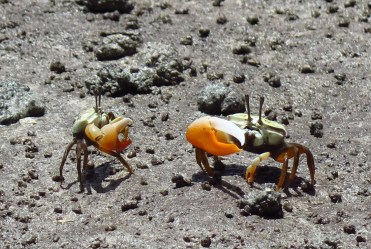
Two male fiddler crabs facing off

Fiddler crabs are colourful little crabs, and are named for the males’ disproportionally large claw. One claw is small and used like any other crab uses its claws, the huge claw is used to show off (what did you expect?). The males wave their big claw around to get the attention of females, and to ward of other males encroaching on their territory. If you  ever find yourself in a mangrove with plenty of time on your hands, I can highly advise watching these little guys at work for a while, it’s pretty captivating and highly entertaining.

While I didn’t go into the jungle, there were plenty of little lizards to spot while strolling along the beach or heading to my room. Apparently, there are quite a few snakes to find in the jungle, and legend has it there’s even deer around, maybe I’ll have to bring shoes next time and go have a look.  If mangroves or jungle or jungle trekking aren’t your thing, you can always just chill out, have a beer and watch the geckos on the wall eating bugs or fighting each other. The tropics really are accommodating for any life style 😉

Sophie_Max.jpg

Sophie and Max enjoying the ocean view

Photo Story: Hidden Treasures Amongst the Muck – Guestblog by Luke Gordon

Luke

Time to kick of December with a new guestblog, this one by none other than my good friend and science hobbit Luke Gordon! Luke is a very talented photographer whom I’ve been having ocean adventures with for many years. He is currently based in Canada, but continues his photography work there. Increasingly he uses his art as more than mere beautiful pictures, but instead uses it to tell important stories about ocean conservation issues. You really should have a look at his site, but until you do, here is an introduction to his most recent story.


Diverting the majority of my photography work towards conservation photo journalism has been an incredibly rewarding experience so far. I am very lucky to have met various people & organisations over the years which has now allowed me to get up close and personal to certain issues such as, establishing sustainable fisheries in Fiji, and now looking at salmon enhancement projects in British Columbia, (and of course Maarten, the first person worldwide to be dedicating a PhD solely to the soft sediment world & the creatures living there).

photo-01

A ‘barren habitat’ could not be further from the truth, life here as evolved in the most intricate of ways, mimicry is the name of the game on the muck slopes. Species such as this Giant Frogfish (Antennarius commersoni) have evolved near perfect mimicry of sponges as they sit in wait for unsuspecting prey.

The critters of the muck for me, and I am sure for the large majority of photographers who have experienced this world, are the perfect definition of evolution and beauty of the natural world. Everything about this underwater paradise captivates me. From the story of its discovery to the most elusive of its organisms, muck is a magical world.

Let us start at the discovery, muck was discovered by chance by Bob Halstead, a man credited for pioneering the liveaboard industry and diving in Papua New Guinea, the story goes that whilst on a liveaboard in PNG the boat had moored up in Milne Bay for the night where it was calm, Bob Halstead still wanted to go for a night dive and despite the attempted dissuasion from local dive masters they went for a dive right beneath the boat. As the dive masters had predicted the bottom was just endless sand (soft sediment) from where the name of ‘muck’ originated, however the dive masters were wrong about one thing, and that is that there was no life down there, quite the contrary, what they found were creatures that looked like extra terrestrials, creatures that even the like had never been seen before, muck diving was born.

photo-06

A tiny, recently settled juvenile Ornate Ghost Pipefish hangs above a crinoid. Even though this little critter doesn’t know it, the large ‘creature’ in the background is paving the way forward for future research into this unique habitat.

This all happened in the 1980’s, the diving community took a while to catch on, but boy has it caught on, muck diving now is a booming industry which supports thousands of people across Southeast Asia, as Maarten’s research will soon shed more light on. Divers and photographers (and now researchers of course) alike will travel half way across the world just to glimpse these weird and wonderful creatures, and these creatures are not behemoths like the African mammals, no, they are tiny critters which have evolved perfect mimicry and other adaptions to survive in a sandy desert, perfect photography subjects.

So how does a photo story fit into all of this?

Luckily enough for me (well not that lucky, I am referred to as a science hobbit by Mr. De Brauwer, yes, there is an earlier blog about this!) I was able to help Maarten with a large proportion of his fieldwork in North Sulawesi & Bali, Indonesia and on Negros, The Philippines. This gave me a fantastic opportunity to tell a story about this industry and now, the research being conducted. Currently it is quite staggering how many divers travel to muck locations around the world and it is equally staggering how little we know about the ecology, abundances and diversities of these creatures and the threats they face. This is a huge problem, as I have already mentioned thousands of people now rely on the jobs created by the industry and the money the industry brings into countries such as Indonesia and The Philippines. On top of this there is also no baseline data outlining the abundances and diversities of the creatures that have traditionally existed in these habitats, we have no way of gauging how these habitats are responding to the huge increase of direct and indirect anthropogenic pressures.

photo-04

Arjay Salac is a dive master and one of the figure heads for Atmosphere Resort & Spa’s dive centre. Arjay is from a family of fishermen who live on the adjacent plot of land to the resort, after initially being employed as a landscaper when the resort first opened Arjay took a keen interest in the dive world going on. Enthusiasm and work ethic allowed him to move into a boat crewman position. Through continued excellence in the role he was offered the opportunity of being put through the resorts PADI dive master scholarship. Needless to say Arjay excelled and six years later is now one of the most respected dive guides in the area, eagle eyes are a description which fit Arjay perfectly.

This story is a way for everybody, diver or not, to understand how and why these organisms are so special, the pressures they face and how these tiny organisms have changed the lives of so many people across coastlines in Southeast Asia, and now, what research is being conducted to answer the many, many unanswered questions we have.

photo-03

A Juvenile frogfish is measured after being caught in one of the S.M.U.R.F‘s. Frogfish, like many of the cryptobenthic organisms, are still unknown to science, this particular individual is most likely a new, undescribed species of frogfish (Antennatus sp.). Note from Maarten: this animal was returned to the ocean alive and well

This blog shows a few small extracts of the story, please visit my site for the full photographic story.

photo-05

The future generation of instructors, dive masters and dive guides.

Fluo time

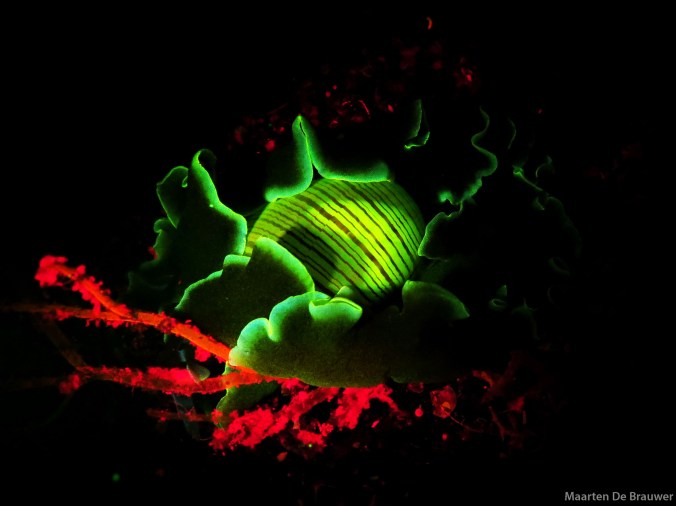
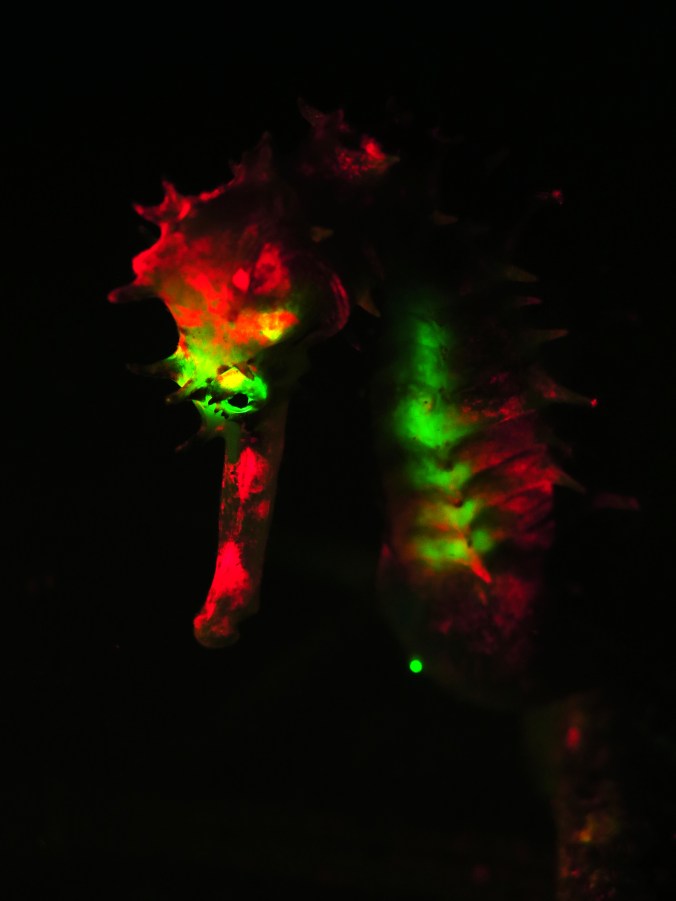
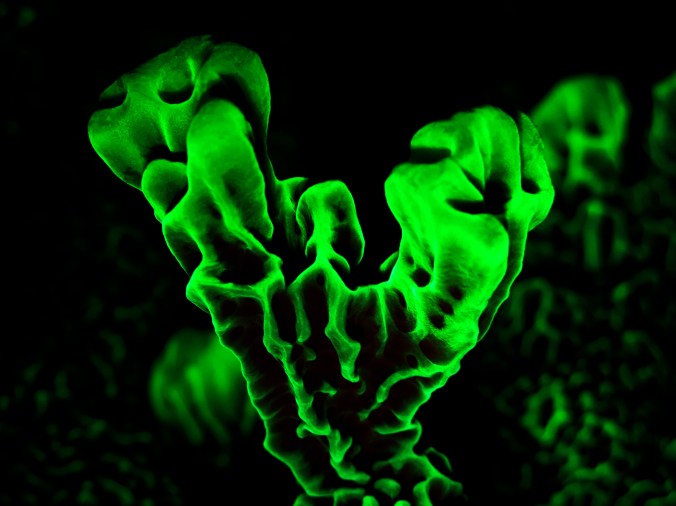
If this isn’t the first time you’ve read this blog, you probably know I am interested in the phenomenon of biofluorescence. I’ve previously talked written about what it is and what it might be used for. In the near future I’ll be tell you all about the details what I was actually doing. But I realized I haven’t shared any pictures recently that show just how beautiful and otherworldly it can be. So here is a random selection of fluo shots I took over the last two years. Enjoy!

bubbleshell

A bubble snail (Hydatina physis) photographed in Lembeh Strait, Indonesia


hippocampus-histrix_fluo_4

Thorny seahorse (Hippocampus histrix) in Bima Bay, Indonesia


seahorse_fluo_mdb

West Australian Seahorse (Hippocampus subelongatus) in Perth, Australia


coral_fluo

Amazing coral in Raja Ampat, Indonesia


snake-eel

Reptilian Snake Eel (Brachysomophis henshawi) in Amed, Indonesia


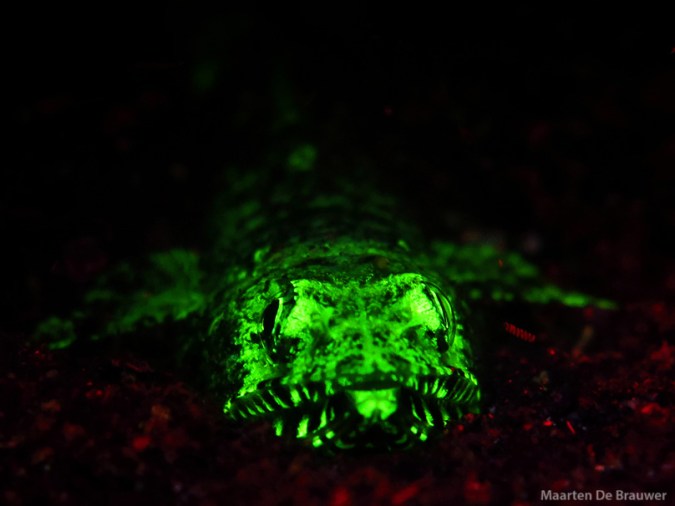
lizardfish

Lizardfish (Synodus sp.) in Lembeh Strait, Indonesia


ablabys

Cockatoo Waspfish (Ablabys sp.) in Lembeh Strait, Indonesia


picnogonid

Sea spider (Pycnogonid sp.) in Tulamben, Indonesia


a-pictus_fluo_small

Painted frogfish (Antennarius pictus) in Lembeh Strait, Indonesia


a-pictus-fluo

Juvenile Painted frogfish (Antennarius pictus) in Dauin, Philippines)


echidna-polyzona

Barred moray (Echidna polyzona) in Nusa Kode, Indonesia


Flamboyant Cuttlefish

It’s been a long time since I put a critter in the spotlights, so it’s time for one of my personal favourites: the Flamboyant Cuttlefish! I am definitely not the only one to like this amazing little animal, for most divers it is high in the top 10 of critters to see. With good reason as well, Flamboyant Cuttlefish are one of the most beautiful and intriguing inhabitants of sandy dive sites.

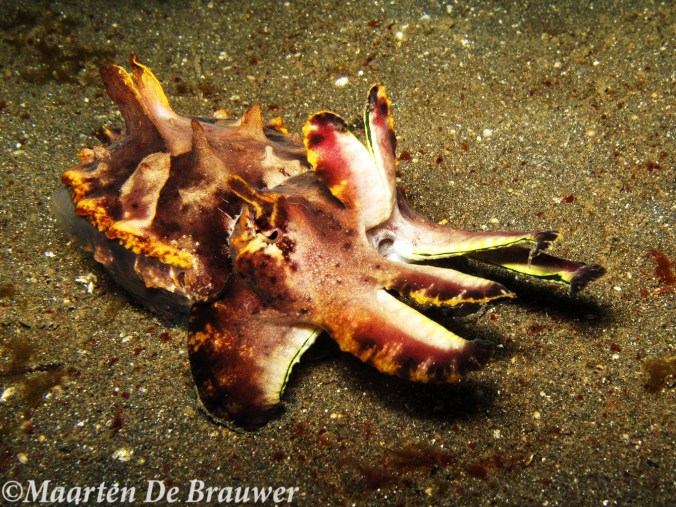
flamboyant-cuttlefish2

Flamboyant Cuttlefish (Metasepia pfefferi) striking a pose

The small cephalopod many divers call “Flamboyant Cuttlefish” are in fact two species: the Flamboyant Cuttlefish (Metasepia pfefferi) and the Paintpot Cuttlefish (Metasepia tullbergi). The first one lives in Malaysia, Indonesia, Papua New Guinea and the north of Australia. The Paintpot Cuttlefish is found further north, from the Gulf of Thailand all the way up to southern Japan. Both species are classic muck dive critters, they only occur on muddy or sandy bottoms, so you will have to move away from coral reef to encounter them.

flamboyant-cuttlefish3So why does this animal deserve the effort of searching sandy plains for days on end, in the hope catching a glimpse of it? To start with (the name is a bit of a give-away) they are very flamboyant critters. We are talking yellows, pinks, blacks and whites, all at once! If that wasn’t enough, they often change their colours into “traveling waves”, even more so than normal cuttlefish or octopuses. From my experience, smaller Flamboyant Cuttlefishes have the brightest colours and make the most extravagant displays. When I write small, I do mean really small: adults do not grow much bigger than 8cm. They ideally sized Flamboyant Cuttlefish for the best colour-show  would be around 3-5 cm!

If finding an animal that size seems difficult, you might also want to consider the following. When they are not disturbed, hunting, or mating, Flamboyant Cuttlefish are anything but flamboyant. In their “standard” state, they blend in perfectly with their background, so they will be a mottled grey, brown, or black. For this reason some divers or photographers are tempted to disturb the animal to better see its colours. It is obvious that this is a bad idea, as it will stress out the cuttlefish. Be patient  instead, observe it for a while and you might even be rewarded by seeing it hunt small shrimp, lay eggs, or even mate!

Another thing that is special about them is that they do not swim, but walk across the bottom. To do so they use two of their arms and an adaptation of their mantle. They can swim, but only do so when they’re startled and over short distances. I could easily spend an entire dive watching these guys wander across the seafloor, little blobs of colour on a quest to eat as many shrimp as possible. It might be because of the awkward way they walk, but I always imagine them to be mildly grumpy animals. A bit like an old man with stiff joints who can’t walk that well, grumbling to himself about how the terrible weather…

flamboyant-cuttlefish4

A juvenile Flamboyant cuttlefish (M. pfefferi) walking across the rubble

An interesting mystery surrounding these animals is whether or not they are toxic. Their colours would suggest some form of aposematic colouration, in the same way nudibranchs advertise their toxicity with bright colours. Some authors have even suggested flamboyant cuttlefish might mimic nudibranchs such as the Ocellate Phyllidia (Phyllidia ocellata). I have however, not read a single bit of conclusive evidence of this. It seems to be one of these “facts” people have assumed, written about and then it just got copied. To date there seem to be no papers out their describing whether or not Flamboyant Cuttlefish really are toxic, and which toxin they would produce. If anyone would have come across that information, I would be very grateful if you could share it with me and the rest of the world.

As is often the case with small critters, we don’t know very much about them. But that doesn’t have to stop us enjoying looking at them. Which is why I couldn’t resist adding a video of one of these guys. The title is a bit too sensational, but the footage is great, enjoy!