New publication: Big bucks for small critters

One of the most important chapters of my research has recently been published in the journal Marine Policy. The paper explains that scuba dive tourism focused on small critters (“muck diving”) has a very high value and how muck diving can be a sustainable alternative to more destructive uses of the environment. This is the link to the paper, but since it is behind a paywall, is rather detailed and perhaps a bit to dry for those of you who are not economists, below is a summary that is easier to digest.
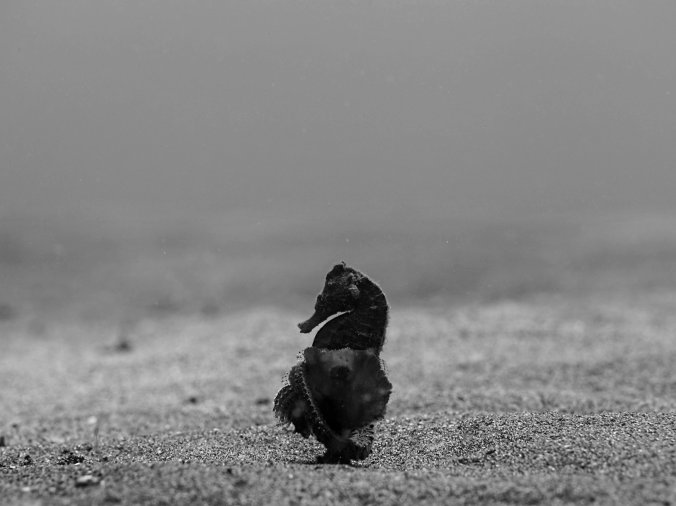
Seahorse_muck

A typical muck diving scene: a sandy bottom with few defining features. In the foreground an Estuary seahorse (Hippocampus kuda) holding on to algae (Photo by Dragos Dumitrescu).

If you don’t know what muck diving is, I invite you to have a look through this site to get a feel for it. But in short: muck diving is scuba diving in sandy areas, usually without coral or other landscape features. The goal is to find weird critters (like flamboyant cuttlefish or hairy frogfish)  that you’d rarely see on normal dive sites. It is very popular in places like Lembeh Strait and Dauin in Southeast Asia, but it is done by divers and photographers all over the world.

Typical for muck diving is that the people doing it are very experienced, with an average of 580 logged dives. Most of them (73.5%) use underwater cameras, often the expensive dSLR cameras, to photograph all the weirdness down there. Many of the divers are well-educated and have a high yearly incomes. Importantly, most divers would be willing to pay for marine conservation if it benefits the species they come to see.

So what does it matter if some fanatic divers like to spend their holidays rooting through the sand instead of cruising by pretty coral reefs? Well, for starters, those fanatic divers spend a combined whopping $152 million per year in Indonesia and Philippines alone. The real value is probably much higher, as this estimate is only for dive centres that specialise in muck diving, and does not include liveaboards or more general dive centres that visit muck dive sites. The real value could be over $200 million per year! Also bear in mind that this number is for Indonesia and Philippines only, it does not include muck dive tourism in Malaysia, Papua New Guinea, or the rest of the world. With more than 100,000 divers visiting Indonesia and the Philippines to go muck diving, you would expect to get the attention of people managing tourism or ocean resources. Especially since many of the divers said they would not have visited the region, or even the country, if they could not muck dive.
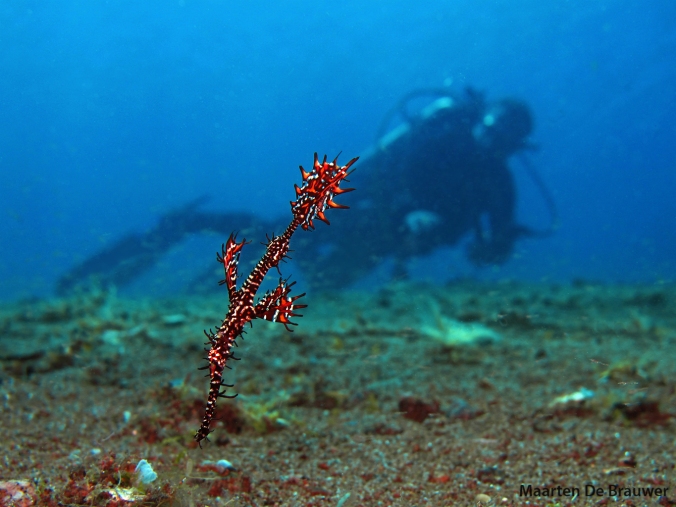
OrnateGhostPipe_RedBlack_Diver

Diver and Ornate ghostpipefish (Solenostomus paradoxus) in Dauin, Philippines

While these numbers might not change anything in your life, they make a huge difference for the thousands of local people that work in this branch of the dive industry. Muck diving is often done in remote locations with limited other forms of income besides fishing. Working as a dive guide and looking at fish is not only more sustainable than catching fish, it also pays a lot better. Roughly $51 million is paid in wages to the local staff working in muck dive tourism annually, and dive guides can earn nearly 3 times more than the minimum wages in the area….

Just stop and think about that for a minute. Imagine the minimum wage in your own country, now triple it. Got the number? OK, now imagine this choice: you can either make that amount by showing cool animals to divers, or you can work your ass off in a factory or risk your life fishing for a third of that amount. Small wonder that many people prefer the first choice, which is great news for marine life in the area, because it means less people fishing and more people trying to protect this valuable source of income.
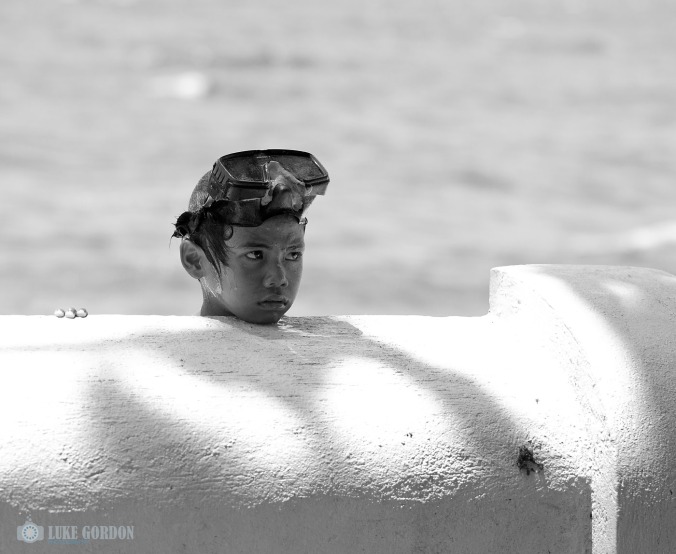
photo-05

The future generation of muck dive guides? Not without a healthy ocean (Photo: Luke Gordon)

That is what it comes down to in the end, protecting these extremely interesting and valuable ecosystems. Make no mistake, muck sites can be threatened as well. Coral reefs might bleach because of climate change, mangroves might be cut to make space for shrimp ponds and seagrass might be dredged to mine for sand, but sandy habitats could face other risks with equally bad consequences. All the habitats above receive far more research and conservation attention than the “barren” sandy sites in the tropics. If this paper proves anything, it is that soft sediment habitats have a very high value, and that it should get more attention to avoid loosing amazing biodiversity and the subsequent loss of income for the thousands of people that depend on it.

And that does not even consider loosing that feeling of pure joy when you finally find a critter you’ve dreamed of seeing for years 😉
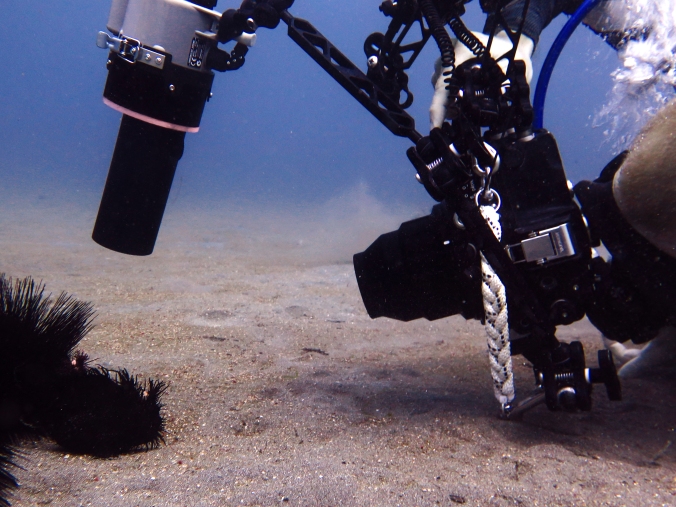
Luke_Snoot_Black Hairy

Muck diving scene: a diver (the science hobbit) taking a picture of a frogfish (black Hairy frogfish – Antennarius striatus)

Photo Story: Hidden Treasures Amongst the Muck – Guestblog by Luke Gordon

Luke

Time to kick of December with a new guestblog, this one by none other than my good friend and science hobbit Luke Gordon! Luke is a very talented photographer whom I’ve been having ocean adventures with for many years. He is currently based in Canada, but continues his photography work there. Increasingly he uses his art as more than mere beautiful pictures, but instead uses it to tell important stories about ocean conservation issues. You really should have a look at his site, but until you do, here is an introduction to his most recent story.


Diverting the majority of my photography work towards conservation photo journalism has been an incredibly rewarding experience so far. I am very lucky to have met various people & organisations over the years which has now allowed me to get up close and personal to certain issues such as, establishing sustainable fisheries in Fiji, and now looking at salmon enhancement projects in British Columbia, (and of course Maarten, the first person worldwide to be dedicating a PhD solely to the soft sediment world & the creatures living there).

photo-01

A ‘barren habitat’ could not be further from the truth, life here as evolved in the most intricate of ways, mimicry is the name of the game on the muck slopes. Species such as this Giant Frogfish (Antennarius commersoni) have evolved near perfect mimicry of sponges as they sit in wait for unsuspecting prey.

The critters of the muck for me, and I am sure for the large majority of photographers who have experienced this world, are the perfect definition of evolution and beauty of the natural world. Everything about this underwater paradise captivates me. From the story of its discovery to the most elusive of its organisms, muck is a magical world.

Let us start at the discovery, muck was discovered by chance by Bob Halstead, a man credited for pioneering the liveaboard industry and diving in Papua New Guinea, the story goes that whilst on a liveaboard in PNG the boat had moored up in Milne Bay for the night where it was calm, Bob Halstead still wanted to go for a night dive and despite the attempted dissuasion from local dive masters they went for a dive right beneath the boat. As the dive masters had predicted the bottom was just endless sand (soft sediment) from where the name of ‘muck’ originated, however the dive masters were wrong about one thing, and that is that there was no life down there, quite the contrary, what they found were creatures that looked like extra terrestrials, creatures that even the like had never been seen before, muck diving was born.

photo-06

A tiny, recently settled juvenile Ornate Ghost Pipefish hangs above a crinoid. Even though this little critter doesn’t know it, the large ‘creature’ in the background is paving the way forward for future research into this unique habitat.

This all happened in the 1980’s, the diving community took a while to catch on, but boy has it caught on, muck diving now is a booming industry which supports thousands of people across Southeast Asia, as Maarten’s research will soon shed more light on. Divers and photographers (and now researchers of course) alike will travel half way across the world just to glimpse these weird and wonderful creatures, and these creatures are not behemoths like the African mammals, no, they are tiny critters which have evolved perfect mimicry and other adaptions to survive in a sandy desert, perfect photography subjects.

So how does a photo story fit into all of this?

Luckily enough for me (well not that lucky, I am referred to as a science hobbit by Mr. De Brauwer, yes, there is an earlier blog about this!) I was able to help Maarten with a large proportion of his fieldwork in North Sulawesi & Bali, Indonesia and on Negros, The Philippines. This gave me a fantastic opportunity to tell a story about this industry and now, the research being conducted. Currently it is quite staggering how many divers travel to muck locations around the world and it is equally staggering how little we know about the ecology, abundances and diversities of these creatures and the threats they face. This is a huge problem, as I have already mentioned thousands of people now rely on the jobs created by the industry and the money the industry brings into countries such as Indonesia and The Philippines. On top of this there is also no baseline data outlining the abundances and diversities of the creatures that have traditionally existed in these habitats, we have no way of gauging how these habitats are responding to the huge increase of direct and indirect anthropogenic pressures.

photo-04

Arjay Salac is a dive master and one of the figure heads for Atmosphere Resort & Spa’s dive centre. Arjay is from a family of fishermen who live on the adjacent plot of land to the resort, after initially being employed as a landscaper when the resort first opened Arjay took a keen interest in the dive world going on. Enthusiasm and work ethic allowed him to move into a boat crewman position. Through continued excellence in the role he was offered the opportunity of being put through the resorts PADI dive master scholarship. Needless to say Arjay excelled and six years later is now one of the most respected dive guides in the area, eagle eyes are a description which fit Arjay perfectly.

This story is a way for everybody, diver or not, to understand how and why these organisms are so special, the pressures they face and how these tiny organisms have changed the lives of so many people across coastlines in Southeast Asia, and now, what research is being conducted to answer the many, many unanswered questions we have.

photo-03

A Juvenile frogfish is measured after being caught in one of the S.M.U.R.F‘s. Frogfish, like many of the cryptobenthic organisms, are still unknown to science, this particular individual is most likely a new, undescribed species of frogfish (Antennatus sp.). Note from Maarten: this animal was returned to the ocean alive and well

This blog shows a few small extracts of the story, please visit my site for the full photographic story.

photo-05

The future generation of instructors, dive masters and dive guides.

Fluo time

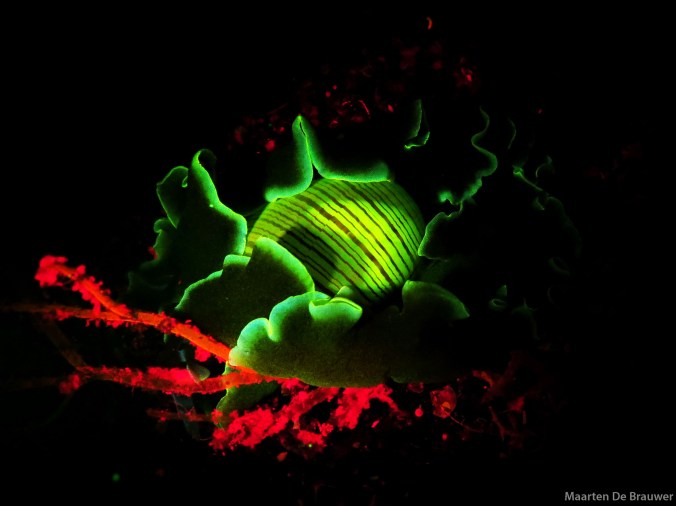
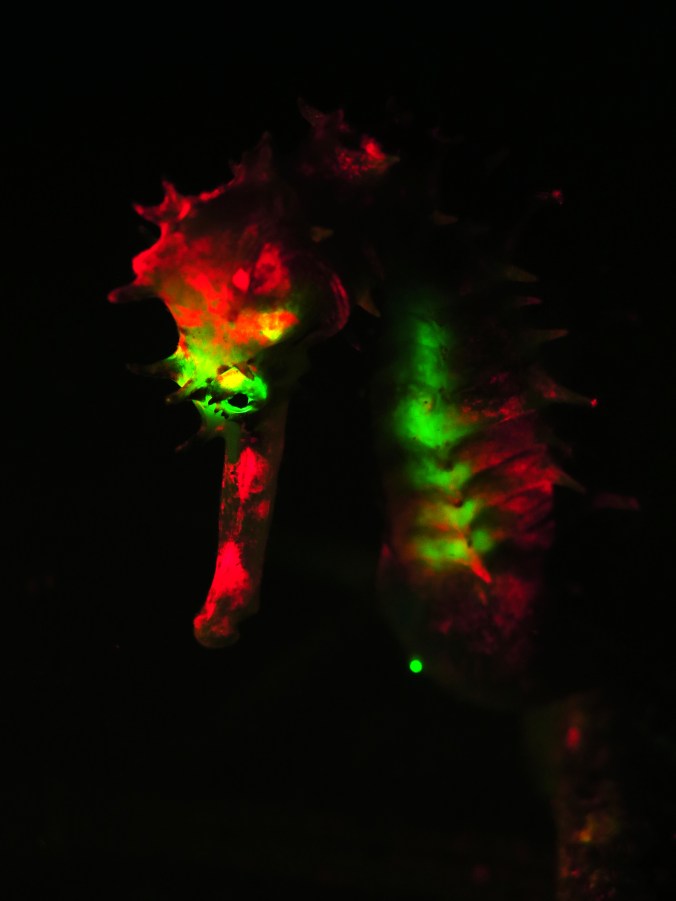
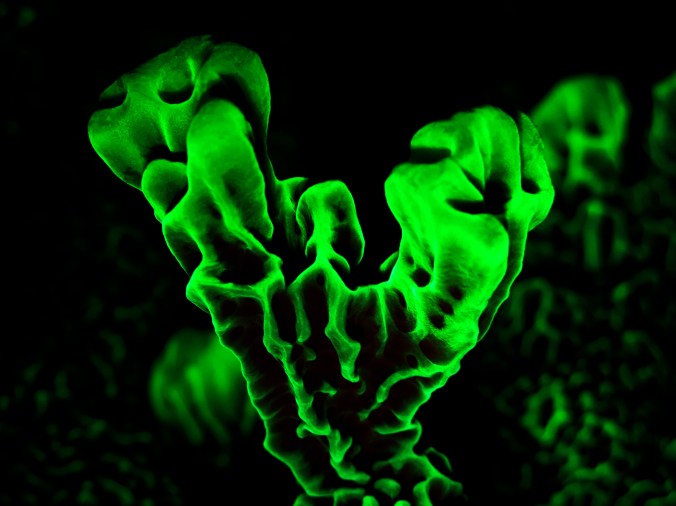
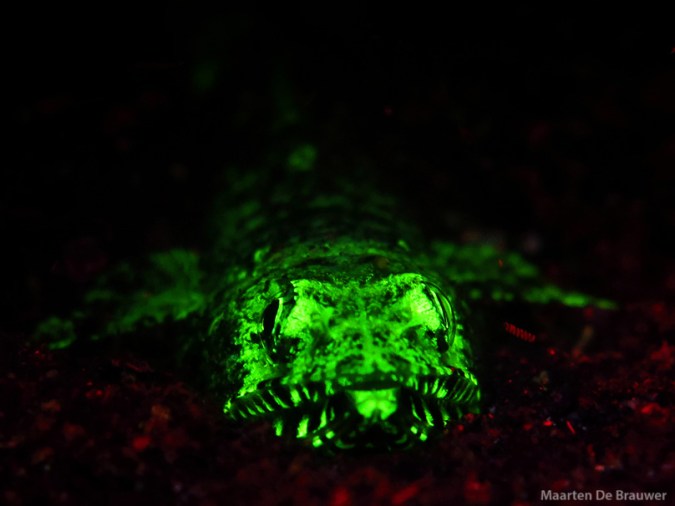
If this isn’t the first time you’ve read this blog, you probably know I am interested in the phenomenon of biofluorescence. I’ve previously talked written about what it is and what it might be used for. In the near future I’ll be tell you all about the details what I was actually doing. But I realized I haven’t shared any pictures recently that show just how beautiful and otherworldly it can be. So here is a random selection of fluo shots I took over the last two years. Enjoy!

bubbleshell

A bubble snail (Hydatina physis) photographed in Lembeh Strait, Indonesia


hippocampus-histrix_fluo_4

Thorny seahorse (Hippocampus histrix) in Bima Bay, Indonesia


seahorse_fluo_mdb

West Australian Seahorse (Hippocampus subelongatus) in Perth, Australia


coral_fluo

Amazing coral in Raja Ampat, Indonesia


snake-eel

Reptilian Snake Eel (Brachysomophis henshawi) in Amed, Indonesia


lizardfish

Lizardfish (Synodus sp.) in Lembeh Strait, Indonesia


ablabys

Cockatoo Waspfish (Ablabys sp.) in Lembeh Strait, Indonesia


picnogonid

Sea spider (Pycnogonid sp.) in Tulamben, Indonesia


a-pictus_fluo_small

Painted frogfish (Antennarius pictus) in Lembeh Strait, Indonesia


a-pictus-fluo

Juvenile Painted frogfish (Antennarius pictus) in Dauin, Philippines)


echidna-polyzona

Barred moray (Echidna polyzona) in Nusa Kode, Indonesia


Mandarin madness

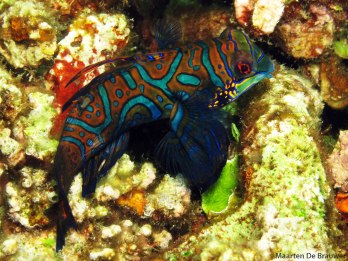
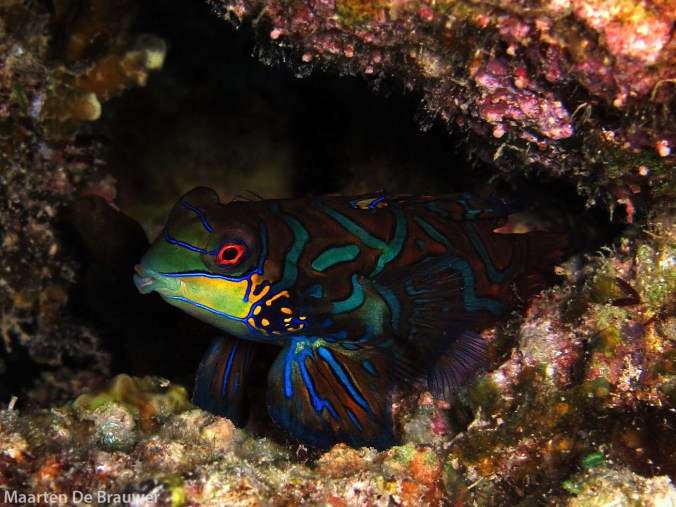
My last trip to Komodo was a successful one, not only because of the data I collected or the nice group on the boat, but also because I managed to have a good look at two very elusive critters, one of them a first! I had seen Mandarinfish (Synchiropus splendidus) before, but this was the first time I had a proper look at a Picturesque Dragonet (Synchiropus picturatus).

Both species are closely related Dragonets belonging to the genus Synchiropus. They are exquisitely coloured, which makes them big hits both with divers and marine aquaria hobbyists. The colours and patterns of the picturesque dragonet have earned it the synonym of “psychedelic mandarinfish” or even “LSD-fish” in German! Of the two, the mandarinfish is best known to divers, probably because it is found more frequently in areas where divers are likely to dive, unlike its psychedelic sister-species.

Both species are found in the Indo-West Pacific, they range from the south of Japan to the north of Australia. The best places to spot them are Indonesia and the Philippines. They are found in sheltered lagoons, usually in areas with coral rubble. You can also find mandarinfish in stands of branching corals. Picturesque dragonets are more frequently found in areas with silty bottoms close to mangroves. Both species are shallow water fish that are rarely seen deeper than 20m.

The best time to see mandarinfish is at dusk or late in the afternoon on overcast days. At these times the fish come out of hiding to spawn. Both species live in small social groups which usually consist of a male and a few females. The males are easily recognized by their larger size and long dorsal fin.

Synchiropus picturatus_2_MDB

Two Picturesque Dragonets (female in the front, male at the back)

As is the case with many secretive critters, we don’t know very much about them. The things we do know show that there is more to them than just a pretty face. For example, they secrete a thick mucous that might even contain toxins. According to the literature, this mucous smells bad and tastes bitter, which makes me wonder exactly how they found this out 😉 Regardless of research methods, this toxicity means that the highly visible colours could in fact be a warning signal to potential predators, much in the way nudibranchs advertise their toxicity. For those interested in impressing their fellow divers, this trick is called “aposemetic colouration“.

Best of Lembeh_Synchiropus splendidus2_MDB

Mandarinfish – a fierce predator?

Mandarinfish are tiny carnivorous fish, which feed on tiny prey. Too bad they are so small, just imagine how much fun it would be to see a great white shark in the colours of a mandarinfish?!? Until the day an evolutionary trip-up creates a giant mandarinfish stalking the oceans, they feed mainly on small crustaceans, small molluscs and fish eggs. Which might be more convenient for the many people that keep these small fish in aquariums.

And make no mistake about it, both species are VERY popular in the marine ornamental trade. Research in Batasan Island (near Bohol) in Philippines showed that in 2000, between 1800 to 2400 mandarinfish were exported per month! If you have ever searched for mandarinfish while diving, those numbers will seem even more impressive. Fishermen usually catch the fish with miniature spearguns, since other methods are not as successful. This method obviously inflicts damage on the fish, often leading to the fish dying either shortly after being caught or during transport to aquariumshops. Another problem with catching mandarinfish for the aquariumtrade is that people prefer larger fish. A trend that causes the larger males to disappear first, which can in turn lead to reduced reproduction rates for the remaining fish.

These lovely critters might be very popular with aquarium enthusiasts, unfortunately they are difficult to keep alive in a tank. The fish require specific food and shelter, lack of those are the cause of many mandarinfish dying shortly after they’ve been bought by their new owners. There have been some reports of mandarin spawning in tanks, but raising the larvae to healthy adults is still difficult. As far as I could find, the vast majority of mandarin fish sold in aquarium shops are still caught in the wild, which might have a big impact on fish populations in the ocean.

Might have a big impact, since we don’t really know. Neither species has been assessed by the IUCN, so we don’t know if populations are in decline and if they are at risk of extinction. So until we do, enjoy looking for them during your dives, but think twice before buying one!

Best of Cabilao_Mandarinfish_MDB