Seahorse and pipefish blog collection

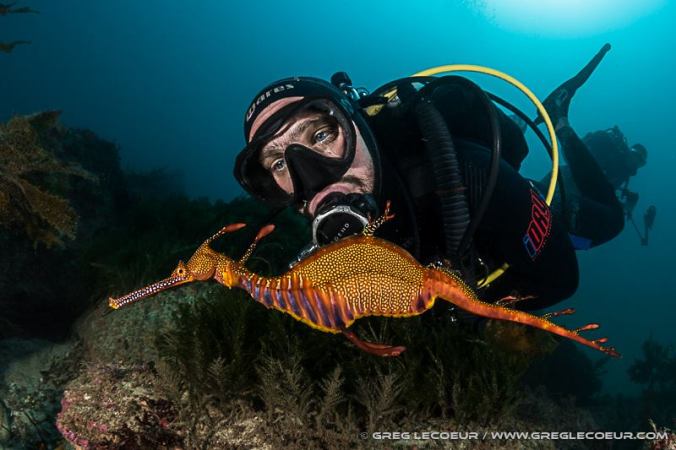
syngbioI am currently in Florida at the University of Tampa, to attend Syngbio 2017. Syngbio is the global conference about Syngnathidae. “Syngnathidae” is the scientific name for the group of animals that consists of seahorses, pipefishes, etc. The conference is being attended by over 100 experts from across the world, who are discussing topics ranging from behaviour, to genetics, husbandry and conservation.

Once the conference is over, I will write a blog about the main conclusions of the conference. But since I am currently in a syngnathid mind-set, I figured it made sense to have a look at previous blog posts I wrote about seahorses and their relatives and combine them for anyone interested to learn more about these fascinating animals.

  • Little known seahorse facts: an overview of interesting facts about seahorses you might not have heard of before
  • Winged pipefish: one of my favourite pipefish species that I feel deserves more attention
  • Seadragons and other critters found in the cold waters around Sydney
  • Ruby seadragons, deep sea seahorses and other critters beyond the reach of divers
  • Keeping seahorses in tanks: a rant on how I struggled keeping West Australian seahorses in tanks. Read this blog if you are considering keeping seahorses in tanks yourself
  • Ornate ghostpipefish: ghostpipefishes are gorgeous animals, but very understudied. This blog is an overview of what we know about the ornate ghostpipefish.
  • Fluo seahorses: A photo compilation of some of the fluoresence work I’ve done, including fluo seahorse shots

Seadragon

Growing up

Growing up isn’t always easy, going from the playful life of a child to become a (seemingly) functional adult takes blood, sweat and tears. Anyone reading this blog who longingly remembers the awkward changes your body goes through puberty, please feel free to share in comments below whether it was the pimples, the voice changes, gangly limbs or any other similar affliction you’d like to get back in your life. I am fairly confident the comment section won’t be overly populated. If you think growing up was hard for you or any other human, take some time to consider how much more extreme becoming an adult is for fish.

As you or may not know, most fish start their life as transparent larvae, floating through the blue. Once they are large enough to become proper fish, they “settle” on the reef. This settling is the first big growing up fish have to do.  Forget about years to grow from a baby into a teenager. Typically within less than 2 days, the freshly arrived larvae change colour and massively grow in size. If you think changing colour and doubling in size within a month isn’t hard enough as a childhood, consider the following. Over 50% of baby fish arriving on the reef get eaten within the first two days of arriving on the reef! Talk about a bad first day at school…

Childhood might be the most dangerous time for fish, but that doesn’t mean puberty is any easier. While we humans complain about acne and high pitched voices, fish have got other things to cope with. Many fish change colour again as they become adults, which is a minor nuisance compared to the fact that some radically change shape. Good examples are batfishes, which start by looking like leaves or flatworms to then turn into a relatively boring plate-looking fish.

Shapeshifting is peanuts compared to a process many fish have go through during puberty: sex change. Many fishes are born as one sex, but will turn into the opposite sex as they grow up. The best known example are clownfishes, which are all born as a male, but turn into females later in life. Including this process would have made “Finding Nemo” a much more interesting film in my humble opinion. Other species, such as parrotfishes and wrasses are born as females, but then turn into males as they grow up. While surprising to most people, the whole sex change thing is actually very common in the ocean.

Part of growing up in humans is learning to appreciate different kinds of food: whether it’s vegetables, olives or alcohol, children like different things than adults. The same goes for many fish species. Frogfishes for example start by mostly eating small shrimp, and then evolve a more delicate palate including fish like seahorses, lionfish, or pretty much any other fish that fits in their mouth. Interestingly, for frogfish growing up can mean that you start of as prey for a fish, but turn into a predator for that same fish once you’re big enough. Conclusion: growing up can be difficult for any animal, but some have it worse than others.

Critter getaway in Bangka

Mangrove view

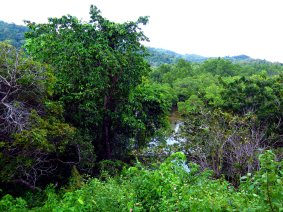
Mangroves at Bangka Island

At the moment I am back in Lembeh Strait for what will be the last visit to Indonesia during my PhD. So I am making the most of it, enjoying every moment and taking time to visit friends spread out across the archipelago. A few days ago I went to Bangka Island to visit Sophie and Simon, who own Nomad Divers, a very pleasant small dive resort. I wrote about Bangka before, so check it out here if you want to know what the island is all about.

I enjoyed a few very relaxed days, playing (and losing ) board games, teaching their kids how to behave badly and philosophising about science while enjoying gin-tonics. But I also got to appreciate the abundant critters that live in the mangroves and jungle of Bangka Island. Those few days of not working (not a single dive done and no computer in sight), and just enjoying nature reminded me why I fell in love with the tropics in the first place. The beauty of Indonesia (and much of the tropics by extension) is that there is so much wildlife all around you, as long as you just keep your eyes open…or just get plain lucky.

Tarsier_nom

Tarsier in the ceiling! I never realised how long their tails were…

On my first night, while we were catching up and sharing stories about science hobbits, a small tarsier decided to have his dinner in the restaurant. These small primates are rare and vulnerable to extinction, they are only active at night and are usually very shy. If you want to see them in the wild, your best bet is to find yourself a good guide who knows where they roost during the day, so you can see them waking up and moving out to hunt when night falls. Just seeing one is great, having one sitting just above you, while eating a gecko is dumb luck and freaking amazing. For Sophie and Simon, this was a first in 4 years on Bangka!

Tarsir

Nomnomnom. Tarsier (Tarsius Tarsier) eating a gecko (Hemidactylus frenatus) in Bangka Island

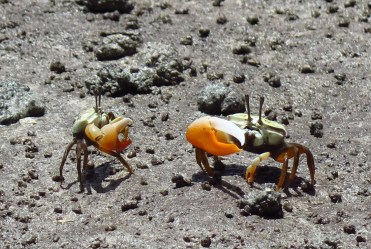
There was plenty to see by day as well. I had a great time wandering through the mangroves, looking around for interesting crittersAs you may or may not know, mangroves are important nursery areas for all kind of fish, so it was no surprise to see lots of baby snappers, damsels and other small fish darting around in the shallows. But there was a lot more, loads of mudskippers (skipping around in the mud, as they do), kingfishers in the trees, and the always busy fiddler crabs in the intertidal zone.

Fiddler_faceoff

Two male fiddler crabs facing off

Fiddler crabs are colourful little crabs, and are named for the males’ disproportionally large claw. One claw is small and used like any other crab uses its claws, the huge claw is used to show off (what did you expect?). The males wave their big claw around to get the attention of females, and to ward of other males encroaching on their territory. If you  ever find yourself in a mangrove with plenty of time on your hands, I can highly advise watching these little guys at work for a while, it’s pretty captivating and highly entertaining.

While I didn’t go into the jungle, there were plenty of little lizards to spot while strolling along the beach or heading to my room. Apparently, there are quite a few snakes to find in the jungle, and legend has it there’s even deer around, maybe I’ll have to bring shoes next time and go have a look.  If mangroves or jungle or jungle trekking aren’t your thing, you can always just chill out, have a beer and watch the geckos on the wall eating bugs or fighting each other. The tropics really are accommodating for any life style 😉

Sophie_Max.jpg

Sophie and Max enjoying the ocean view

Ocean pretenders: Eat or be eaten

Pipefish_winged_name

Algae or  a pipefish pretending to be algae?

At some point or other, all of us have pretended to be something that we are not. From trying to look old enough to buy alcohol as a teenager, to keeping your head low and pretending to be a pot plant in the corner of the office when the boss is looking for someone to take notes during a meeting. Some people might pretend more often than others, people might have good reasons for wanting to look like someone (or something) they are not, and some individuals might have less than innocent intentions when hiding their true identity. The same thing happens in the oceans but the stakes are usually higher than (trying to) look cool with a beer, or the tedium of having to take notes. A critter’s skill at pretending often means the difference between getting dinner or being dinner…

The ocean-pretending I am talking about is more commonly known as camouflage and mimicry. The terms are frequently mixed up or even assumed to be synonyms, but they are two different concepts. To distinguish between the two, it helps to know that the goals of camouflage and mimicry are opposite from each other. Animals using camouflage are trying very hard not to be seen, like you trying to be a pot plant instead of a potential scribe. Mimicry attempts to do the opposite: wanting to be seen, while hoping observers will believe you are someone else, like our teenager bluffing he’s old enough to drink.

Usually when biologists (who know their shit) talk about camouflage, they are thinking of mobile animals that are pretending to be objects or animals that don’t move; these objects could be plants, rocks, sand, sponges, etc. When those same biologists talk about mimicry, they mean active animals that pretend to be different species of active animals. But that is just the start of it, the obvious question is why? What are the reasons behind camouflage and mimicry? As a rule, fish don’t like alcohol, so there must be some other cunning plan.

For camouflage it boils down to two options: defensive or aggressive. People tend to intuitively understand defensive camouflage: hiding so you don’t get eaten or killed. Two ocean examples are seahorses pretending to be seafans or crustaceans looking like sponges. Aggressive camouflage is when an animal tries not to be seen, so it can eat unsuspecting animals coming closer. Frogfish are masters at this, so are most scorpionfish, and many other species. It is perfectly possible for an animal to use both defensive and aggressive camouflage at the same time. Think about the human version: soldiers wearing camouflage do not want to get shot, while aiming their guns at the enemy.

Mimicry has similar uses, depending on what the animal mimics. Unlike camouflage, mimicry needs a distinctive “model species”, which is imitated by the “mimic”. Depending on the nature of the model and the mimic, we distinguish three kinds of mimicry. Batesian mimicry has a dangerous model, but a harmless mimic. Mullerian mimicry has a dangerous model and a dangerous mimic. The last type, Peckhamian mimicry, has a harmless model, but a dangerous mimic.

Batesian mimicry can be compared with our teenager trying to buy alcohol. He might try to look like the real deal, but really is not. A great ocean example is the (non-toxic) baby pinnate batfish (Platax pinnatus), which look like a toxic flatworm. Or baby sea cucumbers pretending to be toxic nudibranchs. Predators assume the mimic is toxic, so they avoid eating it, good news for the mimic!

In Mullerian mimicry both mimic and model are “the real deal”.  This is very common in nudibranchs of the Phyllidiidae family. Most species in this family are very toxic and they all look very much alike. When a predator tries to eat one species, he’ll learn to avoid the other similar looking species as well. A bit like the leather-clad members of different motorbike gangs which look equally dangerous to outsiders. The bikers can tell the difference between other gangs, but I would advise against picking a fight with any of them.

Peckhamian or aggressive mimicry happens when the mimic pretends to be a harmless model, usually to get close to prey. This method is used by predators like dottybacks, who pretend to be harmless damselfish so they can get close enough to juvenile damselfish to eat them. A (purely hypothetical) human example could be a person living in a fancy white house, who pretends to be a silly orange clown, but in reality is a dangerous would-be dictator. As it turns out, land is no different than the ocean: the animals that believe in the illusion are most likely to suffer from it.

Best of Dauin_Lizardfish eating Dragonet

Aggressive camouflage in action: this dragonet failed to see the lizardfish hiding in the sand.