Growing up

Growing up isn’t always easy, going from the playful life of a child to become a (seemingly) functional adult takes blood, sweat and tears. Anyone reading this blog who longingly remembers the awkward changes your body goes through puberty, please feel free to share in comments below whether it was the pimples, the voice changes, gangly limbs or any other similar affliction you’d like to get back in your life. I am fairly confident the comment section won’t be overly populated. If you think growing up was hard for you or any other human, take some time to consider how much more extreme becoming an adult is for fish.

As you or may not know, most fish start their life as transparent larvae, floating through the blue. Once they are large enough to become proper fish, they “settle” on the reef. This settling is the first big growing up fish have to do.  Forget about years to grow from a baby into a teenager. Typically within less than 2 days, the freshly arrived larvae change colour and massively grow in size. If you think changing colour and doubling in size within a month isn’t hard enough as a childhood, consider the following. Over 50% of baby fish arriving on the reef get eaten within the first two days of arriving on the reef! Talk about a bad first day at school…

Childhood might be the most dangerous time for fish, but that doesn’t mean puberty is any easier. While we humans complain about acne and high pitched voices, fish have got other things to cope with. Many fish change colour again as they become adults, which is a minor nuisance compared to the fact that some radically change shape. Good examples are batfishes, which start by looking like leaves or flatworms to then turn into a relatively boring plate-looking fish.

Shapeshifting is peanuts compared to a process many fish have go through during puberty: sex change. Many fishes are born as one sex, but will turn into the opposite sex as they grow up. The best known example are clownfishes, which are all born as a male, but turn into females later in life. Including this process would have made “Finding Nemo” a much more interesting film in my humble opinion. Other species, such as parrotfishes and wrasses are born as females, but then turn into males as they grow up. While surprising to most people, the whole sex change thing is actually very common in the ocean.

Part of growing up in humans is learning to appreciate different kinds of food: whether it’s vegetables, olives or alcohol, children like different things than adults. The same goes for many fish species. Frogfishes for example start by mostly eating small shrimp, and then evolve a more delicate palate including fish like seahorses, lionfish, or pretty much any other fish that fits in their mouth. Interestingly, for frogfish growing up can mean that you start of as prey for a fish, but turn into a predator for that same fish once you’re big enough. Conclusion: growing up can be difficult for any animal, but some have it worse than others.

Valentine special: Sex on the sand

In the aftermath of valentine’s day, I figured a post about nautical naughtiness was suitable. Popular media such as romantic comedies, reality tv-shows or more dubious videos available on the internet might have you believe that a moonlit fondle on a tropical beach is the highlight of romance. They are, however, very much mistaken! Late night walks on the beach turning into passionate, steamy scenes of desire and lust are in fact the best way to discover that sex and sand really don’t mix well. No matter how hard you try, sand will get where you absolutely don’t want it to get. But for creatures that spend their entire lives on soft sediments there is no way around it. They have no choice but to deal with the gritty truth that is sex on sand. As you can imagine, this blog is not going to be a pretty story, but if you think you can handle it, here is how things go down in the muck…

froggie-pair_small

A small male frogfish (Antennarius pictus) risking his life to get closer to a larger female

Getting started with one my favourites, frogfishes, immediately proves my point on how difficult romancing is on the sand. As in humans, competition for females is fierce, but competition is made worse because frogfish are usually quite rare, so there aren’t many females around. The result is that males will often stalk a female for multiple days or even weeks, waiting until she might be ready to mate. This is a very risky strategy though. At best, the larger female will reject a male by pushing him away or swimming off. At its worst, the grumpy female might decide to eat the male! It sure would make Tinder a lot more exciting if this trend would catch on in humans. Have a look at a cannibalistic frogfish below (Video by Albert Kang).

When the female frogfish is in the mood however, the male will gently put its pectoral fin on her belly when they’re almost ready to mate. He’ll prod her until she’s ready, at which point the female swims up, partially pushed by the male, and releases her eggs. The male then releases his semen over the eggs, after which the now fertilised eggs drift off, forming a sort of raft until the young frogfish hatch. The attentive blog-reader will have noticed that frogfish also avoid the sand when mating, clever! Here is a rather explicit video of two hairy frogfish in action (video by BlueWaterLife1)

Unlike frogfish, the blue ringed octopus wastes no time on small talk or courtship. Male blue ringed octopuses just pounce upon any opportunity, inserting their hectocotylus (scientific slang for “penis-arm”) in any other blue ringed octopus they encounter. The problem is that males unfortunately can’t tell the difference between males or females. So they will try any octopus and only know if they hit the jackpot or got themselves into a rather embarrassing situation until after attempting to copulate (not unlike some drunk male tourists in dodgy bars in Thailand or the Philippines). The unfortunate males on the receiving end don’t seem to take it too badly and do not react aggressively, preferring to wait passively until the mistake becomes obvious. The females however are more feisty and tend to finish the act by “forcefully pulling the males from their body“, occasionally attacking or even killing and eating the males (is it me or am I seeing a trend here?). The actual deed takes on average 90 minutes, but I think we can all agree it hugely lacks in romanticism.

Best of Dauin_Blue ringed octopus_small

A blue ringed octopus on the prowl. For what I don’t know, and turns out neither does he…

Best of Dauin_Seahorse thorny_MDB

Male Thorny seahorse (Hippocampus histrix) showing off its pregnant belly

Seahorses are more romantic, forming stable couples that sometimes stay together for life. The couples greet each other every morning by doing a little dance. When mating their dance gets more elaborate and ends up with both fish swimming up in the water-column and doing the act at the highest point of their dance. But then it gets a bit kinky, as it is the female who penetrates the male! She deposits her eggs in the male’s pouch, who then fertilises the eggs, gets pregnant and gives birth to baby seahorses. Shortly after giving birth the couple mates again (within as little as 30 minutes for pygmy seahorses!), and the males gets pregnant all over again. No rest for these little guys!

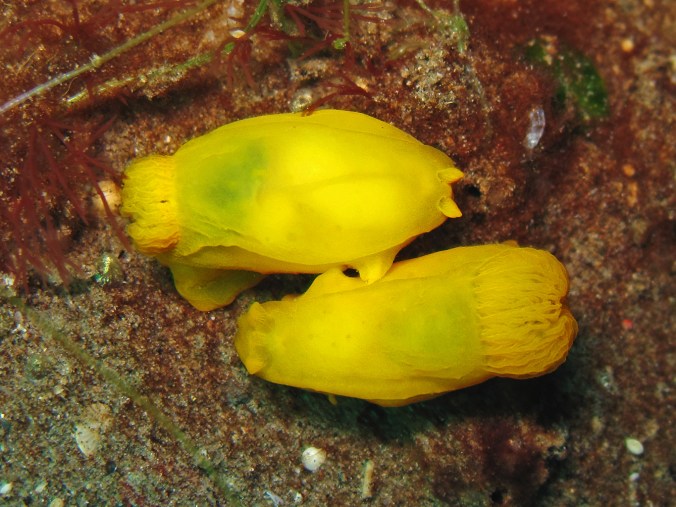
At least for nudibranchs life is a bit simpler, there is no such thing as a male or female nudibranch, since they are both at the same time. It is believed that being hermaphrodites (simultaneously male and female) is an adaptation to being rare and not being able to move very far during their lifetime. After all, you wouldn’t want to spend half of your life on your own, getting increasingly horny, to then finally meet a single other individual of your species and find out you can’t reproduce with them. So when nudibranchs mate, they usually get pregnant and make the other one pregnant in one go, talk about efficiency. Being efficient at mating does not mean mating is a boring occasion. Nudibranchs are some of the most deviant critters in the ocean. They occasionally indulge in mating aggregations (aka orgies),  S&M (most of their penises have backward pointing spines), mating with different species than our own (a slug’s a slug), and some species even practice protandry (adults mating with juveniles). But it gets even worse….

best-of-dauin_mating-nudies

Nubibranch sex: These Gymnodoris nudibranchs clearly show how both animals penetrate each other at the same time

Some species amputate their own penis after mating, mostly because pulling out is just too much effort with those backwards pointing spines. They do have spares and the amputated penis regrows, so no harm done. In what is probably one of the most bizarre cases of sex on the sand, a species of Siphopteron-slugs uses a part of its forked penis to stab its partner through the head during mating! You read that correctly, they use an adapted penis to stab each other in.the.head while having sex. Not the mouth, not any other orifice, the head, right above the eyes. As if that’s not enough, they even inject prostate fluid into the head as well. A process beautifully coined as “cephalo-traumatic secretion transfer”. Call it what you want, this stuff is a bit too kinky for my liking. Oh, and the reason why? You guessed it…we don’t know, although researchers have suggested it might change the behaviour of the receiving slug, go figure…

As you see, sex on the sand is a lot more complicated (some might argue interesting) than in more conventional places. Try to remember that during your next romantic walk on the beach.


Why the ocean matters and why we should talk more about how awesome it is…

This week I attended the CommOcean 2016 conference in Belgium. CommOcean was all about marine science communication and what the best ways are for marine scientists to interact with the general public. Science communication is about more than just reaching non-scientists, but also about making an impact and transforming how people perceive the ocean, it’s about making a positive change. But why would anyone really care about the ocean, or even more, change their day-to-day behaviour for it? A question particularly relevant if you live far away from the sea or don’t have a taste for fish.

15317838_337598576633265_7576656498167989292_n

The CommOcean2016 crowd in front of the beautiful conference venue in Bruges

The thing is, the ocean matters big time, for everyone, everywhere. On a global scale, the ocean produces more than 50% of the oxygen we breathe (more than trees!). If breathing isn’t your thing, the ocean also provides other trivial things such as food, cures to certain cancers and other diseases, a way to transport most goods around the globe (90% of international trade), and so much more. Current human impacts such as climate change can and will have effects on everyone, even those living furthest away from the sea.

For the people fortunate enough to live close to the coast, the ocean is even more important. Over 1 billion people depend on the sea as their main source of protein, which explains why overfishing is such a big issue. Besides food, the sea also provides a way to make a living as fishermen, through trade, industry, or tourism (muck diving being only one example). For people living on low islands, rising sea levels are a very real and very large threat. Entire countries might sink below the ocean and will have to move elsewhere. Countries like Tuvalu and Kiribati are already negotiating with Australia about possibilities to move their entire population there. Popular holiday destination Maldives has even gone further and is already buying up land in other countries to prepare for relocating its people.

Communicating ocean science is often challenging when people aren’t faced with the ocean in a way the Maldivians or other islanders are. Not being able to see what is below the waves might be the biggest challenge to get people to care about our oceans. It is hard to comprehend  just how amazing life in the sea can be without diving in it, or without the help of talented filmmakers and photographers to show us.

The fact that many scientists are still perceived to live in their “ivory tower of knowledge”, without interacting with people does not help either. The issues facing the oceans are often more complicated than those on land and often seem overwhelming. If the only news people hear about the oceans is bad news, they won’t be keen to listen to the yet another doomsday talk. Most marine scientists are not trained to be communicators and are often too worried about oversimplifying their message, resulting in nuanced, scientifically correct communication that is unfortunately understand by nobody else but scientists. Lastly, in a world where Twitter, Facebook, etc. are increasingly the main source of information for people, it is hard to get attention with a science message. After all, who wants to read about weird fish, if you could be reading about what a Kardashian had for breakfast or that your favourite soccer player went wild on a party last night?

15380513_10154757504941565_3592208402805027098_n

Rita Steyn explaining the ins and outs of Twitter

So what is the solution? How do you get the message across that the oceans matter? I’m in no way an expert, but luckily there were experts around at CommOcean. The first step is to adapt you message to the people you are talking to, don’t go wild on the crazy science talk, have a clear message. (in case you forgot: “Oceans are awesome! Get the news out there!“). Ideally try to interact directly with the people to whom your research is important, stop talking over people’s heads and listen to what they care about. Using social media is a good thing, but do it right and don’t get stuck on just one method. Not everyone uses Twitter or visits websites about science, many people don’t have smartphones and might prefer written media, etc. Don’t forget that humans are visual animals, presenting your message in a more attractive way than dry text will get more attention.


Lastly, maybe most importantly, don’t forget to give the good news. There might be a load of bad news out there, but the ocean is still a beautiful place, something I feel everyone should know about too. Telling people about the beauty that can be found and offering practical tips on how to do something about protecting it can go a long way.

In the long run, what we really need is ocean science to become ingrained in all levels of education. As one of the most important ecosystems in our world, the ocean deserves more attention. After all, as long as people are not aware of the importance of the ocean (and the issues facing it), they cannot change their attitudes about the ocean and they will definitely not change their behaviour to preserve it.

15391398_10157926887225473_5668082405720644482_o

PS: In the spirit of using different communication channels, crittersresearch is now also live on twitter as @DeBrauwerM.

PS: All photos sourced from the CommOcean2016 Facebook page


Photo Story: Hidden Treasures Amongst the Muck – Guestblog by Luke Gordon

Luke

Time to kick of December with a new guestblog, this one by none other than my good friend and science hobbit Luke Gordon! Luke is a very talented photographer whom I’ve been having ocean adventures with for many years. He is currently based in Canada, but continues his photography work there. Increasingly he uses his art as more than mere beautiful pictures, but instead uses it to tell important stories about ocean conservation issues. You really should have a look at his site, but until you do, here is an introduction to his most recent story.


Diverting the majority of my photography work towards conservation photo journalism has been an incredibly rewarding experience so far. I am very lucky to have met various people & organisations over the years which has now allowed me to get up close and personal to certain issues such as, establishing sustainable fisheries in Fiji, and now looking at salmon enhancement projects in British Columbia, (and of course Maarten, the first person worldwide to be dedicating a PhD solely to the soft sediment world & the creatures living there).

photo-01

A ‘barren habitat’ could not be further from the truth, life here as evolved in the most intricate of ways, mimicry is the name of the game on the muck slopes. Species such as this Giant Frogfish (Antennarius commersoni) have evolved near perfect mimicry of sponges as they sit in wait for unsuspecting prey.

The critters of the muck for me, and I am sure for the large majority of photographers who have experienced this world, are the perfect definition of evolution and beauty of the natural world. Everything about this underwater paradise captivates me. From the story of its discovery to the most elusive of its organisms, muck is a magical world.

Let us start at the discovery, muck was discovered by chance by Bob Halstead, a man credited for pioneering the liveaboard industry and diving in Papua New Guinea, the story goes that whilst on a liveaboard in PNG the boat had moored up in Milne Bay for the night where it was calm, Bob Halstead still wanted to go for a night dive and despite the attempted dissuasion from local dive masters they went for a dive right beneath the boat. As the dive masters had predicted the bottom was just endless sand (soft sediment) from where the name of ‘muck’ originated, however the dive masters were wrong about one thing, and that is that there was no life down there, quite the contrary, what they found were creatures that looked like extra terrestrials, creatures that even the like had never been seen before, muck diving was born.

photo-06

A tiny, recently settled juvenile Ornate Ghost Pipefish hangs above a crinoid. Even though this little critter doesn’t know it, the large ‘creature’ in the background is paving the way forward for future research into this unique habitat.

This all happened in the 1980’s, the diving community took a while to catch on, but boy has it caught on, muck diving now is a booming industry which supports thousands of people across Southeast Asia, as Maarten’s research will soon shed more light on. Divers and photographers (and now researchers of course) alike will travel half way across the world just to glimpse these weird and wonderful creatures, and these creatures are not behemoths like the African mammals, no, they are tiny critters which have evolved perfect mimicry and other adaptions to survive in a sandy desert, perfect photography subjects.

So how does a photo story fit into all of this?

Luckily enough for me (well not that lucky, I am referred to as a science hobbit by Mr. De Brauwer, yes, there is an earlier blog about this!) I was able to help Maarten with a large proportion of his fieldwork in North Sulawesi & Bali, Indonesia and on Negros, The Philippines. This gave me a fantastic opportunity to tell a story about this industry and now, the research being conducted. Currently it is quite staggering how many divers travel to muck locations around the world and it is equally staggering how little we know about the ecology, abundances and diversities of these creatures and the threats they face. This is a huge problem, as I have already mentioned thousands of people now rely on the jobs created by the industry and the money the industry brings into countries such as Indonesia and The Philippines. On top of this there is also no baseline data outlining the abundances and diversities of the creatures that have traditionally existed in these habitats, we have no way of gauging how these habitats are responding to the huge increase of direct and indirect anthropogenic pressures.

photo-04

Arjay Salac is a dive master and one of the figure heads for Atmosphere Resort & Spa’s dive centre. Arjay is from a family of fishermen who live on the adjacent plot of land to the resort, after initially being employed as a landscaper when the resort first opened Arjay took a keen interest in the dive world going on. Enthusiasm and work ethic allowed him to move into a boat crewman position. Through continued excellence in the role he was offered the opportunity of being put through the resorts PADI dive master scholarship. Needless to say Arjay excelled and six years later is now one of the most respected dive guides in the area, eagle eyes are a description which fit Arjay perfectly.

This story is a way for everybody, diver or not, to understand how and why these organisms are so special, the pressures they face and how these tiny organisms have changed the lives of so many people across coastlines in Southeast Asia, and now, what research is being conducted to answer the many, many unanswered questions we have.

photo-03

A Juvenile frogfish is measured after being caught in one of the S.M.U.R.F‘s. Frogfish, like many of the cryptobenthic organisms, are still unknown to science, this particular individual is most likely a new, undescribed species of frogfish (Antennatus sp.). Note from Maarten: this animal was returned to the ocean alive and well

This blog shows a few small extracts of the story, please visit my site for the full photographic story.
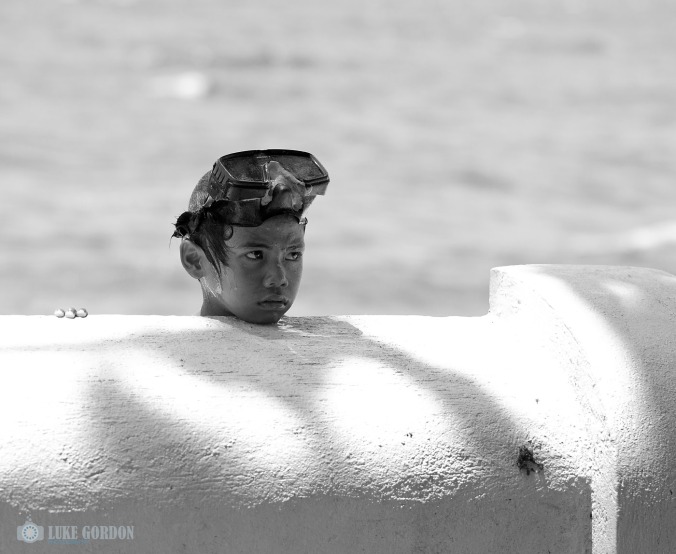
photo-05

The future generation of instructors, dive masters and dive guides.